If you’re building AI tools for creators, copyright is no longer a distant legal topic. In 2025, it shapes product decisions directly. The creator economy keeps expanding – it reached 205.25 billion USD in 2024 – and more tools now process videos, audio, images, branded assets, and user-generated content. When AI touches these materials, copyright risks move into the engineering layer.
For founders, the main issue is predictability. AI speeds up production, but it also introduces legal uncertainty through training data, user uploads, and model outputs. These risks appear early, grow with scale, and can affect product stability long before a company reaches wide adoption.
At Vilmate, we’ve built AI solutions for creator workflows and have seen how important it is to address copyright from the earliest technical decisions. That experience helps us guide teams with a product vision, but who need a safe, reliable way to implement it. If you have an idea for an AI tool for creators, a carefully engineered foundation gives you a much smoother path to market.
In this article, we outline the core copyright challenges in 2025, explain where risks arise in AI creator tools, and share practical steps to help founders build products that stay legally safe as they scale.
The Core Issue: AI and Copyright in Creator-Focused Products
Building AI tools for creators always raises copyright questions. Most models learn from huge datasets that mix licensed work, public content, and materials that fall somewhere in between. When protected works end up in that mix, no one can say with full certainty how the law applies. Fair use varies across regions, and courts are still figuring out where the limits lie.
Creator-focused products face this problem earlier than others. Video editors, design assistants, music tools, and post-production systems work with assets that are protected by strong copyright. A single video frame, a short audio sample, or a branded element can introduce risk long before the tool becomes public.
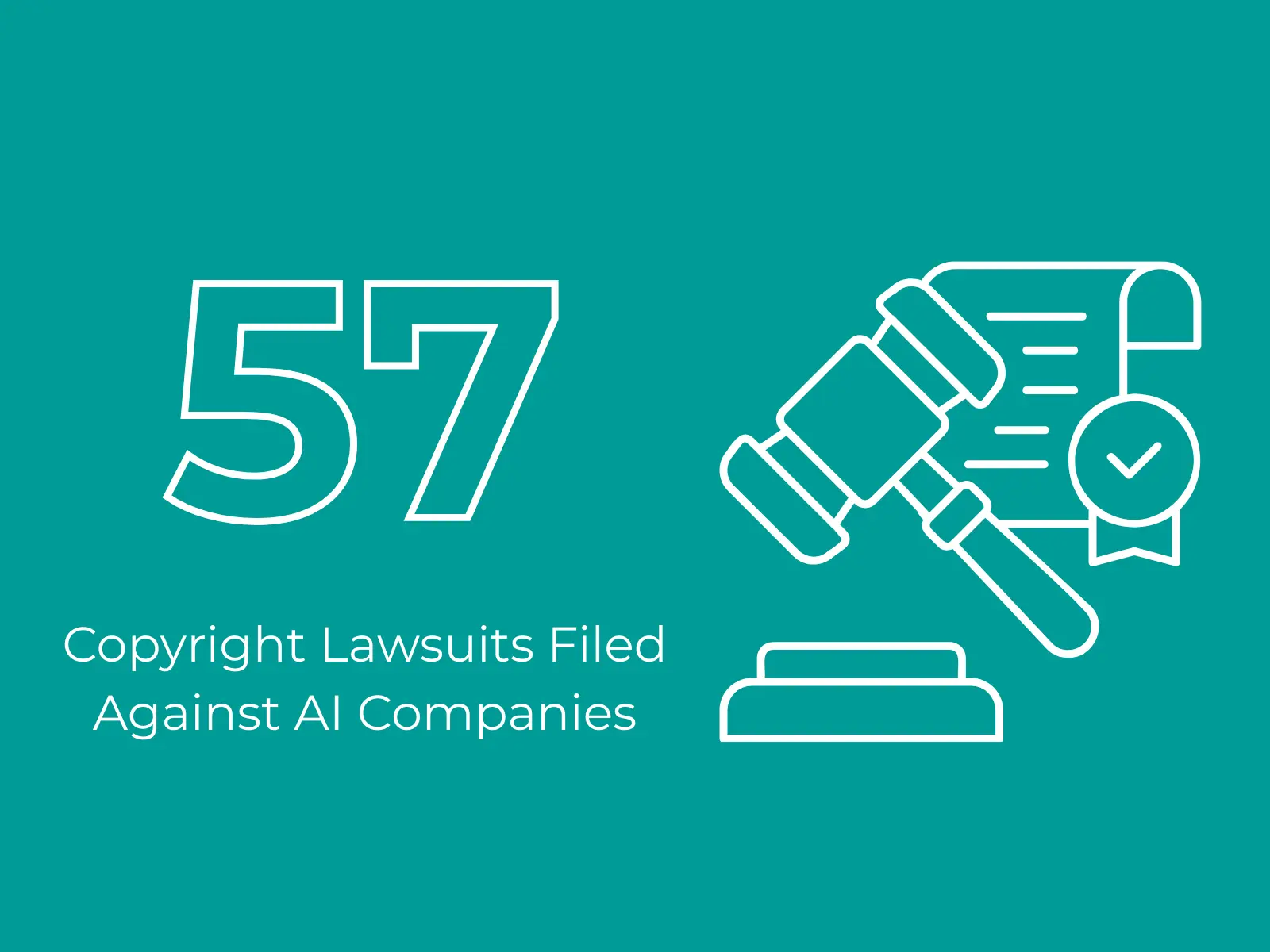
Legal pressure keeps growing. The lawsuit by The New York Times against OpenAI shows how quickly copyright issues arise when training data includes protected material – even if the output appears original.
Ownership rules make things even more complicated. In the United States, fully AI-generated work cannot receive copyright protection. In the EU and UK, the answer depends on how much the user shapes the result. For founder teams, this means one thing: the rights to the output depend on what the user contributes and how the system handles the source materials.
Because of this, AI and copyright becomes part of the technical foundation. Creator tools rely on user uploads, reference assets, branded visuals, and multi-step generation pipelines. Each layer introduces its own constraints. The earlier a team understands these limits, the easier it becomes to design a product that scales without legal surprises.
Where Copyright Problems Actually Show Up in AI Tools for Creators
Teams that build AI tools for creators face copyright challenges long before their products reach the market. Most issues arise within real workflows—not in legal theory. These are the situations that most often shape product decisions and influence how teams approach AI and copyright in practice.
1. Creators assume the tool understands rights
When a platform accepts uploads — footage, audio, images, branded elements — many users expect the system to recognize what they can legally use. In reality, the platform carries part of the risk if the workflow encourages creators to work with assets they don’t fully own. For teams building AI creator tools, this becomes one of the most common AI copyright issues.
2. AI mixes assets that follow different licensing rules
Creator workflows combine original files, stock materials, references, archived assets, and AI-generated content. A model cannot distinguish which assets belong together. When a tool blends mismatched resources into a single output, it can unintentionally introduce copyright risks in AI, even if each file would look safe on its own.
3. Style guidance that imitates more than intended
Visual and audio tools often help creators explore a style. When a model follows a reference too closely, the result may resemble a recognizable artist or brand. This risk grows quickly in video editing, design tools, and AI-assisted music production – areas where creators rely on strong creative identity.
4. Users export AI-generated content, assuming full ownership
Some creators treat AI output as automatically theirs to publish or monetize. Current rules don’t guarantee protection for fully AI-generated work, and rights differ across regions. A creator may export a file believing they control it, only to learn that the content carries uncertain ownership. For a platform, this friction often returns as a product issue, not a user mistake.
5. Small AI-driven transformations shift legal meaning
Enhancement, cleanup, upscaling, color adjustments, and timing fixes — these steps may seem technical, but they can change how copyright applies to the final file. Many AI and copyright issues come not from the generation itself, but from how AI modifies existing material.
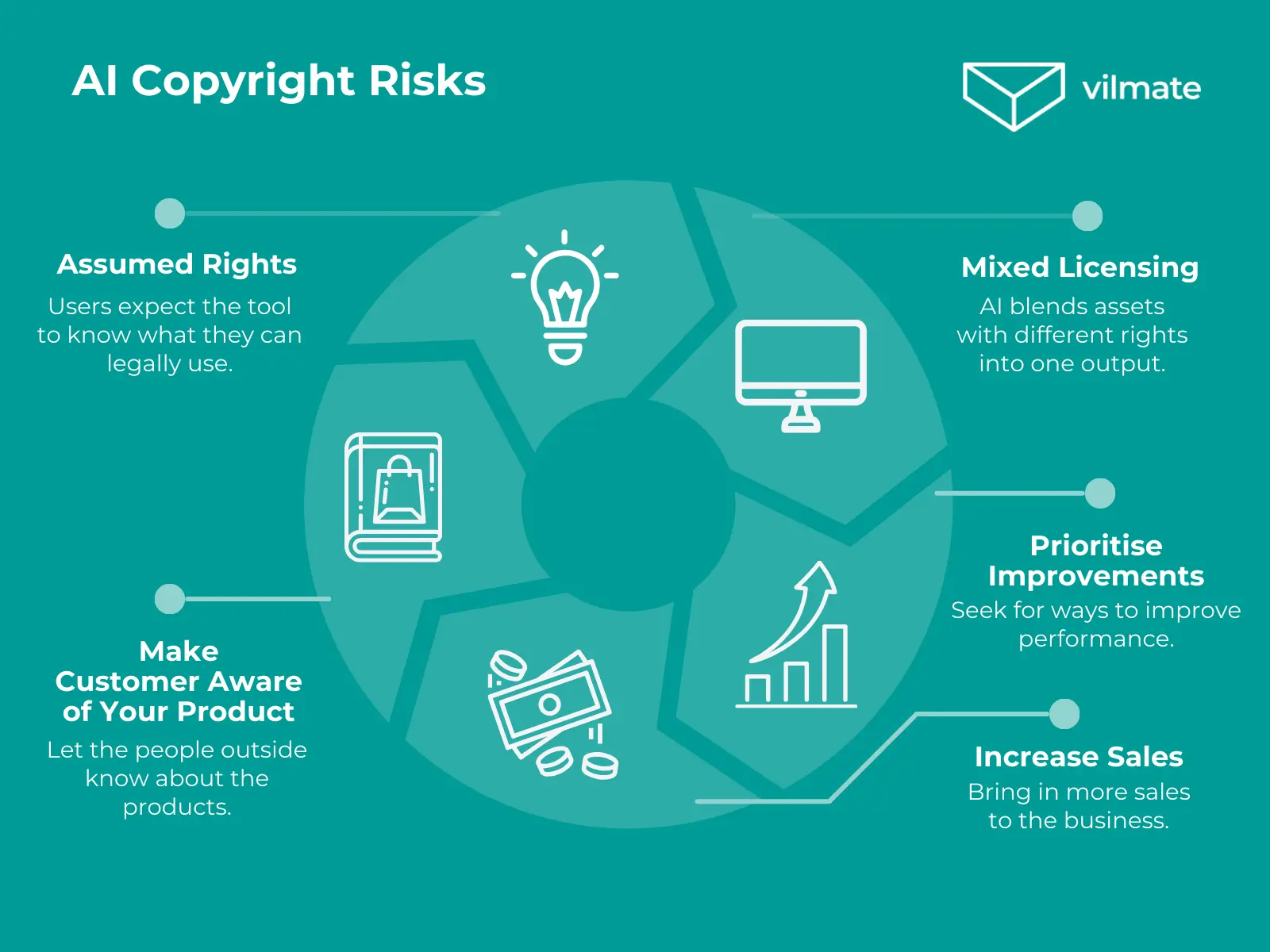
Why does it matter for founders? Creator tools operate in environments that mix rights, legacy assets, user uploads, and branded content. If a product does not clearly define how AI and copyright interact across the workflow, problems surface later – in publishing, monetization, partnerships, or support.
Teams that plan for these constraints build safer products and scale with fewer surprises.
Vilmate already works with creator-focused AI systems, so we understand how to design these boundaries early – before they become blockers.
A Practical Copyright Checklist for Founder Teams
Founder teams building AI products for creators often meet AI copyright issues much earlier than expected. If you’re already exploring development options, it helps to understand where copyright becomes a real product concern – and where the right engineering partner makes the process smoother.
- Different content types follow different rules. Video, audio, images, and branded assets each carry their own copyright constraints. A team that understands these distinctions can design workflows that avoid early copyright risks in AI.
- Creator uploads introduce more variability than expected. Users mix personal files, old footage, reference images, and stock materials. Not all of them come with clear rights. A product benefits from an architecture that keeps these assets separated and prevents accidental reuse.
- Style and reference features need thoughtful boundaries. AI often imitates more closely than intended. Teams experienced with AI and copyright know how to guide creative exploration without drifting into protected territory.
- Export flows should reflect real ownership rules. Creators want to publish and monetize their work without confusion. Regional laws differ, and not every AI-generated output receives stable rights. Clear export logic protects both the user and the product.
- Seemingly small edits can change how the final file is treated. Enhancement, cleanup, color adjustments, and upscaling look technical, but they often shift the legal meaning of the output. A careful approach helps avoid surprises later.
- Growth brings new edge cases. Most copyright challenges appear only when usage scales. A partner who understands creator workflows can anticipate these patterns early and build a structure that stays safe as the product expands.
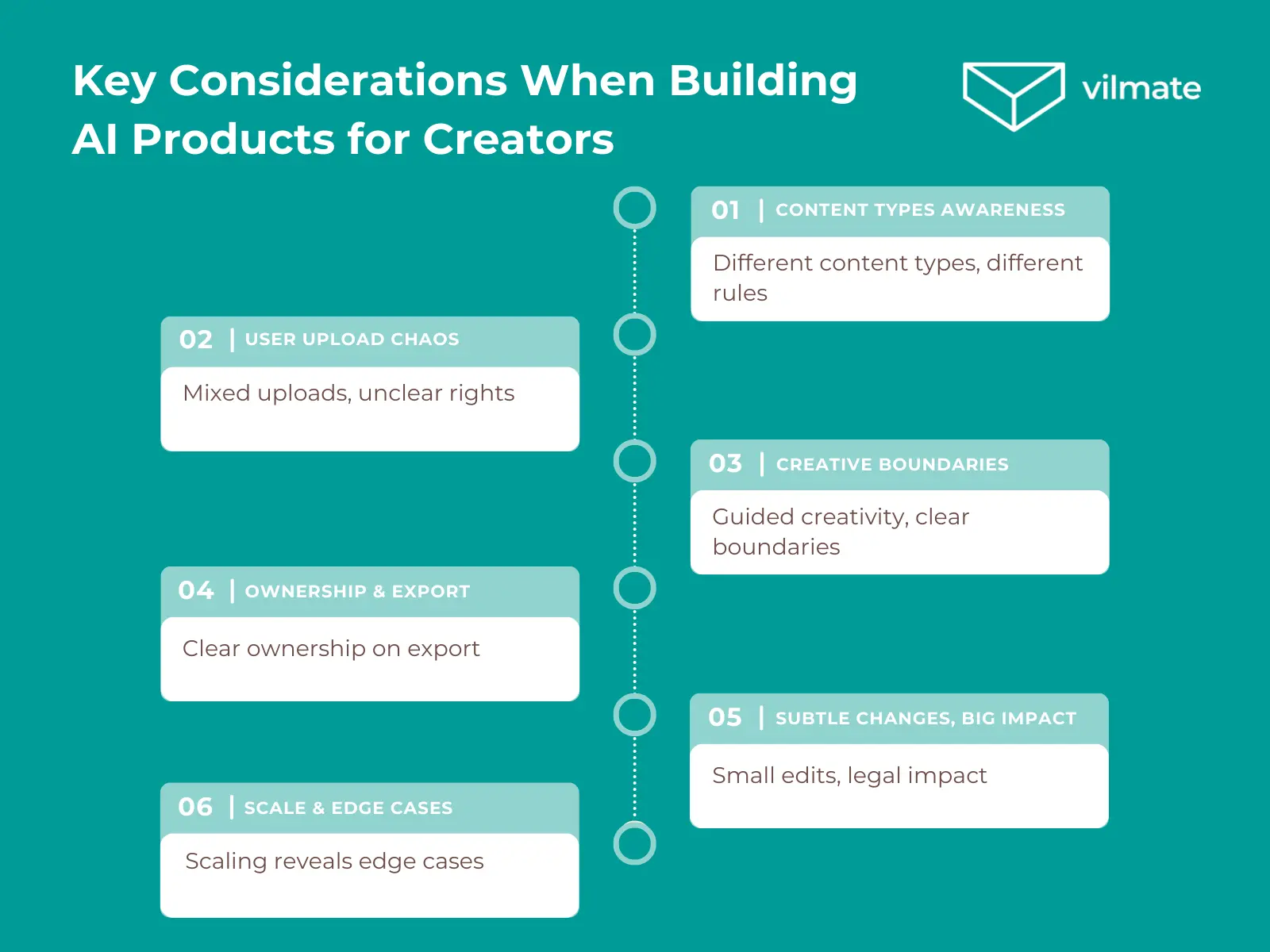
Creator products evolve fast. When a development team understands the patterns behind AI copyright issues, the tool grows without friction and creators trust the output from day one.
If you plan to build something in this space, partnering with engineers who already recognize where copyright risks appear — and how creator workflows behave in real products — makes the entire process more predictable.
Our experience with creator-focused AI projects enables us to define these boundaries early, ensuring the product stays safe as it grows.
Conclusion
The mix of creator workflows and AI reshapes how products handle content — and how copyright applies to it. Teams that understand the real shape of AI copyright issues can design tools that feel intuitive for creators without exposing the product to unnecessary risk.
The goal is not to slow creativity, but to support it with a structure that stays safe as the tool grows.
The landscape will keep shifting. Laws evolve, platforms introduce new rules, and creators adopt new formats faster than most industries can track. A thoughtful technical foundation helps a product stay flexible in that environment and gives creators confidence in the work they publish or monetize.
If you plan to build AI features for creators, working with engineers who already understand where AI and copyright intersect makes the entire process more predictable.
Vilmate has experience with creator-focused AI systems, so we help teams design solutions that stay safe, scalable, and genuinely useful for the people who create with them.