Everyone agrees that a B2B website is a must. The real stress begins a few weeks into the project.
Pricing logic turns out to be more complicated than expected. Approval chains don’t fit neatly into the chosen platform. ERP integration exposes missing fields. Someone suddenly asks how repeat orders will work for multi-department accounts. And the design that looked clean in Figma starts feeling crowded once real data is added.
This is usually the moment teams realize they’re not building pages—they’re building infrastructure.
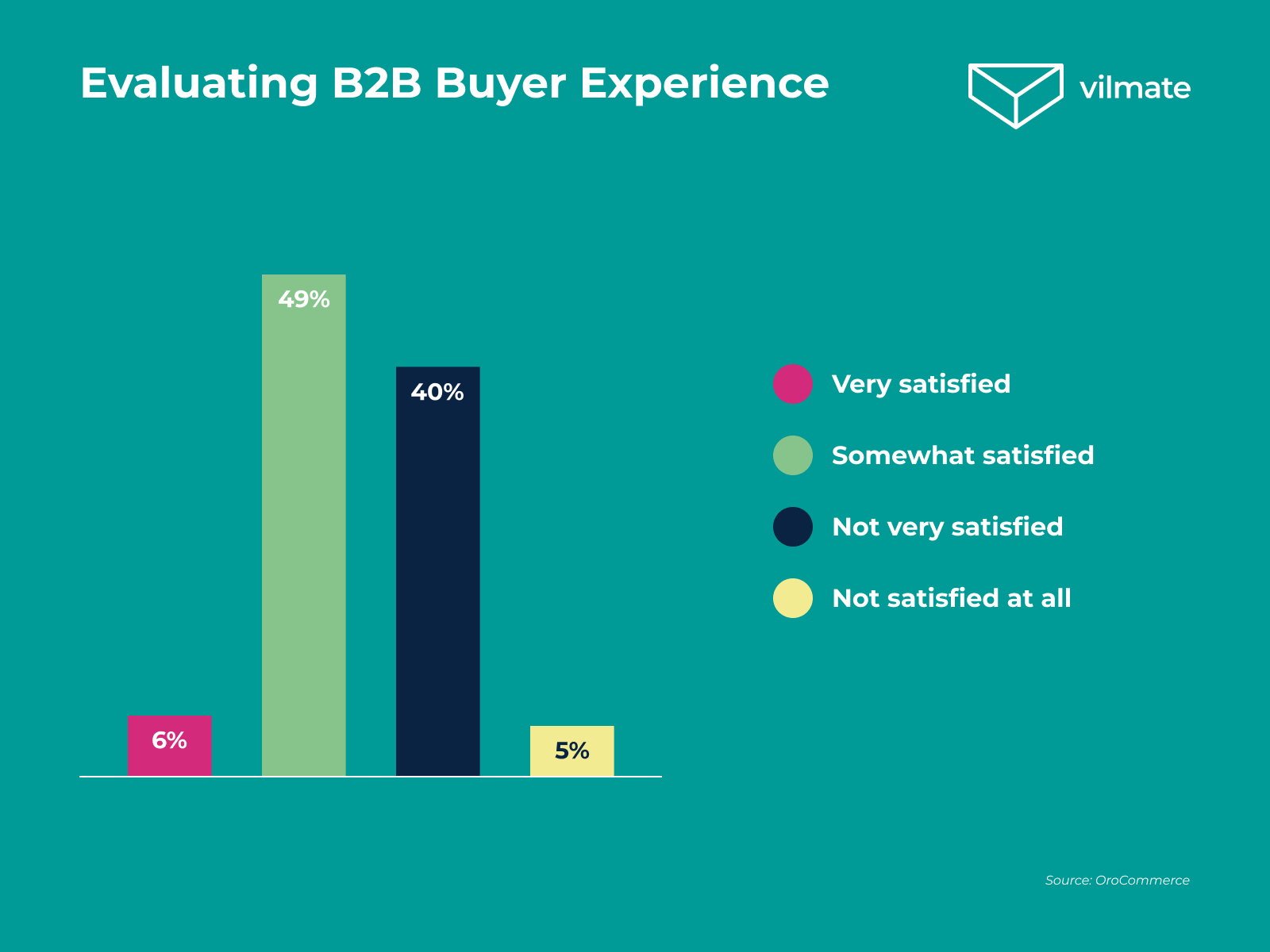
B2B e-commerce website development involves decisions that affect pricing models, internal roles, integrations, data consistency, and operational speed. Those decisions either support daily workflows or create new friction. In this guide, we walk through the development process step by step, covering what needs to be defined early to keep the system stable as it grows.
B2B vs B2C: Different Context, Different Complexity
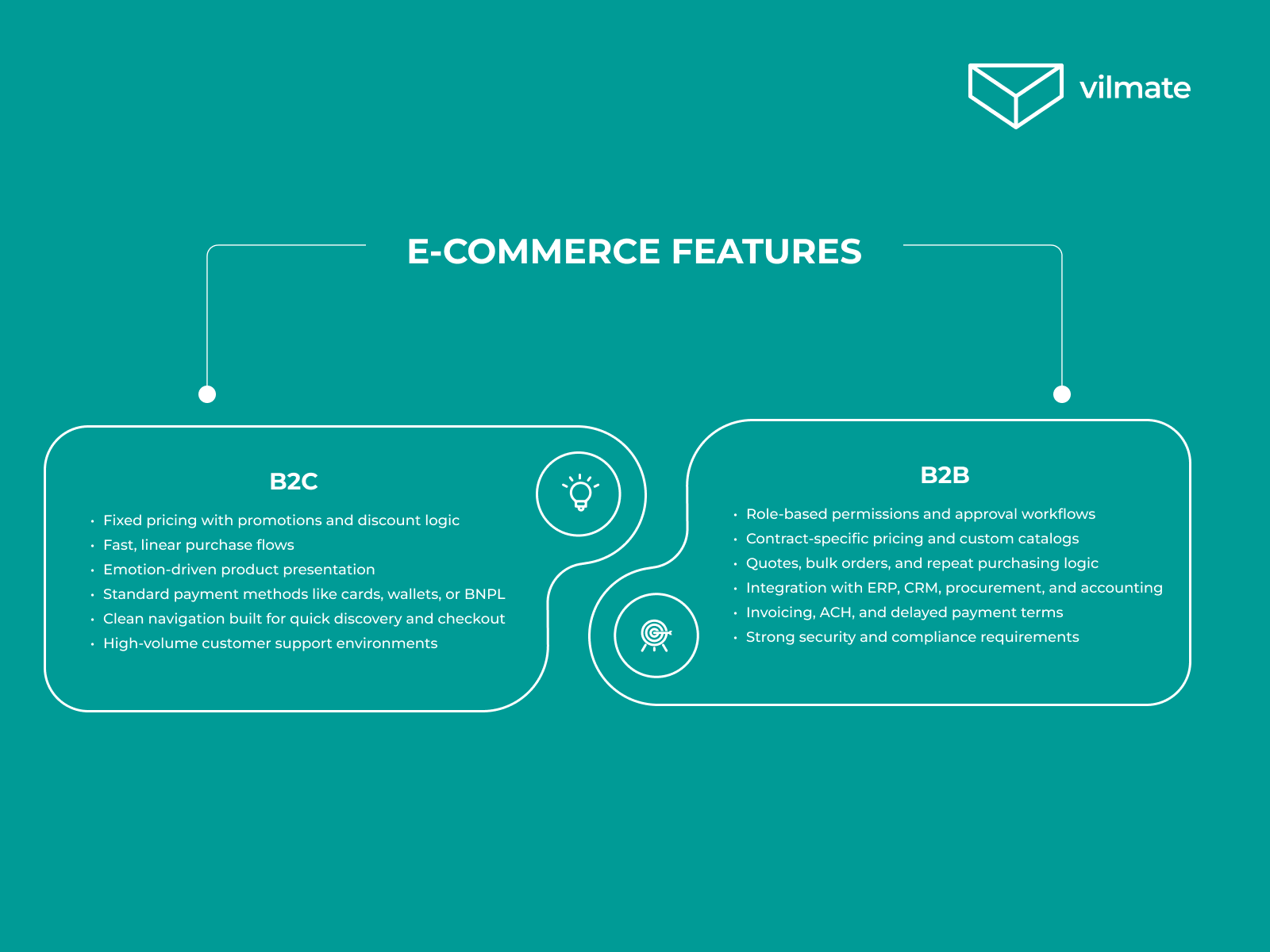
At first glance, e-commerce is e-commerce: product pages, checkout, payments, integrations. The interface looks familiar, yet the logic underneath tells a different story. In B2C, development revolves around individual buyers and short decision cycles. Platforms are typically designed to support:- Fixed pricing with promotions and discount logic.
- Fast, linear purchase flows.
- Emotion-driven product presentation.
- Standard payment methods like cards, wallets, or BNPL.
- Clean navigation built for quick discovery and checkout.
- High-volume customer support environments.
- Role-based permissions and approval workflows.
- Contract-specific pricing and custom catalogs.
- Quotes, bulk orders, and repeat purchasing logic.
- Integration with ERP, CRM, procurement, and accounting systems.
- Invoicing, ACH, and delayed payment terms.
- Strong security and compliance requirements.
These differences shape both B2B e-commerce website design and underlying system decisions. Data structures, integration planning, and permission logic need to be defined early. Teams experienced in e-commerce website development for B2B environments anticipate these requirements before they create problems, which reduces rework and shortens delivery cycles.
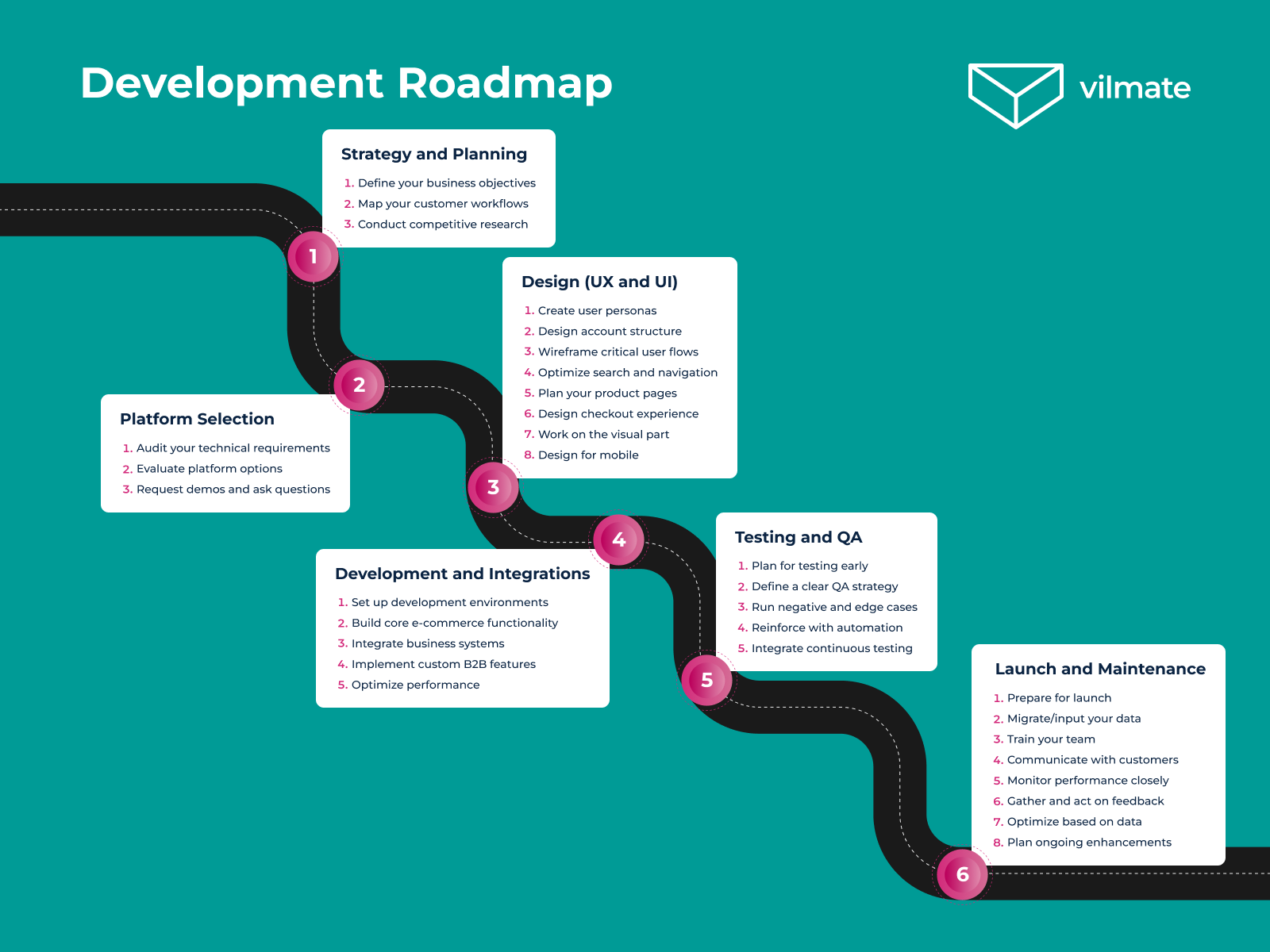
B2B E-Commerce Development Step-by-Step
It’s best to follow a clear process from the beginning when building a B2B e-commerce website. Having defined steps helps avoid extra work, keeps business and technical teams aligned, and prevents last-minute issues. Here’s a typical step-by-step process for development.Step 1. Strategy and Planning
Successful e-commerce website development for B2B starts long before choosing a platform or designing interfaces. Strategy defines what the future B2B e-commerce website must support in real operational terms.
- Define your business objectives. Clarify what the platform should achieve: automate repeat orders, support wholesale pricing, reduce manual processing, or enable account-level self-service. In custom B2B e-commerce website development, vague goals usually turn into feature overload later.
- Map your customer workflows. Document how buyers research products, request quotes, place orders, and move through approvals. Include internal steps as well. These workflows directly influence B2B e-commerce website design and determine what the system must handle from day one.
- Conduct competitive research. See how other companies set up their B2B e-commerce sites. Pay attention to how they handle pricing, account access, and business processes, not just how the site looks.
- Establish your KPIs. Define measurable outcomes early: automation rate, repeat purchase frequency, reduction in manual tasks, onboarding time for new accounts. Clear KPIs protect the project from drifting.
- Create a realistic timeline. Factor in integrations, data preparation, stakeholder alignment, and testing. B2B projects usually involve more dependencies than expected, and planning should reflect that.
Step 2. Platform Selection
Once the strategy is defined, the next decision shapes everything else: choosing the right B2B commerce platform and defining the foundation of your e-commerce technology stack.
- Audit your technical requirements. List the non-negotiables. Required integrations, pricing logic, approval flows, security standards, expected traffic, and multi-store needs. This step defines what your future e-commerce website architecture must support.
- Evaluate platform options. Compare platforms based on B2B capability, scalability, flexibility, and integration ecosystem, not just feature lists. Some projects require a robust enterprise solution; others benefit from a modular setup or headless e-commerce architecture. The choice should reflect the level of operational complexity and long-term scalability requirements.
- Request demos and ask specific questions. Generic demos rarely reveal limitations. Ask how the platform handles contract pricing, bulk ordering, role-based access, ERP synchronization, and edge cases. The goal is to test operational fit, not UI polish.
Step 3. Design (UX and UI)
B2B e-commerce website design translates business logic into a usable structure. This is what your development team is to do at this stage:
- Create user personas for each buyer type. Define the roles within a customer account and what they need to accomplish. Those differences shape navigation, permissions, and overall flows.
- Design account structure and permissions. Plan how multi-user accounts work—сlear permission logic prevents messy workarounds later.
- Wireframe critical user flows. Map the journeys that matter most: search, quote requests, bulk orders, reorders, approvals. Wireframes help validate logic before development locks it in.
- Optimize search and navigation. As product ranges expand, buyers rely on structured filters and accurate search results to locate what they need quickly.
- Plan your product pages. They should support decisions with specs, documentation, pricing context, and availability. Buyers use these pages to reduce risk, not to be entertained.
- Design checkout experience. B2B checkout often includes purchase orders, invoicing terms, delivery rules, and approvals. The flow should feel predictable even when the logic is complex.
- Work on the visual part. Visual hierarchy keeps heavy screens readable. Consistency helps users move faster without re-learning the interface.
- Design for mobile. Mobile usage in B2B is usually task-driven: approve, reorder, check status. Prioritize speed and the most common actions.
Now the logic is visible. The main workflows are mapped, the account structure is defined, and the interface provides a clear foundation for development.
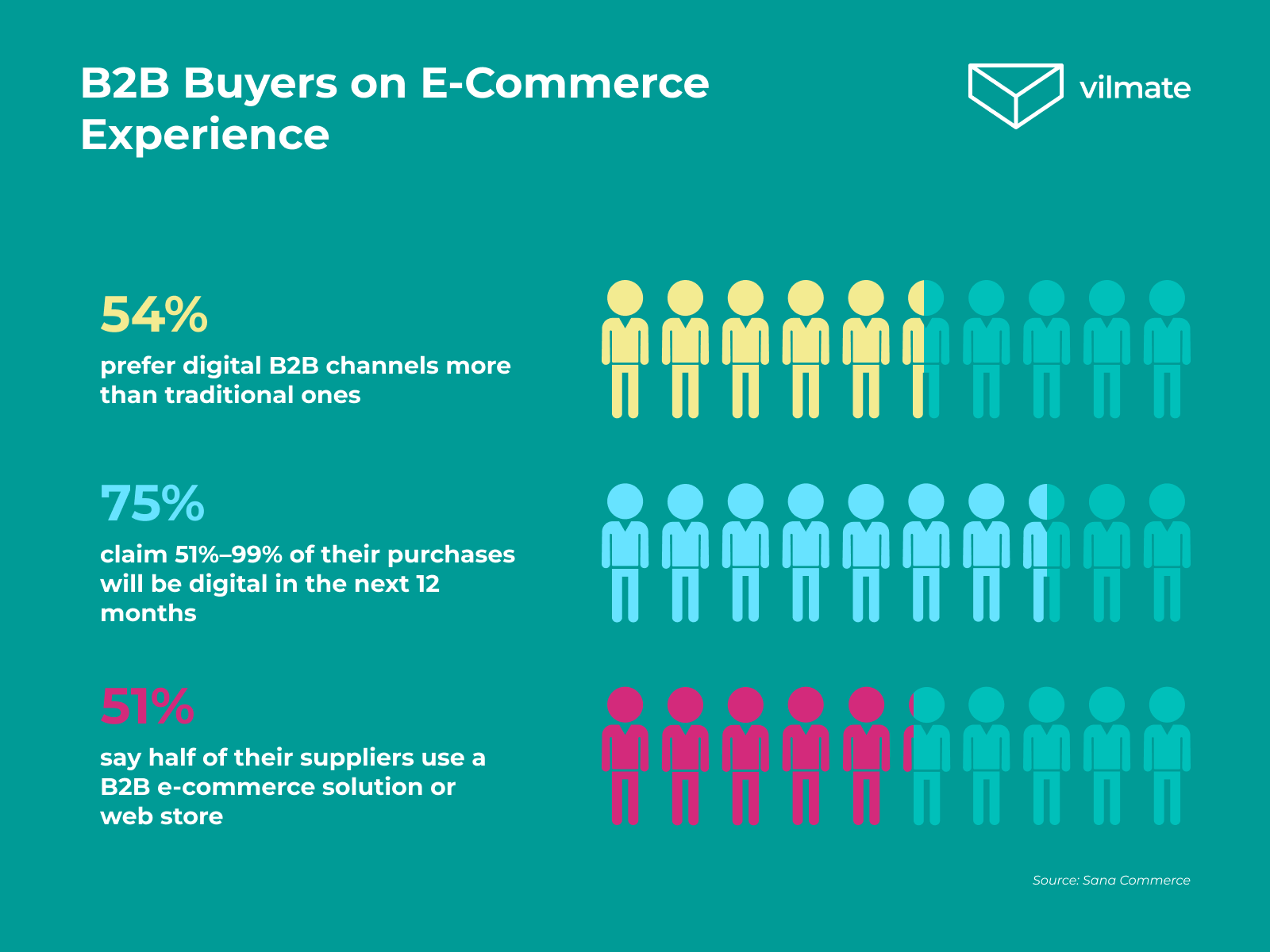
Step 4. Development and Integrations
This is where planning, platform selection, and design start turning into a working system. The e-commerce website architecture defined earlier becomes real infrastructure, real logic, and real code.
From here, the work usually unfolds across several interconnected streams:
- Setting up development environments. The team configures development, staging, and testing environments to mirror production conditions as closely as possible. This foundation supports a scalable e-commerce architecture and allows continuous validation instead of last-minute fixes.
- Building core e-commerce functionality. The platform’s core logic takes shape here—from catalog structure and pricing models to account permissions and checkout behavior. If the solution relies on e-commerce microservices, features are built as modular components, making future changes more controlled and less disruptive.
- Integrating business systems. The team connects ERP, CRM, PIM, inventory, and accounting systems to the platform. Thoughtful e-commerce integrations keep data synchronized and reduce manual reconciliation. Implementing custom B2B features. Developers translate contract pricing, bulk ordering, and approval workflows into operational logic that supports real transactions.
- Optimizing performance. Engineers test the platform under realistic load conditions and refine performance to ensure long-term stability.
Step 5. Testing and QA
Testing in B2B e-commerce projects cannot be an afterthought. The strategy should be defined early and embedded into the development process itself.
- Plan for testing early. Adopt a shift-left mindset. Testing starts alongside development, not after features are “finished.” This reduces late surprises and costly rework.
- Define a clear QA strategy with proper coverage. Cover critical workflows end-to-end: pricing logic, approvals, checkout, integrations, permissions, and data synchronization. B2B systems fail quietly if coverage is shallow.
- Test negative scenarios and edge cases. What happens if pricing data is missing? If an approval is rejected? If inventory changes mid-checkout? These situations are not rare—they are normal.
- Reinforce the strategy with automated tests. Automated coverage protects core logic from breaking as the platform evolves. Regression testing becomes faster and more reliable.
- Integrate continuous testing into CI/CD. Every new change should be validated automatically before reaching production. Testing becomes part of delivery, not a separate stage at the end.
Step 6. Launch and Maintenance
Launch shifts most of the responsibilities from the project team to daily operations. Still, it doesn’t mean the development stops at this point. Given the market dynamics, it hardly ever stops, but you can approach it in iterations—core features first, improvements next, and following the trends as the background is ready. So, here’s what you’ve got to do:
- Prepare for launch. Before going live, double-check integrations, permissions, data consistency, and monitoring. The system should enter production with visibility, not assumptions.
- Migrate or input existing data. Data quality matters more than speed here. Incorrect pricing, outdated catalogs, or broken account structures create friction immediately.
- Train your team. If internal teams hesitate to use the platform, customers will feel it. Clear internal workflows prevent unnecessary manual overrides.
- Communicate with customers. Give them clarity. What’s new, what stays the same, and where to find what they need.
- Monitor performance closely. Watch how the system behaves under real load. Look for bottlenecks, pricing inconsistencies, and integration delays.
- Gather and act on feedback. Patterns matter more than isolated comments. Friction that repeats is friction worth fixing.
- Optimize based on data. Usage data reveals where users slow down, hesitate, or abandon actions. Adjust accordingly.
- Plan ongoing enhancements. A B2B e-commerce website is not a static infrastructure. It evolves with pricing models, customer expectations, and operational complexity.
The website is now operational and positioned for continuous improvement. In wholesale B2B e-commerce website development, ongoing refinement of pricing logic, repeat ordering, and integrations support long-term growth.
To Sum Up
Picture this.
A client logs into your new B2B e-commerce website and immediately sees contract pricing already applied. The interface reflects their role, so nothing feels cluttered or confusing. Reordering takes minutes. Approvals move through the system without extra emails. ERP data matches what appears on the screen. The design feels clear and structured, so no one wastes time figuring out where to click.
That result comes from deliberate decisions made early—around architecture, integrations, workflows, UX, and testing. When those pieces are aligned, daily operations feel stable and predictable.
If you’re building or rebuilding your website, aim for that experience. And if you need a team that has delivered custom B2B e-commerce website development across complex environments, the Vilmate team is ready to help you get there.