How to Build a Mobile App for Real Estate: Detailed Guide
In this article
SHARE TO:
Designing an application for your business is a surefire way to boost its popularity, so real estate mobile app development is what you must embark upon if your enterprise operates on the real estate market. A look at recent statistics only proves what we have known from the horse’s mouth, having implemented several projects for the Real Estate vertical: it is an ever lucrative trade to ply.
According to CNBC, the price of a median US home in the recent year of 2016 was up to 7.5% higher in comparison to 2015. It constituted a hefty $ 273 000. Though making trillions of dollars, the US housing market was worth all the more difficult to calculate.
Notably, this growing trend holds true for most major international Real Estate markets. If India’s property market was worth some $ 105 billion back in 2015, it will have reached $ 462 billion by 2025, Morgan Stanley predicts. Seems like enough of an incentive for both IT entrepreneurs who are considering a digital Real Estate startup and those Real Estate agencies that are still at sea about going digital, mobile or about expanding their business presence on the Web.
Are you considering real estate app development, and, in particular, real estate mobile app development? Are you still in doubt as to whether developing a mobile real estate app is worth the investment? What should you be mindful of in order to make it with your real estate app?
As long-time real estate app developers, we can answer some of the questions, dispel some of the doubts and share a handful of tips that can help you raise the odds of your real estate application.
Why your real estate business needs a mobile app
It can be mentioned upfront that for a real estate business, a mobile app is an absolute must, and increasingly so.
This is so, in the first place, due to the very nature of this business. Real estate agents often do things on the fly. Frequently, both they and their clients have to be quick in responding to events in order to be able to clinch a good deal.
And in the second place, yet back in 2015, 48% of all searches for services in the real estate and property sector were initiated (SmartInsights). Since then, the percentage has only grown.
Thus, on no account should you regard a mobile app as an accessory or a welcome, but too costly an addition to the rest of your business tools and facilities. In all probability, mobile will shortly render your brick-and-mortar and Web-enabled business secondary. It will become your principal earner and means of communication with your clients and business partners.
Real estate mobile app features
To go about developing software within your chosen app niche, you should understand and be able to apply the basic principles. So, let’s start with the easy part:
Customer panel
Signup and login. Not only registration as such is an important step; also, new users should be verified, ideally both online and offline (e.g. a government-issued ID, last four of your SSN or national ID number), in order to create more trust.
Map view for housing listings. An interactive map allows visualizing all the essential information for users to be able to find what they are looking for in the most convenient and rather informative way. If paired with Map APIs, an application can provide its users with some extra information about public transit in the area, schools, entertainment and more.
Property search. Given some basic parameters like location or property type, an app displays currently available property to customers.
Property feature filtering. Choosing the basic parameters, you are still likely to have a huge listing left. A more detailed search may help, namely filtering by price, amenities, and facilities.
Push notifications
Information on the property: its history, photos, videos, 360 virtual tour, and full details.
Contact broker for additional information or an appointment.
Property submission for sale, rent, or lease
Admin panel
Property management. It can be submitted or removed using the admin panel.
User management. It refers to both brokers and tenants (or customers.) The admin blacklists, adds, edits, and updates users relying on their activities in the app.
Revenue management. The admin monitors and controls the total revenue that is received as a result of property deals.
Customer support management. Admins are oftentimes responsible for delivering quality support for the users to feel comfortable and secure while in an app.
Subscription package management
Reporting & analytics. The admin manages reports or various requests.
Must-haves and advanced features
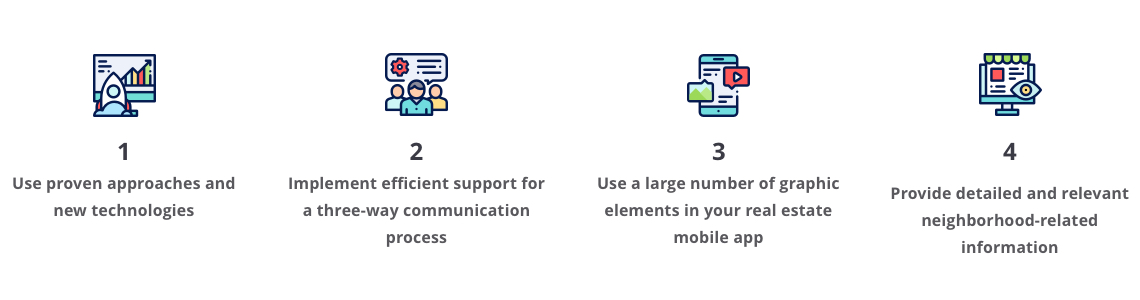
1. Search functionality is paramount. Use proven approaches and new technologies
Powerful and refined search functionality is paramount for most real estate apps. It is imperative that you make your property profiles searchable using a diverse range of relevant criteria.
In addition to the must-haves — which, among others, can include location, year built, on-site parking and so on — you should take into account the local specifics, for example, the availability of some sales documents of that kind.
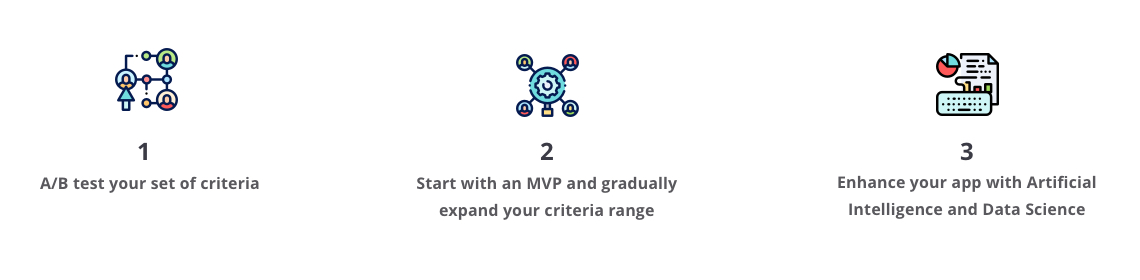
There are three ways in which you can enhance the functionality of your real estate application:
A/B test your set of criteria and the order in which they are displayed to the user.
Start with an MVP and then gradually expand your criteria range, testing each of the new criteria as it is added.
Enhance your app with Artificial Intelligence and Data Science.
While Data Science analytics can help you analyze the search-related data your app has amassed and, thus, allow you to give prominence to the more frequently searched criteria, the AI-techniques of Natural Language Processing (NLP) and Machine Learning can enable your real estate application to analyze search queries at much greater depth. NLP can give your app the ability to fathom the meaning of entire search queries rather than that of individual keywords. Thus, the “long tails” of search queries that often include important information on your visitors’ preferences will not be disregarded. They will be used by your real estate app to better refine the search results and choose those that suit your visitors’ needs best.
Additionally, if you intend to provide support for a long-term property search (for example, some of your clients may want to find a home that meets an extensive set of requirements and is based in a specific, in-demand area), you could implement an NLP capability to help such users. This capability would scour all added properties for those that meet the users’ requirements and inform them accordingly, for example, by email.
2. Implement efficient support for a three-way communication process
It is, certainly, important to implement easy-to-use and detailed property profiles. However, the functionality of your real estate app must also effectively support and facilitate the interactions between your agency, your real estate agents and your clients. This means that you should implement a chat feature that allows comprehensive communication and interaction between the three parties, including the sending of audio and video files.
You may also want to consider implementing the following features in order to enhance the communication process:
Sharing of property profiles with multiple users (both agents and prospective clients) with the ability to add comments.
Auto-responder and call-recording functionality, which is a great feature that can personalize your interactions with prospects and make them a lot more engaging.
3. Use a large number of graphic elements in your real estate mobile app
Such is the nature of mobile devices that things have to be presented on them in a succinct manner. This means that most of the property-related information that can be categorized must be presented to the user in the form of graphic elements and information.
Be prepared to spend part of your development budget on creating a large number of icons and other graphic elements, compelling and easy on the eye.
4. Provide detailed and relevant neighborhood-related information
When buying a home, we buy an environment that is characteristic of a range of important things, such as infrastructure, crime rate, or close availability of sports facilities. This information must necessarily be provided by your real estate mobile app.
There are several things that should be factored in here:
Firstly, similar to your prioritizing when selecting the right property search criteria, you must first identify the categories of neighborhood information that are more likely to be of interest to the user. This information must be made searchable and your app must default to it.
It is up to you which approach to take in creating the neighborhood map. Not to clutter up the map and make it better navigable, you can make it clickable the way it is done in the famous real estate app Zillow and display the neighborhood info after the map is clicked on, or you can build a heat map that uses the color spectrum and overlays the regular map at a click.
Secondly, it would be smart to implement a separate screen that displays neighborhoods with similar characteristics and allows the user to select one of them to get a close-up.
Thirdly, in many cases, the concept of boundaries is not applied in its usual sense. Instead, the notion can often be used to refer to the user’s family, friends and places of interest that make a good neighborhood. The users must be given the ability to define (or — in the case of mobile app development for Real Estate — rather, to draw) their own boundaries and display the neighborhood info for the drawn area.
Lastly, one can say that implementing the neighborhood map functionality of a real estate app is very much akin to implementing the functionality of a navigation app. Your app developers will face the same set of difficulties. However, it is experience and expertise in navigation app development (and not just mobile real estate app development) that can help make the similar functionality of a real estate mobile app more sophisticated and usable. Also, a development team that has such experience can deal with the kind of technical hurdles that are bound to arise more efficiently, and, consequently, more cost-effectively.
Top 5 benefits of real estate mobile app development
1. Stay connected 24/7
Despite rising mortgage rates, millennials are reported to make up the largest share of home buyers for the next ten years. What we also know about this age group is that they are considered to spend most of their time online. This demand for housing together with love of digital technologies and good bargains may result in the real estate mobile applications’ popularity. It means that property is expected to be sold like hotcakes. Thus brokers should be accessible nearly all the time for their clients to find the housing of their dreams and remain satisfied with what they get and with how well the agent has been able to deliver the services.<.p>
2. High customer engagement and conversion
Yet, it works both ways. Mobile apps are used to boost customer engagement. According to Real Estate in a Digital Age Report, 56% of buyers aged 36 or below and 50% of those aged 37-51 found their new housing online. So, chances are it is applications that strengthen customer engagement, conversion, and retention.<.p>
3. Extended market reach
However, not only millennials are interested in purchasing a property. By creating a real estate mobile app for your enterprise, you not only facilitate communication with and get closer to the target customers: Millennials, Boomers, and Gen Xers, but also extend your services to all these groups.
4. The better property viewing experience
Some real estate companies go so far as to offer 360 degree interactive VR real estate video tours right in their iOS and Android applications. A quality property view like this both gives an undeniable advantage to enterprises leveraging the technology and helps engage prospective buyers with an interactive presentation relying on the latest visualization technologies like 3D / 360°, Virtual, Augmented and Mixed Reality.
5. An easy way to build a powerful brand identity
A strong brand identity attracts customers. A mobile app for real estate will help you target the audience that is likely to become buyers or tenants. Accordingly, your application is not only a great place to express your identity in, but also an effective means of creating this identity. Think over how your offering may differ from many others of this kind to make your app a must-have for real estate agents and buyers. Naturally, be aware of what mistakes you should avoid to not disrupt your reputation — your competitors are sometimes giving such examples, just be observant and pay attention to as many details as possible.
How do real estate apps make money?
Apps like Zillow or Trulia are not inspired exclusively by the idea of providing free assistance in finding new homes to people. It is still business which has to generate revenue. These are some alleged sources of revenue for your free real estate app:
Monthly fees from brokers. Real estate agents can be asked to pay for featuring them on your app. Advertised agents get visible to a larger audience of buyers and sellers. They appear in property listings more frequently and win more clients.
Ads sold to third-party businesses. Real estate applications have advertising space to sell to interested parties like mortgage lenders, interior designers, and other relevant websites willing to expand their reach by leveraging your platform.
Premium features. It is also a good idea to separate free and paid features. Regular reports run on a daily, weekly, biweekly, monthly, quarterly, or yearly basis can serve as an example of paid features. However, it just part of the premium package. Zillow in its turn offers the whole set of advanced plans (Silver, Gold, and Platinum) known under the umbrella term Zillow Premier Agent, which makes life easier for real estate agents.
How much does it cost to develop a real estate mobile application?
No universally applicable answer can be given to a question like that. An array of parameters must be taken into account. The total cost will also depend on the project complexity and the hourly rate is calculated based on where software engineers and other specialists working on your app reside. Supposing that $30 is an average hourly rate, let’s find out how much real estate mobile application development may cost you:
Web development: Custom and admin panels
300 hours
$9,000
Native development: iOS and Android apps
900 hours
$27,000
UX/UI Design
200 hours
$6,000
Testing and Quality Assurance
450 hours
$13,500
Project Management (10-15% of the total budget)
–
$5,500
Total Cost
$61,050
Yet, keep in mind that the estimate is approximate and always has to be discussed and further specified.
Conclusion
Purchasing a new home or taking property on lease became easier after the mobile app development for real estate had been introduced.
Mobile applications for real estate agents and customers will benefit all those involved in finding and deciding on a perfect place to call home. If taken seriously, the process of creating such an app will become a success and your product will eventually contribute to making people happier. So, go for it — improve property management (i.e. its buying, renting, and selling), do not hesitate and start your journey!
AUTHOR BIO
Anastasiia Rezinkina
Copywriter / Content manager
Anastasiia is a content writer at Vilmate with a focus on e-commerce, AI, and emerging tech trends. She turns complex topics into clear, practical reads — whether it’s comparing CMS platforms or unpacking how AI is reshaping online retail.
At WWDC 2025, Apple introduced iOS 26. As always, there’s a lot of talk about the new design, AI-powered features, and improvements for gamers. The good news for app owners is that there are no significant disruptions this time. However, there are still some details to consider. They will help your app stay modern, easy […]
A smartphone is an essential accessory in the modern world. People use mobile devices to communicate, learn, work, and entertain themselves. Of course, shopping has also moved to smartphones. If you own a retail store, making it easily accessible on your customers’ smartphones should be a top priority. But it’s not just about having a […]
Mobile and web app distribution is crucial as it ensures widespread availability and accessibility, reaching a vast user base. It facilitates app discovery, enhances user engagement, and contributes to the app’s overall success by making it available on various platforms. Recently, our CTO Igor Bagayev held an internal townhall, where he presented some vital points […]
Cookies help us see what's working on this site and make it better. Your call on what we track.
Functional
Always active
The technical storage or access is strictly necessary for the legitimate purpose of enabling the use of a specific service explicitly requested by the subscriber or user, or for the sole purpose of carrying out the transmission of a communication over an electronic communications network.
Preferences
The technical storage or access is necessary for the legitimate purpose of storing preferences that are not requested by the subscriber or user.
Statistics
The technical storage or access that is used exclusively for statistical purposes.The technical storage or access that is used exclusively for anonymous statistical purposes. Without a subpoena, voluntary compliance on the part of your Internet Service Provider, or additional records from a third party, information stored or retrieved for this purpose alone cannot usually be used to identify you.
Marketing
The technical storage or access is required to create user profiles to send advertising, or to track the user on a website or across several websites for similar marketing purposes.