Search for "BigCommerce vs. Shopify", and you’ll quickly notice a funny pattern: both platforms have comparison pages, and both somehow win. A shocking turn of events from vendor-owned content.
The BigCommerce vs. Shopify Reddit debate is full of merchants, developers, and store owners arguing from actual experience: app costs, checkout limits, B2B needs, theme quality, and the classic “why is this simple feature suddenly an extra subscription?” Since every business case is different, the debate never settles on a single perfect answer. Humanity survives another unresolved thread.
The market adds another layer. Shopify dominates the broader e-commerce conversation with its ecosystem, ease of use, and massive merchant base. BigCommerce plays a different game, leaning into API-first flexibility, built-in functionality, and stronger appeal for complex catalogs, B2B, and enterprise commerce.
A proper BigCommerce vs. Shopify comparison means looking past vendor claims and forum drama. You need to compare pricing, daily usability, built-in features, scalability, B2B options, marketing tools, security, and long-term fit.
So let’s compare them properly.
Pricing and total cost of ownership
Let’s start with the economics, because Shopify vs.BigCommerce pricing includes more than the monthly subscription. The number on the pricing page matters, but transaction fees, app costs, payment setup, annual sales thresholds, and implementation effort usually do more damage to the budget. Quietly, of course. Budget damage has manners.
Subscription tiers
Both platforms split pricing into four main tiers, so the first comparison looks neat: entry, growth, advanced, and enterprise.
One detail before we compare the plans. Starting June 1, 2026, BigCommerce is updating its plan names:
- "Standard" becomes "Core."
- "Plus" becomes "Growth."
- "Pro" becomes "Scale."
- "Enterprise" becomes "Performance."
Most core product functionality stays the same, but BigCommerce is also updating GMV (gross merchandise volume) thresholds, adding an Open Payment Provider fee for self-serve plans, and changing support rules for the entry tier. Very subtle. Almost as subtle as putting “enterprise-pricing” directly into the URL.
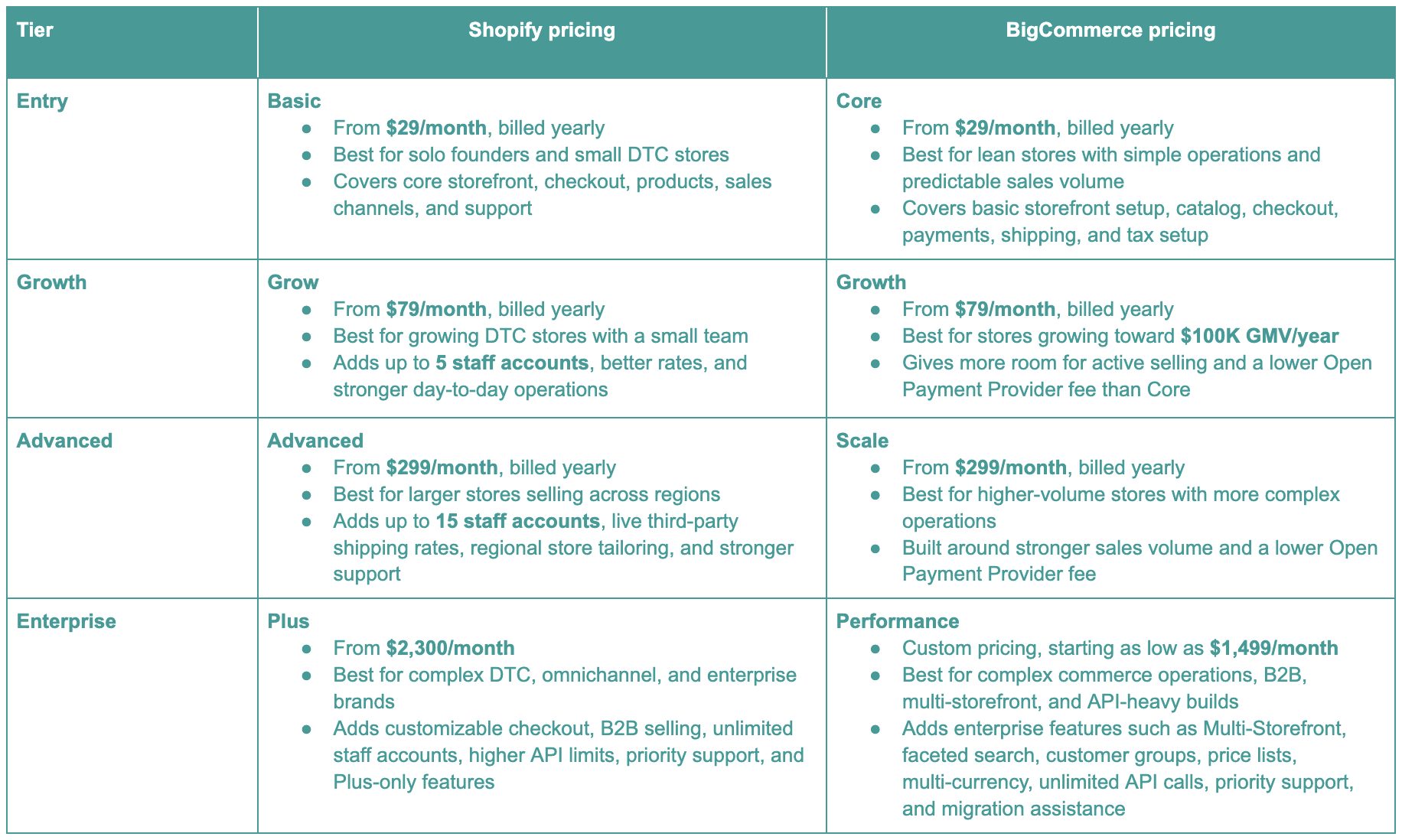
Pricing note: Shopify prices may vary depending on store location and billing terms, so the figures above should be treated as USD reference points. BigCommerce prices are shown in USD based on its 2026 pricing update.
So, for both platforms, the subscription fee only shows where the bill starts. Shopify is easier to match to business maturity. BigCommerce makes you think harder about GMV, payment setup, and future commerce logic before growth starts sending invoices with personality.
Transaction and payment fees
Payment fees apply to every order, so they start to matter quickly as sales volume grows.
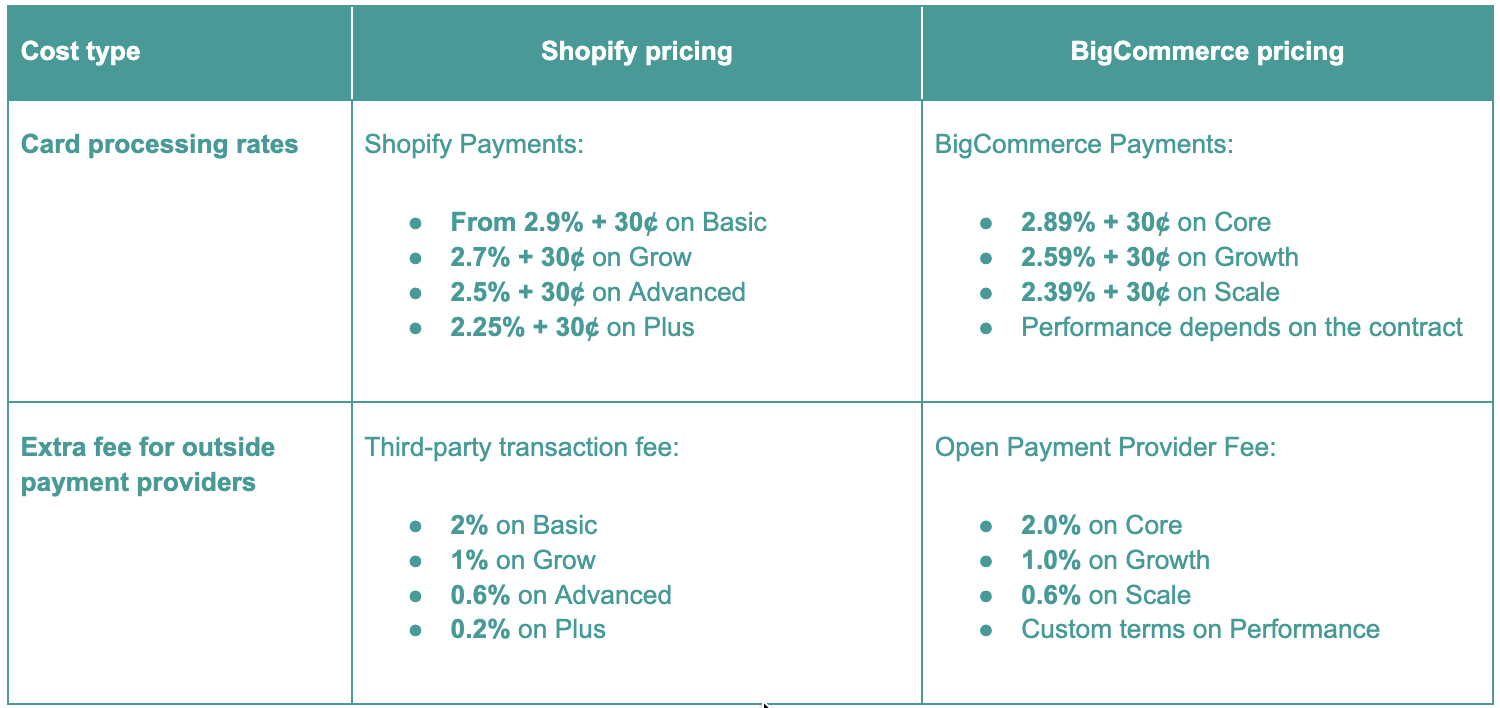
Shopify is the cleaner choice if Shopify Payments works for your markets, currencies, and business model. The math is easier, the rules are more predictable, and Shopify pricing stays easier to forecast. Everyone gets to pretend payment setup is simple for five peaceful minutes. Shopify still lists extra rate categories for premium cards, international payments, PayPal Wallet, in-person payments, and manual payments, so the calm is not absolute. It is e-commerce, after all.
BigCommerce is more interesting if you need payment-provider flexibility. Its Open Payment Provider Fee does not apply when orders are processed through providers from the Embedded Payment Providers list. Before choosing a plan, check whether your preferred gateway is on the list.
App costs
App costs are where a cheap-looking plan can start getting ideas.
Shopify has a stronger app ecosystem, which is great for speed. Need subscriptions, loyalty, reviews, advanced discounts, custom search, or extra reporting? There is probably an app for that. The upside: faster setup and fewer custom builds. The catch: every paid app adds another monthly fee, another dependency, and another small way to complicate Shopify's total cost of ownership.
BigCommerce includes more commerce functionality natively, so stores may need fewer apps to reach the same baseline. That can make BigCommerce costs easier to control for complex catalogs, B2B logic, or advanced promotions. The trade-off is that the setup may take more configuration upfront.
So the choice is simple: Shopify works best for teams that value speed and app flexibility. BigCommerce suits stores where fewer paid add-ons and more native functionality matter from the start.
Gross merchandise volume thresholds
GMV sounds like a finance term that wandered into a platform comparison by accident. Sadly, it belongs here. Revenue volume can affect pricing as stores scale.
Shopify does not use direct revenue-based limits on its standard plans. If your store grows from $80K to $200K in annual sales, Shopify does not automatically move you from Grow to Advanced just because revenue crossed a line. You may still upgrade for better rates, more staff accounts, stronger shipping tools, or enterprise features, but the trigger is usually business need.
BigCommerce ties its self-serve plans to GMV thresholds:
- Core: up to $30K trailing 12-month GMV, then upgrade to Growth.
- Growth: up to $100K trailing 12-month GMV, then upgrade to Scale.
- Scale: up to $33,333 monthly GMV, then 0.9% overage on GMV above that limit.
- Scale to Performance: automatic move to Performance above $2M trailing 12-month GMV.
For BigCommerce vs. Shopify, this is one of the clearest pricing differences.
Enterprise pricing
Enterprise pricing starts when standard plans stop answering the practical question: can the platform handle checkout, markets, integrations, B2B logic, and internal approval cycles without making the team regret its life choices?
Shopify Plus starts from $2,300/month. Shopify usually looks stronger for businesses that want enterprise scale with fast rollout, polished admin, strong checkout, unlimited staff accounts, B2B selling, priority support, and a large partner ecosystem. Good fit for DTC-heavy brands that need more control but still want the platform to feel manageable.
BigCommerce Performance is custom-priced, with BigCommerce’s 2026 update saying it can start as low as $1,499/month. Its stronger case is complex commerce: multi-storefront, faceted search, customer groups, price lists, unlimited API calls, B2B logic, and integrations outside a standard setup.
The cleaner rule is this: choose Shopify Plus when speed, checkout quality, ecosystem, and merchant usability matter most. Choose BigCommerce Performance when B2B, catalogs, integrations, APIs, and multi-storefront architecture are the expensive parts of the project.
True TCO
Total cost of ownership is the price of living with the platform after launch. Subscription is just the first line.
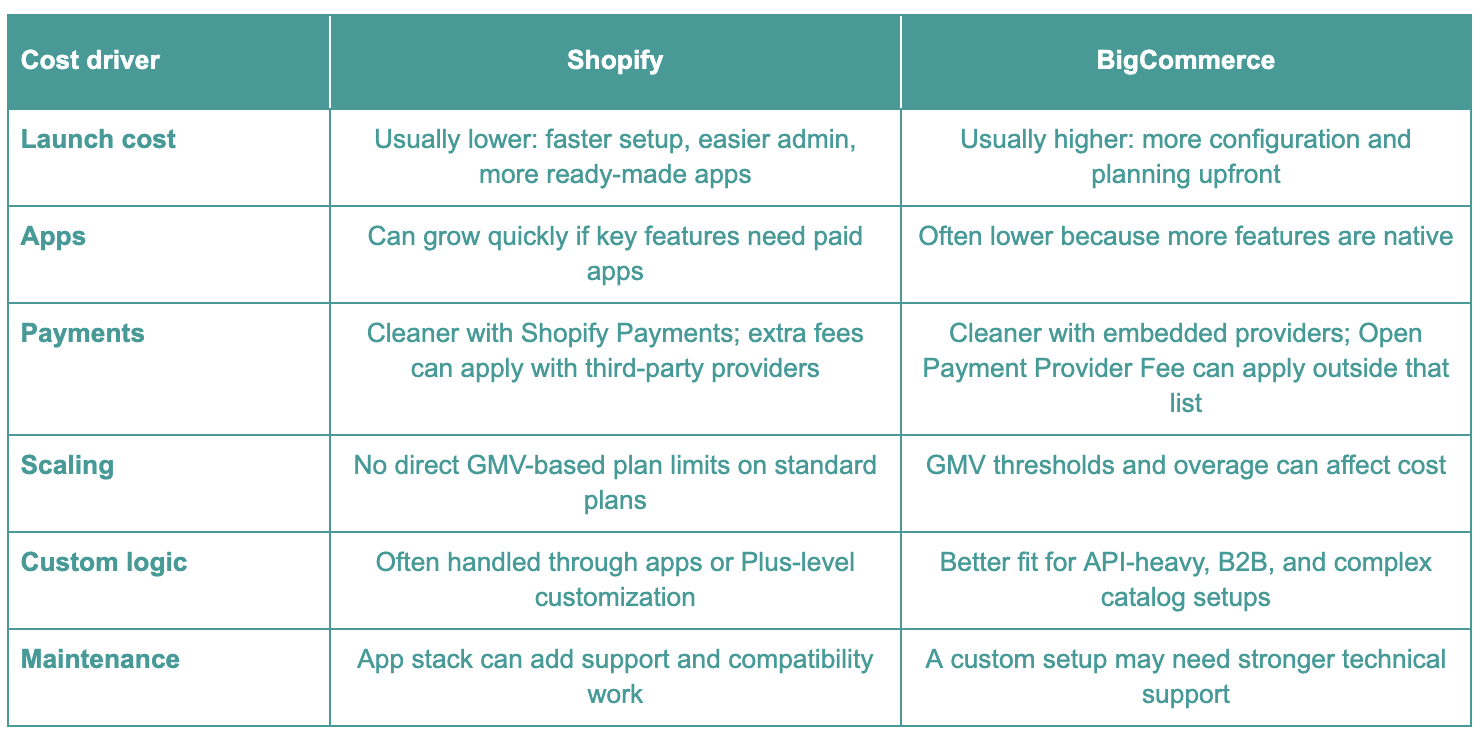
In simple terms, Shopify is usually easier and cheaper to get started, while BigCommerce can be easier to manage as the store gets more complex. But cost is only one side of the decision. The next question is how painful or painless each platform feels when your team actually has to set it up, manage it, and use it every day.
Initial setup and ease of use
Now to the part your team will actually feel every day: launch speed, admin comfort, no-code editing, and developer workflow.
Ease of use matters because the best platform on paper can still become everyone’s least favorite tab if setup is slow, updates are painful, or every small change needs a developer.
Onboarding speed
Shopify is faster to launch for a standard store. The setup flow is guided, the admin is easy to understand, and the platform asks fewer hard questions before you can get products, payments, checkout, and a basic storefront running.
BigCommerce takes more configuration upfront. Store settings, catalog structure, payment setup, tax, shipping, and advanced options may need more attention early, especially if the store has complex products, B2B logic, or integrations. The learning curve is steeper, but that extra setup can pay off from day one when the business needs more control.
Merchant admin
Admin experience matters because the store will not manage itself—sad, but documented by reality.
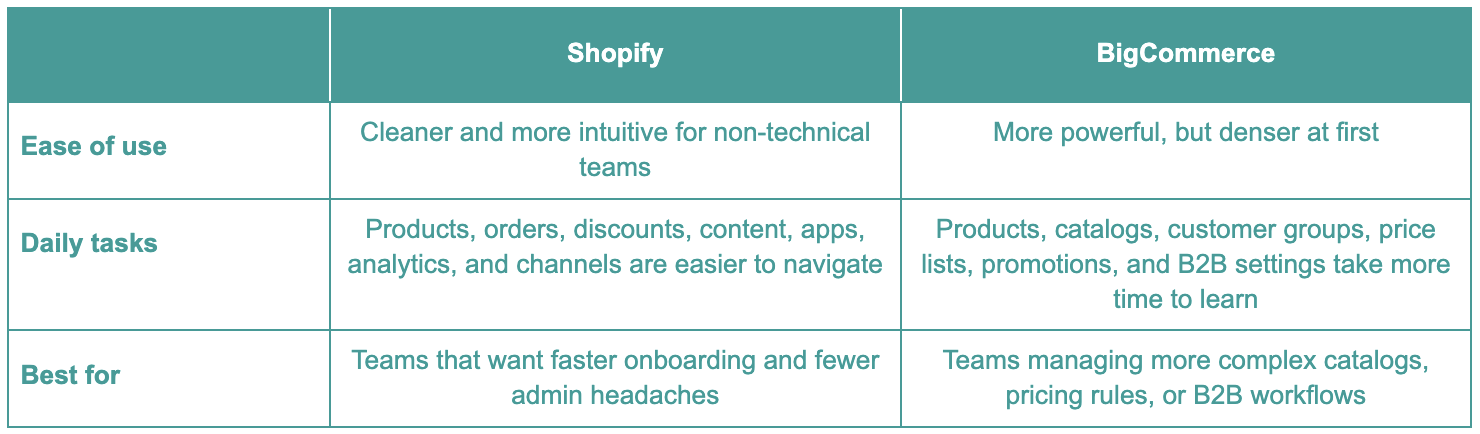
Shopify's ease of use makes it a winner in this category. BigCommerce takes more patience, but gives more room for complex commerce operations once the team knows where everything lives.
No-code tools
Shopify gives merchants a stronger no-code setup for everyday storefront changes:
- Theme editor.
- Sections.
- App blocks.
- Visual layout editing.
- Product and page content updates.
- Basic design adjustments without code.
It works well when the team wants to update pages, move blocks, test layouts, and manage content without having to ask a developer to rescue every button.
BigCommerce also has no-code tools, but the experience is less polished:
- Page Builder.
- Drag-and-drop widgets.
- Banners.
- Homepage and content blocks.
- Basic storefront edits.
- Visual merchandising controls.
It covers routine updates. Complex layouts, branded UX, and custom storefront logic usually fall to developers sooner.
Developer experience
Speaking of developers, Shopify is easier to enter and easier to staff. It has Liquid, Shopify CLI, Storefront API, Hydrogen, strong documentation, a large community, and many proven implementation patterns. For standard DTC builds, theme customization, app setup, and faster delivery, this is comfortable territory.
BigCommerce gives developers more room when the project has custom requirements. Stencil, Catalyst, open APIs, GraphQL Storefront API, and headless support work better for custom storefront logic, complex integrations, large catalogs, and B2B workflows.
Features and flexibility
Now to the part where "BigCommerce vs. Shopify" gets more interesting: what the platform can do before your team starts filling gaps with apps, workarounds, or custom code.
Let’s look at the actual feature split.
Built-in features
Built-in features shape how much your team can do before apps enter the chat.
- Shopify: clean core features for storefront, checkout, products, payments, analytics, sales channels, and basic marketing. Easy to start, easy to extend.
- BigCommerce: more native depth for complex catalogs, product options, promotions, SEO controls, and B2B-friendly workflows. Lower app dependency early.
Shopify features fit teams that want a clean base and fast extensions. BigCommerce features fit stores that need more commerce logic built in from the start.
App ecosystem
Shopify has the larger app marketplace, with 16,000+ apps across marketing, design, fulfillment, analytics, reviews, subscriptions, loyalty, and operations, while BigCommerce has a smaller marketplace but more native commerce functionality built in.
For teams that need to add tools fast, Shopify gives more choice and flexibility; for teams that want fewer extensions and more platform-level logic, BigCommerce keeps the setup cleaner.
Integrations
For integrations, Shopify features lean toward ready-made connectivity, while BigCommerce features are stronger when the setup needs more custom logic.
- Shopify: many native and third-party connectors for common retail, marketing, fulfillment, analytics, shipping, and payment tools. Good when the stack is fairly standard and speed matters.
- BigCommerce: API-first architecture with strong support for custom middleware, complex data flows, B2B workflows, and deeper backend connections. Good when integrations shape the whole commerce setup.
Shopify is easier when your tools already fit its ecosystem. BigCommerce is better when the store needs custom integration logic instead of another connector held together by optimism.
Templates and themes
Shopify is stronger for a fast visual launch. Its official Theme Store has 800+ themes, with filters by industry, catalog size, layout, features, and price, so merchants can usually find a polished starting point, adapt it, and launch without turning the first design iteration into a separate project within the project.
BigCommerce has a smaller theme marketplace, but that matters less when the storefront will be customized anyway. Its themes cover major retail categories, including fashion, beauty, electronics, food, automotive, and B2B, while stores with complex catalog flows, custom UX, or headless architecture usually move beyond the theme layer faster.
Customization and developer flexibility
Here, the difference is easy to see: Shopify is more app-first, while BigCommerce is more API-first.
- With Shopify, customization often goes through apps. This is fast and convenient for common needs such as subscriptions, loyalty, reviews, bundles, search, and promotions. The trade-off appears when the store needs something more specific, and apps start setting the rules.
- BigCommerce gives developers more room to build custom logic through APIs. It fits better when the store has complex integrations, B2B workflows, unusual pricing rules, or catalog logic that should align with the business.
So, Shopify features are easier to extend quickly. BigCommerce features are easier to shape deeply.
Headless commerce
Headless is where both platforms get serious, but the development logic is different. Shopify offers a more packaged, headless approach, while BigCommerce feels more naturally composable.
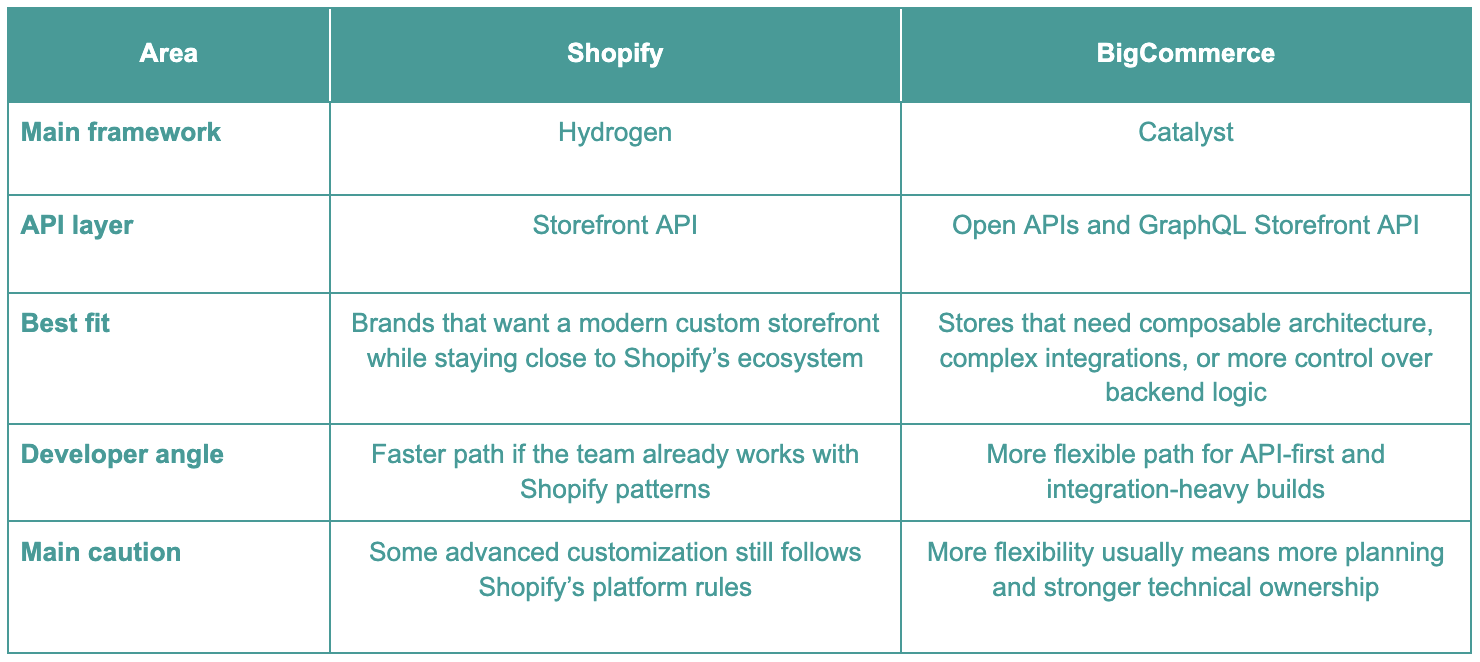
- Need a cleaner custom storefront within a familiar ecosystem? Shopify will likely feel easier.
- Need more control over architecture, integrations, and backend logic? BigCommerce gives you more room to build. Choice is yours, consequences included.
Agentic commerce
Agentic commerce is still early, so the choice depends on how your team wants to experiment with AI: through native tools or custom workflows.
Choose Shopify if:- You want more native AI features inside the platform.
- You need faster help with product descriptions, content tasks, and merchant workflows.
- Your team prefers built-in tools like Shopify Magic over custom AI development.
- You want AI features that stay close to Shopify’s admin and ecosystem.
- You want to connect custom AI tools through APIs.
- Your AI use cases depend on complex catalog data, B2B logic, pricing rules, or integrations.
- You prefer building AI workflows within your architecture.
- Your team has the technical capacity to design and maintain custom AI logic.
AI will likely play a bigger role in daily commerce operations, from content and merchandising to search, support, and decision-making. So, choose wisely.
Scalability and enterprise readiness
Scalability makes BigCommerce vs. Shopify about traffic, catalogs, storefronts, workflows, and operational growth at the same time.
Infrastructure and uptime
Infrastructure is mostly a draw between BigCommerce and Shopify. Both are fully hosted SaaS platforms, so hosting, scaling, updates, and security patches are handled by the platform.
Shopify Plus is easier to reference for enterprise buyers because it may include a 99.99% uptime SLA. BigCommerce also claims 99.99% uptime, but enterprise teams should confirm the exact uptime and support terms in the contract.
Large catalogs
Large catalogs used to be an easy win for BigCommerce, mostly because Shopify had a much tighter variant limit. That argument now needs an update, because Shopify supports up to 2,048 variants per product. Still, it maintains the 3-option structure, so catalogs with unusual product logic may require careful modelling.
BigCommerce supports up to 600 variants per product and provides additional flexibility through modifiers, product options, customer groups, price lists, and B2B-oriented catalog logic. It is still a strong fit for stores where catalog complexity goes beyond variant count: wholesale pricing, custom product rules, segmentation, and integration-heavy product data.
Which one is a fir for you depends on catalog behavior: product options, pricing logic, customer-specific rules, and how cleanly product data moves between systems.
Enterprise features
At the enterprise level, small feature gaps get expensive fast. So the useful question is simple: which platform gives your team more control before custom work, apps, or integrations start doing overtime?
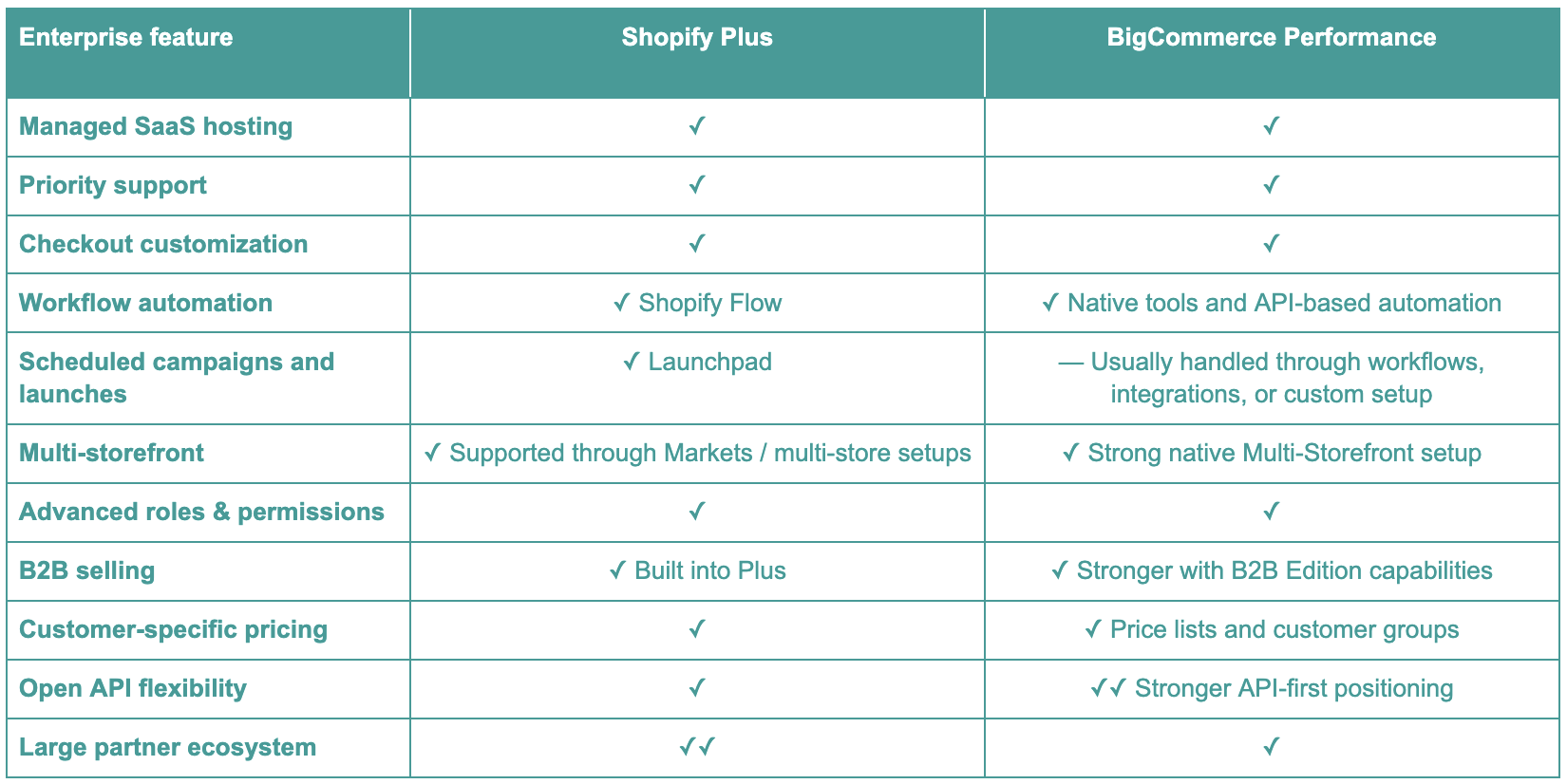
Shopify Plus is the cleaner enterprise path when the team wants proven tools, faster rollout, and fewer surprises in daily operations. BigCommerce Performance earns attention when enterprise complexity sits in the business model itself: B2B rules, storefront networks, pricing logic, and integrations that need room to breathe.
Partner ecosystem
The partner ecosystem matters when you need platform-specific help without turning the vendor search into a second project.
- Shopify has a larger global network, so it is usually easier to find help for setup, theme customization, app configuration, migrations, performance fixes, and growth support.
- BigCommerce has a smaller partner pool, but many partners focus on heavier commerce work: B2B, integrations, enterprise builds, complex catalogs, and API-first setups. Here, fit matters more than count.
Our team works on both Shopify and BigCommerce projects—from setup and integrations to performance optimization, custom storefront development, and long-term support. So if you're comparing BigCommerce and Shopify right now, and the answer already looks like “it depends,” we can help turn that into a technical decision your business can actually use.
B2B and wholesale
Wholesale brings the comparison into negotiated pricing, company accounts, purchase orders, customer-specific catalogs, and account-level permissions.
The BigCommerce vs. Shopify Plus choice depends on how complex the wholesale model gets. Simple B2B alongside DTC can work well on Shopify Plus. Heavier B2B, with layered pricing, catalog rules, and approval flows, usually makes the BigCommerce Enterprise vs. Shopify Plus discussion more serious.
Native B2B tools
Shopify has significantly improved its B2B toolkit, especially on Plus. BigCommerce still feels more naturally built for heavier wholesale logic, especially when buyer accounts, catalogs, pricing, and approvals get layered.
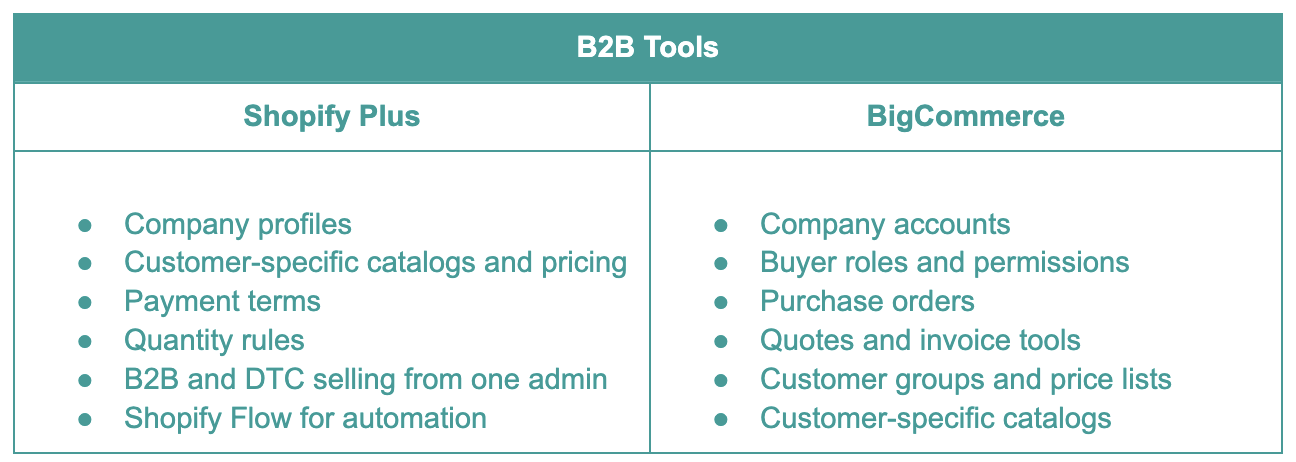
Before choosing, decide what matters most: keeping B2B simple inside a DTC-led store or building wholesale around deeper account, pricing, and approval logic. Shopify Plus works well for the first case. BigCommerce is usually the stronger fit for the second.
B2B Edition
Shopify includes B2B features inside Shopify Plus, so DTC and wholesale can be managed from the same platform: company profiles, customer-specific catalogs, payment terms, checkout rules, and permissions.
BigCommerce offers a dedicated B2B Edition with deeper wholesale tools like buyer portals, quote workflows, shopping lists, role-based access, invoice tools, price lists, and sales rep functions, so BigCommerce Enterprise vs. Shopify Plus mainly comes down to how much B2B control the business actually needs.
International and multi-currency selling
International selling adds a second layer of platform decisions: currencies, taxes, languages, domains, catalogs, regional pricing, and local payment expectations.
In context of BigCommerce vs. Shopify, this section looks at how each platform supports cross-border commerce and how much setup your team needs to sell across markets without creating a beautiful operational headache.
Multi-currency support
Shopify handles multi-currency through Shopify Markets, so it feels more packaged: local currencies, market-specific pricing, rounding rules, and checkout currency sit in one international selling setup. It is convenient, especially for teams that want to sell cross-border without assembling the whole thing from spare parts.
BigCommerce also supports multiple currencies natively, and merchants can manage currencies from the control panel. The setup is solid, but it usually feels less bundled than Shopify Markets. It fits teams that are comfortable configuring currency rules, payment gateways, and regional storefront logic, but require a bit more manual attention.
Localization
Surprise: Shopify Markets reenters the room, looking suspiciously like the team member responsible for international affairs. Fair enough, because localization is where most of the work gets done.
Shopify Markets helps manage languages, domains, regional pricing, duties and taxes, and market-specific settings from a single place. That makes Shopify easier for teams that want a more packaged international setup with fewer regional rules assembled manually.
BigCommerce, meanwhile, returns to its favorite instrument: APIs. It offers greater flexibility through custom configuration, which suits stores that need different catalogs, local integrations, regional storefront logic, or market-specific buyer journeys, beyond a single shared international setup.
Market fit
Both platforms can work across regions, so geography shouldn't be the deciding factor. Still, partner availability, local expertise, and implementation experience can make the project much smoother.
- Shopify: strong global visibility, especially in North America, the UK, Europe, and Australia.
- BigCommerce: strongest in North America and Australia, with Europe still developing.
Notice the overlap? North America and Australia are well served by both platforms. So if you are there, congratulations, the platform gods were in a generous mood. For everyone else, the choice still works, but partner availability deserves an early check before the roadmap starts making brave promises.
Marketing capabilities
Marketing differences between the two show up in the daily work. Shopify marketing is stronger around built-in tools, app choice, audiences, email, and channel integrations. BigCommerce marketing is stronger where SEO control, native promotions, catalog logic, and flexible integrations matter more.
But let’s take it one piece at a time.
SEO
For SEO, BigCommerce takes the cleaner win.
Shopify has solid SEO fundamentals: editable title tags, meta descriptions, redirects, alt text, canonical tags, sitemap generation, and basic performance. For many stores, that is enough. The annoying part is control. Shopify has fixed URL structures like /products/, /collections/, and /pages/, and that can get in the way when the SEO strategy needs a cleaner architecture.
BigCommerce gives more native SEO control. It supports cleaner URL structures, stronger category/product URL customization, editable metadata, 301 redirects, and better handling for complex catalogs and faceted navigation. For stores where organic search matters, BigCommerce features give SEO teams more room to work without immediately reaching for apps or workarounds.
So yes, Shopify marketing is strong across many areas, but SEO is one area where BigCommerce has a clearer advantage.
Email and CRM
After the SEO round, Shopify gets a fair chance to strike back. Shopify marketing feels convenient for smaller teams because Shopify Email is built in: merchants can create branded campaigns, use templates, segment customers, and track basic results without adding a separate email platform right away.
BigCommerce relies on third-party email and CRM integrations such as Klaviyo, Omnisend, Attentive, and others. That works well for teams already using a dedicated marketing stack, with flexibility coming through integrations rather than a native email tool.
Paid advertising
Shopify takes another step forward here. Shopify marketing includes Shopify Audiences on Plus, which helps generate audience lists for ad platforms like Meta and Google, and Shopify also connects well with major paid channels.
BigCommerce marketing depends more on third-party tools and integrations for paid advertising. That still works, especially if the team already manages ads through external platforms, but BigCommerce does not have the same proprietary audience tool built into the platform.
Promotions and discounts
Promotions are a stronger point for BigCommerce marketing, especially when discount logic gets more specific than a basic percentage off.
- Shopify handles standard discounts well: percentage discounts, fixed amounts, free shipping, Buy X get Y, discount codes, and automatic discounts. Advanced rules often need apps or Plus-level customization.
- BigCommerce provides greater native control for complex promotions, including cart-level and product-level discounts, coupon rules, customer group pricing, free shipping conditions, and more layered campaign logic.
If your promo calendar is mostly simple, Shopify will handle it. If you plan to delight customers with oddly specific, beautifully tangled discount logic, well, you already know where this is going.
Abandoned cart and automation
Of course, both platforms have abandoned cart recovery. There is a nuance: someone occasionally likes putting hard-to-live-without features in a plan one level higher.
Yes, we mean BigCommerce, which leaves abandoned cart recovery out of Core and starts offering it from Growth. Shopify is more merciful here: abandoned cart recovery is included across its main plans.
Security
Spoiler: Both platforms handle security well. They have to. You do not become a major commerce platform, let alone one regularly appearing in MrBeast ads, by treating checkout security as a side quest.
This section is a quick sanity check: what the platforms cover by default, what merchants still need to manage, and where security can get messier once apps, integrations, permissions, and custom workflows come into play.
PCI DSS compliance
Both platforms are strong here: Shopify security and BigCommerce security cover Level 1 PCI DSS compliance.
For merchants, payment compliance is largely handled at the platform level.
DDoS protection
DDoS protection also sits in the “covered by default” bucket. Shopify handles it as part of its managed infrastructure, and BigCommerce includes built-in protection as well, with Cloudflare commonly involved on that side.
Fraud tooling
Fraud tooling is the first security subtopic where Shopify gets a clearer product advantage.
- Shopify security includes built-in fraud analysis and automation tools, and Shopify Protect can cover eligible Shop Pay orders against fraudulent and unrecognized chargebacks.
- BigCommerce security leans more on integrations for advanced fraud protection. It integrates with tools like Signifyd, which provides real-time fraud decisions, chargeback management, and automated protection powered by machine learning.
So, Shopify is easier if you want fraud checks closer to the platform core. BigCommerce works well with dedicated fraud tools, especially when fraud prevention is already part of a broader risk setup.
Managed hosting trade-offs
Managed hosting is the reason both platforms feel safe for growing stores: updates, hosting, infrastructure, patches, and much of the security burden stays with the platform.
- Shopify security is very platform-owned. Merchants get reliability and less technical maintenance, but also less control over the underlying stack.
- BigCommerce security operates on a similar managed model, with a bit more flexibility for custom architecture via open APIs. Yes, APIs again. At this point, they deserve their own chair at the table, and honestly, we respect the consistency.
The trade-off is simple: Shopify keeps the stack more tightly controlled. BigCommerce gives technical teams more flexibility around integrations and custom workflows while keeping the hosting layer managed.
Shopify pros and cons vs. BigCommerce pros and cons
After all the details, strengths, and trade-offs, the comparison is easier to scan. Each platform wins in different places: time-to-launch, ecosystem, native features, B2B logic, cost control, or technical flexibility.
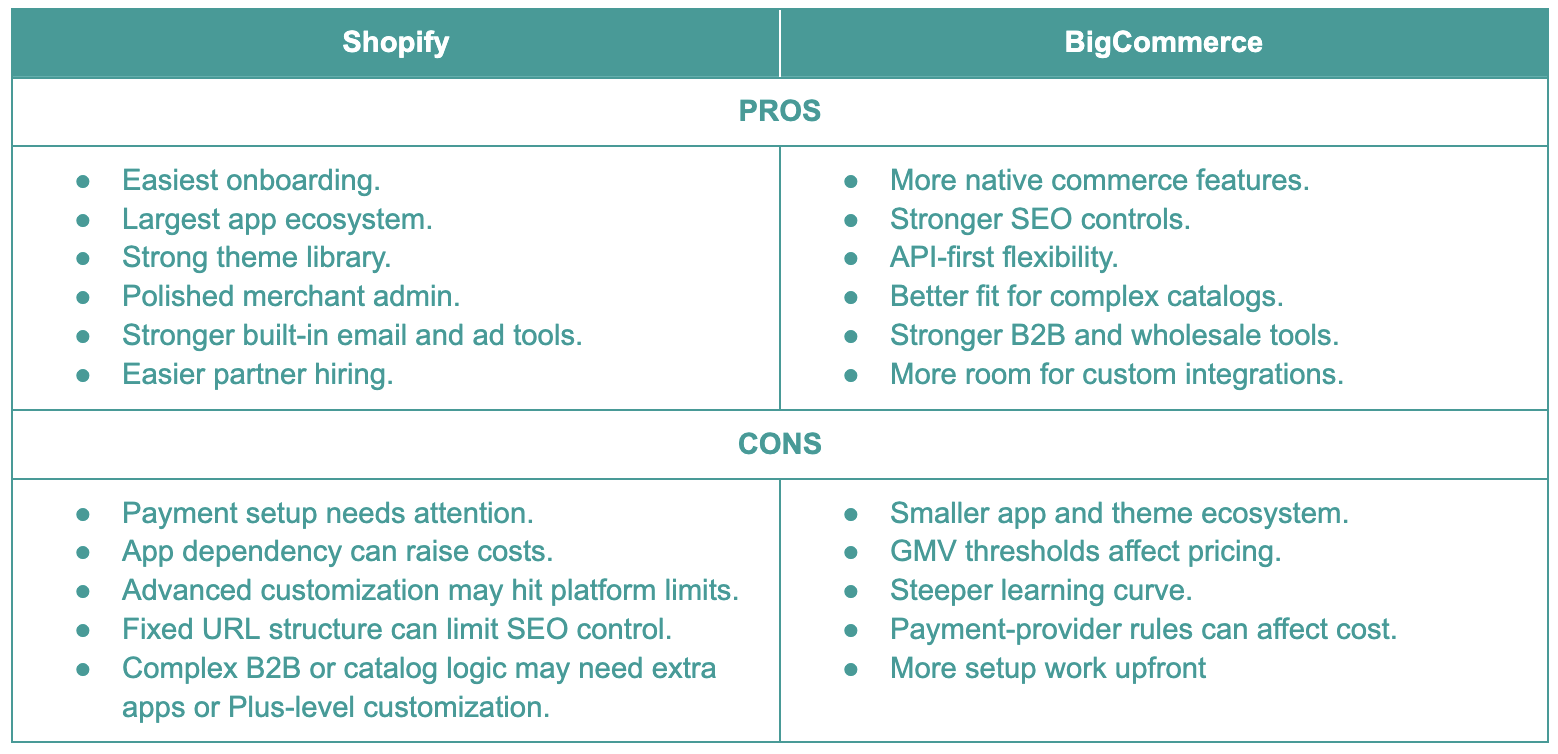
A table is useful, but real platform decisions rarely fit neatly into rows and columns. That is why the BigCommerce vs. Shopify Reddit debate is worth checking: it shows where the clean pros and cons start to diverge in real stores.
The main mismatch is apps. On paper, Shopify’s huge app ecosystem is a clear strength. On Reddit, it often comes with warnings about app costs, conflicts, and dependencies. BigCommerce has the opposite pattern: a smaller marketplace appears weaker in a table, while some users see fewer apps as a relief when more functionality is native.
Ease of use gets similar treatment. Shopify’s simpler setup is still a real advantage, with long-term comfort depending heavily on store complexity. BigCommerce requires more learning upfront, and that trade-off can make sense for teams that need stronger catalog management, SEO, or B2B control.
Reddit adds the missing footnote: every advantage comes with conditions.
How to choose between BigCommerce and Shopify
After all the comparisons, the BigCommerce vs. Shopify choice comes down to the shape of your business.
- Choose Shopify when your team needs speed, simplicity, and a strong ecosystem. It works well for stores that need faster launch, easier admin, ready-made apps, built-in marketing tools, and a more packaged setup for international selling.
- Choose BigCommerce when commerce logic is already more complex. Large catalogs, B2B and wholesale workflows, customer-specific pricing, multi-storefront setups, API-heavy integrations, deeper SEO control, and advanced promotions are cases where BigCommerce becomes a stronger candidate.
The same logic applies if you are considering whether to migrate from Shopify to BigCommerce. Migration makes sense when Shopify still runs the store, but too many workflows depend on apps, manual fixes, or custom workarounds that your team has already outgrown.
At Vilmate, we help teams compare platforms, plan migrations, build custom storefronts, integrate commerce systems, and optimize existing stores. Contact us, and we’ll help you choose the platform that fits your business case, technical needs, and growth plans.