Manufacturers know they need to move B2B purchasing online. Sooner or later, the decision appears in a meeting room: “We need e-commerce. Let’s get online quickly.”
And the rush begins. The task is set: launch B2B e-commerce for manufacturers as fast as possible.
Teams launch storefronts, connect systems one by one, and try to make everything work along the way. Product data lives in one place, pricing in another, distributor tools somewhere else. Before long, the platform starts to resemble Frankenstein’s creature—assembled piece by piece from systems that were never meant to function as a single organism.
The urgency makes sense. According to McKinsey, e-commerce already generates about 34% of B2B revenue for companies that offer it.
But a rushed “online launch” rarely solves the real problem. More often, it creates a platform that technically works, yet remains difficult to scale, maintain, and trust.
In other words: haste makes waste.
B2B e-commerce for manufacturers that ultimately makes a successful project start with something simpler: a clear roadmap. In this article, we’ll show how manufacturers can build B2B e-commerce the right way and avoid the mistakes that turn early platforms into long-term headaches.
The technology stack behind B2B e-commerce for manufacturers
B2B ecommerce projects often start with a simple idea: “let’s build a portal.” A few meetings later, it becomes clear that a portal is the easy part. Behind it sits a small ecosystem of systems that need to cooperate. Here are the core components that usually make that ecosystem work.
Product data foundation
Manufacturing catalogs are rarely simple. One product may include multiple variants, technical attributes, documentation, compatible parts, and regional differences.
Take an industrial pump. The same model can have several sizes, materials, voltage options, and compatible accessories. Updating this information across e-commerce, distributor catalogs, and internal systems quickly becomes difficult.
That’s why many B2B e-commerce for manufacturers projects start with PIM integration. A Product Information Management system stores product data in one place and distributes it across e-commerce and partner channels.
For manufacturers dealing with complex catalog management, this means fewer errors, faster product launches, and consistent catalogs across systems.
Configurator and CPQ
Some products aren’t chosen—they’re configured.
Think about ordering branded T-shirts for an event. You choose color, sizes, fabric, print method, logo placement, and quantity. The final order depends on several parameters.
Without a product configurator, ordering customized products often requires a manual quoting process. A configurator moves that process online. Buyers select options on the product page, while the system validates combinations and automatically builds the order. This is typical for configure-to-order products.
In B2B e-commerce for manufacturers, adding a product configurator early in the roadmap helps move complex ordering online, reducing reliance on manual quotes.
Pricing engine
A distributor logs into the store and adds several products to the cart. Another customer opens the same page—but sees different prices.
That’s normal in manufacturing.
Large buyers, long-term partners, and distributors usually operate under negotiated contracts, volume discounts, or special price lists. If an e-commerce platform shows the same price to everyone, it immediately breaks existing sales agreements.
A pricing engine solves this through customer-specific pricing. The platform automatically displays the prices assigned to each account based on contracts, discounts, or purchase volumes.
Buyers see the prices they expect, and orders can be placed online without sending a quote request to sales.
Portals for distributors and dealers
When manufacturers sell through distributors and dealers, partners usually need their own workspace inside the e-commerce platform. This is where a distributor portal comes in.
Instead of relying on email or sales managers, partners can handle routine tasks directly in the system.
In many cases, buyers would be happy to use a supplier portal—if one existed. 58% of buyers who don’t use portals say their supplier simply doesn’t offer one. Among buyers who already have access, 88% say the portal positively influences their decision to continue purchasing from that supplier.
Inside the portal, distributors can typically:
- Placing orders using their negotiated pricing.
- Accessing partner-specific catalogs.
- Downloading product documentation and marketing materials.
- Tracking orders and shipments.
- Viewing account history and invoices.
As partner networks grow, the portal helps keep sales organized and reduces routine coordination with internal teams.
ERP and inventory connection
Imagine booking a hotel room online, arriving late at night, and hearing at reception that the room is actually unavailable.
That kind of mismatch is frustrating anywhere. In manufacturing e-commerce, it’s even worse.
Online stores may show products as available while inventory, production schedules, or lead times are tracked inside the ERP. Without e-commerce ERP integration, the e-commerce platform and the operational system quickly fall out of sync.
Connecting e-commerce with ERP keeps product availability, order data, and inventory aligned with the real production and warehouse situation. It also supports manufacturing inventory management, where stock levels often depend not only on what is in the warehouse but also on what is currently being produced or reserved.
When the two systems work together, customers see accurate availability, and orders move directly into operational workflows.
Architecture
At some point, manufacturers face a simple choice: use a single e-commerce platform for everything, or connect several specialized systems.
A traditional platform works like an all-in-one machine. Catalog, checkout, and storefront are built together. It’s easier to launch, but changing one part later can be difficult.
A headless commerce for manufacturers approach separates the storefront from the backend systems. The e-commerce engine handles orders and pricing, while the frontend can be redesigned or replaced without touching the rest of the platform.
This structure gives manufacturers more flexibility as e-commerce operations grow, especially when new systems or sales channels need to be added.
How to choose the right platform
So far, we’ve looked at what a functional B2B e-commerce for manufacturers stack actually requires behind the scenes. The next step is choosing technology that can support those requirements without turning the project into a patchwork of custom solutions. To evaluate that, manufacturers typically focus on a few key criteria.
Key evaluation criteria specific to manufacturers
Several practical areas usually determine whether a platform can support manufacturing e-commerce in the long run:
- Product & catalog. Can the platform handle complex products with variants, technical attributes, documentation, and large SKU catalogs?
- Pricing. Does it support customer-specific pricing, contract prices, and volume discounts without manual quoting?
- Channel structure. Can the platform support multiple sales models, including manufacturer-direct sales, distributors, and dealer networks?
- ERP & inventory. How well does it support e-commerce ERP integration and manufacturing inventory management, including accurate availability and order synchronization?
- Search. Can buyers find products quickly using part numbers, technical attributes, or compatibility filters?
- Implementation & ownership. How complex is the implementation, and how much ongoing development is required to maintain the platform?
Platforms that perform well across these areas are far more likely to support B2B e-commerce as the business grows.
But knowing what to look for is only half the job. It also helps to recognize a few warning signs before the platform demo starts sounding too perfect.
Red flags to avoid
Some platform limitations only become visible after implementation begins. The good news is that many of them show up much earlier—usually during demos or the first technical discussions.
Watch for signals like these:
- The platform supports B2B only partially. In reality, you’re getting a B2C store with a few B2B features added later.
- Pricing only works when the ERP is online. If the ERP goes down, the store suddenly can’t calculate prices.
- The configurator is a separate product. Now quotes, product data, and orders live in different systems.
- Customer-specific catalogs require custom development. Something most manufacturers need becomes its own project.
- “ERP integration” means API documentation. The real integration work is left to the implementation team.
- Updating contract prices or product content requires developers. Routine catalog updates turn into development tasks.
- No support for account hierarchies (parent company → locations → buyers). Yet this structure is common in B2B purchasing.
- Platform costs grow with revenue or SKU count. The more successful the store becomes, the more expensive the platform gets.
None of these issues looks dramatic during evaluation. They usually appear later, when the platform has to support real manufacturing workflows. Spotting them early can save manufacturers a lot of time, budget, and painful platform migrations.
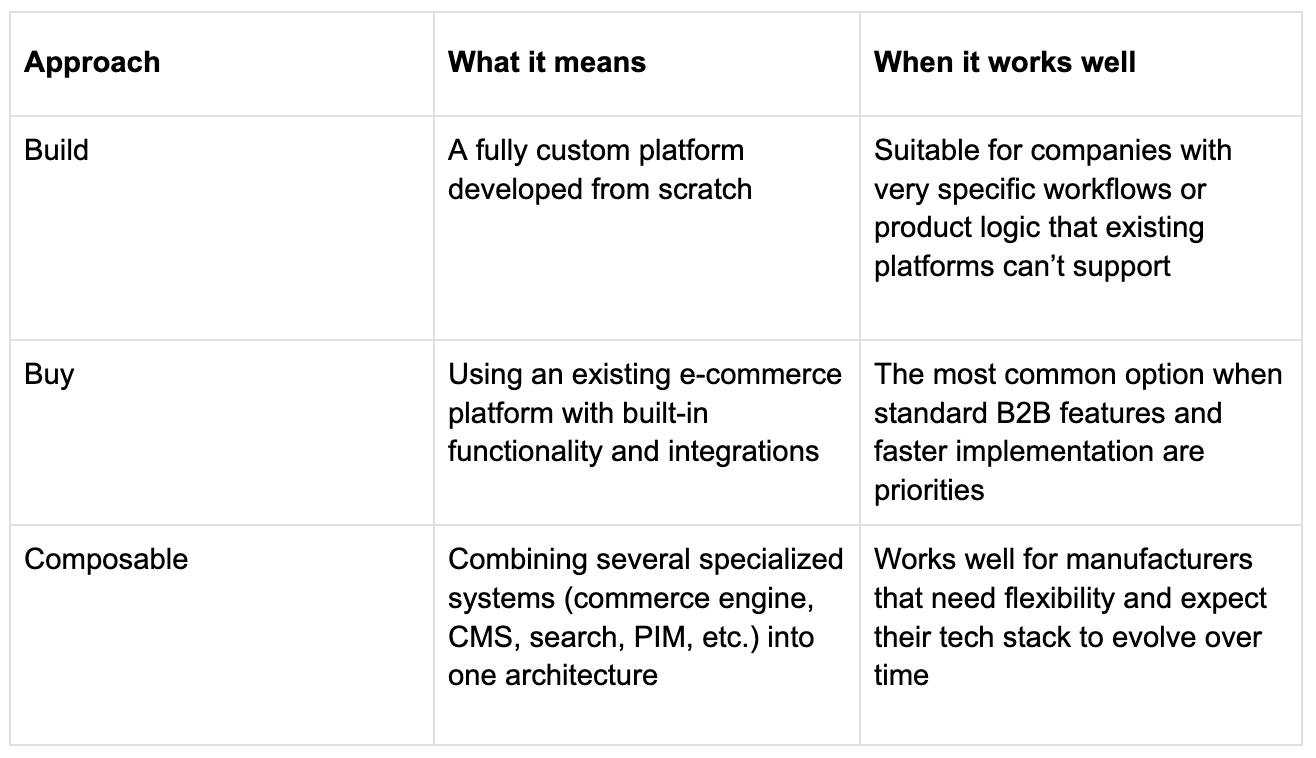
Build vs. buy vs. composable
Once manufacturers understand the platform requirements, the next decision is how to actually build the e-commerce platform. Most projects follow one of three approaches.
Your implementation roadmap
Maybe you’ve encountered a B2B store that feels… almost right.
Prices look correct until a distributor logs in. Inventory seems accurate until someone checks the warehouse. The catalog works—except for a few products that never appear where they should.
It’s a bit like the uncanny valley: the system looks close to working, but the small inconsistencies make it harder to trust.
Most of these problems appear when e-commerce capabilities are introduced in the wrong order.
A more reliable approach to B2B e-commerce for manufacturers is to roll out the platform in stages.
Phase 1: Data and systems readiness
Start with the foundation: product data and operational systems. Clean product data, PIM integration, and e-commerce ERP integration come first.
Phase 2: Core e-commerce experience
Once the data layer is stable, the storefront can follow. This stage usually includes the core store, customer-specific pricing, and a distributor portal.
Phase 3: Configurators and advanced workflows
Once the core ordering process works reliably, manufacturers can add tools, such as a product configurator, for configure-to-order products.
What not to do first
Let’s look at a short list of “don’ts” to help avoid common mistakes.
- Don’t launch the storefront before product data is ready. Inconsistent attributes, variants, or documentation quickly break the catalog.
- Don’t connect the configurator before the pricing logic works. Configure-to-order products depend heavily on correct pricing rules.
- Don’t build the distributor portal until channel conflicts are resolved. Sales teams and self-service ordering need clear boundaries.
- Don’t integrate every system at once. Rolling out integrations step by step makes issues easier to isolate and fix.
- Don’t start with the entire product catalog. Launch with the products that generate the most orders first—often a relatively small share of the catalog.
- Don’t go live before ERP integration is stable. Orders, pricing, and availability must stay synchronized with operational systems.
Every treasure hunt starts with a map. Now you have one—and the treasure, as usual in business, is revenue.
Measuring success beyond revenue
If revenue is the treasure, a few operational signals act as the compass.
In B2B e-commerce for manufacturers, the first signs of success usually appear long before revenue numbers change. They show up in how customers place orders, how often they return, and how much routine work moves away from sales teams.
Several indicators show whether the platform is becoming part of everyday purchasing:
- Order automation rate. When the share of orders placed through the platform grows, e-commerce replaces email chains and spreadsheet orders.
- Reorder frequency. If the platform works well, customers return to place the next order instead of calling a sales rep.
- Self-service adoption vs. sales rep dependency. Routine purchases gradually move into self-service while sales teams focus on complex deals and relationships.
- Distributor portal engagement. Regular logins, product searches, and orders in the distributor portal show that partners actually rely on the system.
When these indicators start improving, revenue usually follows.
Conclusion
If you follow the roadmap, everything falls into place.
Your buyers get what they actually want from B2B e-commerce for manufacturers: clear pricing, accurate availability, easy reorders, and the ability to place orders without emails, spreadsheets, or phone calls.
And you get what matters on the business side: cleaner operations, fewer manual processes, and a platform that can grow as your catalog, distributors, and markets expand.
At that point, you’re no longer stitching systems together like Victor Frankenstein. You’re closer to Pygmalion—shaping your ideal platform as a coherent whole and then bringing it to life.
If you’re planning to build or modernize B2B e-commerce for manufacturers, Vilmate can help you design the architecture, implement the platform, and connect it with the systems that already run your manufacturing business. Get in touch and let’s start building.
FAQ
What are the best B2B e-commerce platforms for manufacturers?
The right platform depends on product complexity, pricing logic, and ERP integration needs. Common options include BigCommerce, Shopify, Adobe Commerce, and composable commerce solutions.
Custom platform vs. an out-of-the-box solution: which works better?
Out-of-the-box platforms allow faster launches. Custom platforms offer more flexibility when products, pricing structures, or ordering workflows are highly specific.
Can we launch a B2B e-commerce platform without replacing ERP?
Yes. Most B2B e-commerce for manufacturers projects integrate e-commerce with the existing ERP system. ERP systems usually serve as the source of truth for inventory, pricing, and order processing.
Can sales reps and e-commerce coexist in a B2B setup?
Yes. E-commerce typically handles routine purchases and reorders, while sales teams focus on complex deals, negotiations, and customer relationships.