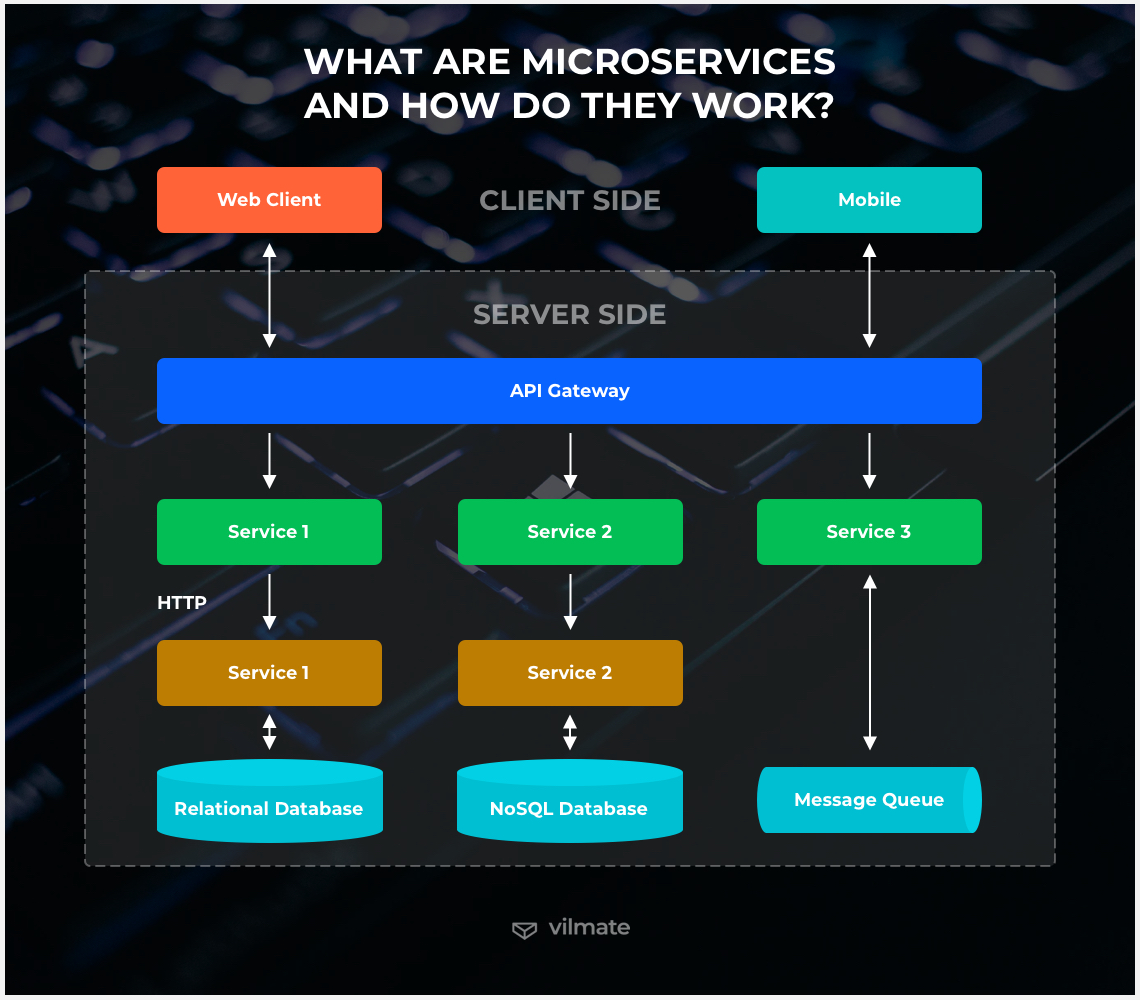
Microservices are an alternative approach to the monolithic architecture that has been the standard of software development for decades. Monolithic architectures have a long history of success and have been universally supported by many software vendors and industry experts. However, times change, and new technological developments emerge to prove more beneficial than what everybody seems to be used to.
In this article, we are going to dig into how microservices work, what makes them better than a monolithic application architecture, what flaws they may have, and how to deal with that. And last but not least – what companies have gone for the microservices architecture and never regretted it.
What are microservices and how do they work?
Microservices, or also known as a microservices architecture, are a modern software development technique and an architectural style applied to achieve business goals through decomposing an interdependent software system into smaller, more autonomous units. These modules work together and communicate with one another but are deployed independently. With the microservice architecture, developers can create separate modules that would work as a selection of individual services. Together, they also ensure the application can be highly performant while supporting its full-featured functionality.
Ideally, a microservice-based application should have multiple independent components – each responsible for a specific function – that are distributed, secured, and kept in sync via various communication channels. Each component should stay in touch with all other components in order to fully understand and support all network activities and future needs of the system. Therefore, it is a common practice to split one project team into smaller teams, each involved in the development of a single microservice.
When we talk about a monolithic application, the technology stack may be as varied, balanced, and complex as it is required to satisfy specific business needs on a particular project. However, even if the monolithic app follows service-oriented architecture, these services can grow with time to become globs supporting dozens of functionalities.
In turn, when developing a microservice-based app, the team will most probably need to prioritize product mentality over the project itself. This means the product must consist of microservices that should have few functionalities to support throughout the whole project’s existence.
For microservices to work harmoniously with one another, the development team has to set up a structure in which direct and fast communication is established. Therefore, from what has been said here, it follows that – no matter whether you’re developing a microservices-based app from scratch or converting an existing monolith – the basic technologies needed to build an application with a microservices-based architecture are going to be more or less the same:
REST API. In a general setup, inter-component communication between microservices must be established via a lightweight messaging mechanism. REST API can provide this simple API-based synchronous messaging solution to embed the connection between microservices in a distributed system. Implemented with HTTP request-response, it makes an app more resource-oriented so that each functionality is represented with a resource and corresponding operations carried out on top of that resource. REST/HTTP synchronous messaging allows developers also to use the following:
JSON and XML message formats
Swagger and RAML definition languages
Docker. Fundamentally, Docker is a container-based virtualization and infrastructure technology whose distributed nature gives developers greater control over resources and features. Moreover, Docker has multiple benefits for a microservice-based app. It simplifies app development, deployment, and maintenance through containerization. It is an excellent fit for a microservices architecture as it enables encasing the developed software in containers so that one container would support one service or functionality. Docker Machine, Docker composer, and Docker Swarm can then also be used to manage those containers in the most efficient and scalable way.
Gateways. With no business logic implemented on it, the gateway can serve as a lightweight dumb pipe for a transferred message. Thus, microservices get exposed through API gateways as through the entry points. And so, not only different APIs can be applied to different microservices, but also they become more lightweight. Besides, API gateways can, in some cases, enable service discovery. For instance, Kubernetes allows for server-side service discovery, in which API-GW is in a position to send requests determining the location of the microservice.
Decentralized data management. Decentralization is an essential part of a successful microservices implementation. Thus, each microservice must have its own private database so that no other microservice could access it. This makes microservices highly decoupled and lets developers choose the appropriate data management technique (SQL/NoSQL) for each separate microservice depending on what business logic stands behind it.
When to use the microservice architecture?
Using the microservices architectural style is something beyond splitting services in a monolith. Therefore, the number of cases, in which it is generally recommended to implement, is larger than it may seem first. For many, microservices are a new concept, and some may not understand upfront the innovation that they suggest. So, let us clarify and say that microservices are a good idea:
When it is imperative for the system components to be able to communicate with one another seamlessly.
When an application is growing more massive, and simply building more modules and moving them to production is not an option.
When a business has all the necessary resources to invest in the development of a microservice-based application in advance once the project starts, which also means hiring the right specialists.
When a business prioritizes the long-term benefits to the short-term positive outcome for the project, which is what a microservices architecture incurs.
When the application under development is going to be resource-consuming, with lots of traffic going to and fro.
Benefits of a microservices architecture
Many organizations, whose applications have been previously based on a monolithic architecture, are now moving them to microservices exactly because the advantages of a microservices architecture have already been proven and realized by other players on the global field.
The benefits of the microservices architecture include continuous delivery and deployment, better scalability, improved fault isolation, greater flexibility, smaller development teams, higher software testability, and improved maintainability.
1. Continuous delivery and deployment – This is a big plus, especially in the case of large, complex applications. Continuous delivery and deployment are two critical components of an effective software development process. And for microservices architectures, where apps work as suites of independently deployable services, they become particularly important. As the microservice architecture gives the project team the freedom to develop and deploy services separately from one another, the capabilities derived from continuous delivery and deployment help the team get any changes into production in a safe and sustainable manner. These practices are more easily implemented with the microservices-based than monolithic architecture. As a result, deliverable throughput and resource utilization are considerably improved.
2. Better scalability – Microservices are far more scalable than a monolith. Although different microservices in a system may have different resource requirements and performance limitations, compared to a monolith, they still are relatively small, so they are easier to scale and integrate with third-party services. And despite the fact that such ecosystems are usually large-scale and distributed, they are at the same time concurrent. Concurrency is a significant characteristic of a scalable application, and microservice ecosystems allow for that. This way, tasks are broken up into smaller sub-tasks and processed in parallel within the microservice architecture. As a result, they are executed much faster than if they were implemented in a monolithic application, which, in turn, enables and supports a scalable deployment pipeline.
3. Improved fault isolation – The canonical monolithic application has lots of inter-dependencies and is characterized by a vast scope. This makes connected parts of such an app less protected from unintended failures and other side effects. In a monolith, there are no barriers between different systems, which is not the case in a microservice-based app. The bottom line is that even bigger microservice-based applications can remain mostly unaffected when the failure occurs in a single module. The modular nature of this app architecture ensures the isolation and resilience of a failed microservice, which in turn prevents all possible failures from spreading and impacting other services.
4. Greater flexibility – The microservices architecture is organized in such a way so that companies can manage the development process according to their current priorities. This is why microservices is precisely what a business needs – they add flexibility to the project. First of all, there won’t be any long-term commitment to a certain technology stack or infrastructure. Since microservices are separate independent entities, a team can decide to develop them using whatever fits the specific requirements and is generally considered best for that particular service at the time. Second, all interactions between microservices can be handled with fluent APIs and stateless architectures, which means a more flexible deployment process. Finally, there is no direct dependence between teams. Each team is not only free to make their choices, but they are also able to adapt the architecture as and when necessary and bear the responsibility for the consequences.
5. Smaller development teams – Microservices are built by small, decentralized development teams, which makes them perfect for the agile methodology implementation. A business that chooses to design a microservices architecture for its application can facilitate smaller units to work on different aspects of the ecosystem. Each team will have a limited and focused business scope for a microservice they are going to build. Then, these teams will be less cumbersome to manage, and the agility in the development and delivery of services will be easier to meet. The only pre-condition is that microservices design ensures the independent development and deployment of the app functionalities. And importantly, a microservice that has considerably grown in size can and must be separated into multiple microservices. That will enable you to organize the development effort around a number of autonomous, independent teams.
6. Higher software testability – Loosely coupled services are tested independently, and thus application decomposition, so common in microservice ecosystems, can significantly increase the app testability. Although the process of testing and verification of microservice systems is far more complex and nuanced than the one of a traditional monolithic application, it can conform to the highest testability standards. An effective test strategy of a microservice-based application must take into account all the peculiarities of the architectural style. Then, if individual services are tested in isolation, and the overall system behavior is continually being verified, the testing coverage will be significantly increased.
7. Improved maintainability – One way or another, microservices are easier to understand and therefore transform and modify than the whole monolithic system. The microservice architecture allows for system-wide changes, such as new features in the platform, to be easily introduced and smoothly integrated with the entire application. Service discovery, integration, and management are simpler in microservices because they are separated. For this very reason, the maintainability of the app remains at its maximum, too – everything from code fixes to version upgrades will be limited to a single service.
Microservices implementation challenges
Due to its advantages, microservices are becoming a go-to approach for building applications. However, there are certain issues that add to the complexity of the implementation process. The top challenges that teams face during their transition to a microservices architecture and microservices implementation include the following:
Migrating the monolithic database to microservices. Best practices claim that once you decide to break the monolith into microservices, the monolithic database must be broken into parts, too. Otherwise, if multiple services remain tied to the same tables in the database, there is a risk that any change made in one service will result in cascading changes in other microservices. Then, the whole point of using microservices can be defeated.
Distributed systems are hard to handle. The distributed nature of microservices is both their advantage and the source of concern for developers. When building a workable distributed system, the team must be ready that such infrastructure communication will be more challenging to maintain. All the dependencies between microservices need to be dealt with in such a way that each service could communicate with another with minimal disruption.
Technology diversity and increased resource use. Each and every microservice team is free to decide what technologies to use for development and deployment. This results in great technological diversity within one project and makes microservices more difficult from a technical perspective than monoliths. So, for the things to run smoothly and without breakdowns, companies need to be sure they can at all times provide the necessary talent for ongoing operations and maintenance of each implemented service. Besides, that can result in higher infrastructure costs.
Increased DevOps complexity. A microservice ecosystem cannot do without an experienced and skilled DevOps engineer or even team. As we’ve already mentioned, the maintenance of microservices-based applications is complex. Not only developers have to put extra effort into the implementation of communicative mechanisms between the services, but also a high level of expertise is required to manage all these moving parts properly. This means that the development and operations must be supervised by highly skilled technical personnel as multiple programming environments, languages, and data stores are expected to be involved.
The risk of network security being compromised. Inter-service communication presents new security challenges that may be difficult to address using traditional means. A microservice-based app consists of multiple moving parts and thus is prone to security vulnerabilities. With microservices that normally utilize various APIs, there is an increased chance of the network being taken over with malicious intent. All in all, security and resilience must always be a concern when operating infrastructure of tens or even hundreds of microservices.
The Internet is full of success stories about how various industry leaders have migrated their infrastructures to microservices and managed to achieve new heights of scalability and performance due to this transition. Some of the companies that have a great deal to say about their positive experience of microservices adoption are:
Netflix
Uber
eBay
Amazon
PayPal
Netflix is particularly eloquent and candid about how they tackle this migration from monolithic to distributed services and what technologies they use on the way. They share details of the process on their Netflix Technology Blog.
Conclusion
The microservice architecture is not a brand new approach, but right now, it is gaining its momentum. In the coming years, microservices will become the new standard for software engineering. This will affect the entire industry, as it will allow continuous delivery and deployment, rapid and scalable development, improved flexibility, and higher software testability. Modular, highly performing, and easy to scale – microservice-based applications have the properties that are welcomed in agile and business-oriented environments. So, why not take advantage of this paradigm, which is only going to get better over time?
Here at Vilmate, we are already putting microservices best practices to use, and we are working on applications that implement and integrate with new-age microservices techniques. If you have a business idea, contact us, and maybe microservices’ benefits will help us shape it into reality and grow your business into something special!
Hanna is a content writer at Vilmate with a background in English philology and a genuine curiosity for all things tech. She covers topics at the intersection of design, development, and emerging technologies — from UX writing and voice interfaces to AR/VR and mobile apps.
Everyone agrees that a B2B website is a must. The real stress begins a few weeks into the project. Pricing logic turns out to be more complicated than expected. Approval chains don’t fit neatly into the chosen platform. ERP integration exposes missing fields. Someone suddenly asks how repeat orders will work for multi-department accounts. And […]
Building a marketplace like Amazon is an ambitious goal—but possible. Today, there are many successful marketplaces around the world. Each follows its path, shaped by the needs of local markets and user preferences. Amazon, for example, started as a regular online store. In 1995, it sold only books. Being one of the first companies to […]
Streaming services have witnessed a remarkable surge in popularity over the years. It has become increasingly rare to encounter individuals who are unfamiliar with giants like Netflix or Apple TV. The repertoire of prominent platforms catering to people’s entertainment needs continues to expand steadily. The question arises: what makes streaming services so appealing? In this […]
Cookies help us see what's working on this site and make it better. Your call on what we track.
Functional
Always active
The technical storage or access is strictly necessary for the legitimate purpose of enabling the use of a specific service explicitly requested by the subscriber or user, or for the sole purpose of carrying out the transmission of a communication over an electronic communications network.
Preferences
The technical storage or access is necessary for the legitimate purpose of storing preferences that are not requested by the subscriber or user.
Statistics
The technical storage or access that is used exclusively for statistical purposes.The technical storage or access that is used exclusively for anonymous statistical purposes. Without a subpoena, voluntary compliance on the part of your Internet Service Provider, or additional records from a third party, information stored or retrieved for this purpose alone cannot usually be used to identify you.
Marketing
The technical storage or access is required to create user profiles to send advertising, or to track the user on a website or across several websites for similar marketing purposes.