How Do Streaming Services Work And, Most Importantly, Make Money?
In this article
SHARE TO:
Streaming services have witnessed a remarkable surge in popularity over the years. It has become increasingly rare to encounter individuals who are unfamiliar with giants like Netflix or Apple TV. The repertoire of prominent platforms catering to people’s entertainment needs continues to expand steadily. The question arises: what makes streaming services so appealing? In this article, we will delve into this very topic.
Let’s discuss how streaming platforms develop and make a profit. And we will also speculate what awaits us in the not so distant future: will streaming services win over cable television, and what can they transform into?
TV vs. streaming services: who will win?
The year 2007 was truly remarkable in terms of revolutionary technologies. Steve Jobs unveiled the first touchscreen smartphone, while Google announced the new Android operating system. In the same year, Netflix, primarily focused on DVD rentals and celebrated their billionth sale. However, the demand for DVDs declined rapidly as more people started using the internet and preferred online streaming. As a result, Netflix announced the launch of its video streaming service.
Even in 2007, voices suggested that television would soon meet its demise. However, we can observe that this prediction didn’t come to fruition. Television still retains its popularity, although its demand is gradually declining. Will television cease to exist in the near future? It’s impossible to provide a definitive answer to this question. However, we can consider that television primarily appeals to the older generation. Consequently, as today’s youth ages, television might eventually lose its audience entirely.
In the meantime, the indicators of streaming services are evergrowing. A Forbes study has shown that 78% of US households are subscribed to at least one streaming platform. Moreover, 82 million people in the United States spend a minimum of $10 monthly on subscription payments.
Online platforms became especially popular during the COVID-19 pandemic, as many people were forced to stay home. During that time, so many individuals turned to online viewing that the government compelled Netflix and YouTube to reduce video quality to alleviate network strain.
Ofcom has reported a 32% increase in viewership in the UK in 2019. People have also started watching television broadcasts for another 31 minutes to seek fresh news on the pandemic. The primary reason television might fade away is the decreasing interest from sponsors. Television networks must air high-quality products to recoup their investments. However, creating high-quality content necessitates significant financial resources as consumer expectations continue to rise.
From this, we can conclude that streaming services will emerge victorious. But what factors can we attribute to the remarkable popularity of these platforms?
Why do young people prefer streaming services?
Streaming services have both advantages and disadvantages compared to cable television. Let’s first discuss the benefits that streaming platforms provide.
1. Flexibility and convenience
Streaming services allow you to consume content conveniently and from any internet-connected device. You can watch your favorite movies, shows, or sports events on your television, computer, smartphone, or tablet. Traditional broadcasting is often limited to TV viewing and requires additional equipment such as cables or satellite antennas.
If you have a subscription to a streaming service, you no longer have to worry about missing an episode of your favorite series. Furthermore, television broadcasting requires you to allocate a specific time to watch the desired content. On a streaming platform, you can pause a movie at any point and resume watching it whenever you want.
2. Personalized content
Streaming services offer recommendations based on your preferences and viewing habits. They utilize machine learning algorithms to suggest content that best aligns with your interests, enabling you to discover new shows and movies you might not have found otherwise.
3. Extensive content selection
Streaming services typically offer a vast library of content, encompassing movies, series, original shows, sports broadcasts, and more. You can explore various genres and styles, discovering content that resonates with your preferences. If you missed the opportunity to watch a new film at the cinema, you can rest assured that you’ll find it on one of the streaming platforms. In contrast, traditional television may not always cater to your specific content preferences.
Moreover, television rarely features content from other countries. Streaming services present the best offerings from around the world. Renowned Korean ‘Squid Game’ and Spanish ‘Money Heist’ have gained worldwide popularity through Netflix. These projects would have faced challenges in achieving such widespread recognition solely through television.
4. Absence of advertisements or reduced ad frequency
The traditional form of advertising we are accustomed to seeing on TV is absent from streaming services.
Specific streaming platforms provide ad-free paid subscriptions. Even in services that include advertisements, the frequency of ad breaks is often lower than that of cable television. A streaming service enables you to enjoy content without frequent interruptions.
On streaming services, you typically pay for a subscription that liberates you from the constant intrusion of commercials.
5. Absence of censorship
Unlike television, which is often subjected to various forms of regulation and censorship by governments or broadcasting companies, streaming services enjoy greater freedom in content presentation. Therefore, you can expect to encounter uncensored language, unrestricted jokes, sensitive content, and nudity in the content offered by streaming platforms.
Drawbacks of streaming services
Like any other technology, streaming services have their drawbacks. It’s important to mention them to make an accurate assessment.
1. The need to make choices
Perhaps the need to make choices independently is one of the main reasons why traditional television hasn’t been forgotten. When you turn on the TV, you can mindlessly flip through channels until you see the content you want to watch.
Streaming services often pose the question: What would we like to see? And it isn’t always easy to answer that question. The problem of choice is a popular topic of discussion in psychology, and it can even apply to seemingly simple decisions like selecting content to watch.
Furthermore, people often use television as background noise. They turn on a channel to feel more at ease while doing household chores or work without getting distracted. Finding a continuous stream of monotonous content on online platforms is often difficult.
2. Dependency on Internet connection
Streaming services rely on a stable and sufficiently fast internet connection.
If you have a low internet speed or an unstable connection, it can lead to problems during streaming. Videos may buffer, resulting in delays and interruptions in playback. The video quality may also be compromised to accommodate the low internet speed. This drawback can be frustrating for some users.
3. Content restriction in specific regions
Some movies, TV shows, or programs may not be available for viewing in your country or region. This inconvenience is due to content rights and licensing restrictions varying between countries.
Streaming service providers enter agreements with distributors and rights holders to obtain the rights to stream content. However, these agreements often come with limitations and may be geographically restricted.
To bypass these restrictions, users can utilize a Virtual Private Network (VPN) to change their location and gain access to content that would otherwise be unavailable in their region. However, it should be noted that using a VPN may violate the terms of service.
4. Additional expenses for subscriptions
While some streaming services offer free versions with limited functionality and advertisements, many require a paid subscription to access the full ad-free content. If you wish to use multiple streaming services, this can lead to accumulating additional costs.
5. Lack of real-time and relevance
Unlike television broadcasts, where you can watch the news, sports events, and other programs in real-time, streaming services typically have a certain delay in updating their content. It can be challenging for those who want to stay current with the latest events or sports broadcasts.
Sports, in particular, remain one of the key reasons why traditional television is still in demand. Nevertheless, streaming services are actively working to address this issue.
In conclusion, most of the drawbacks of streaming services are either insignificant or companies have already started addressing them. The abundance of undeniable advantages is compelling streaming services to attract increasing numbers of users. Let’s discuss some of the most successful cases to understand whether they can easily compete in the market.
Top 3 streaming services
It isn’t easy to pinpoint the absolute best and most in-demand streaming service in the world. Ratings of services vary significantly across different countries. Moreover, certain countries have platforms operating exclusively within their borders.
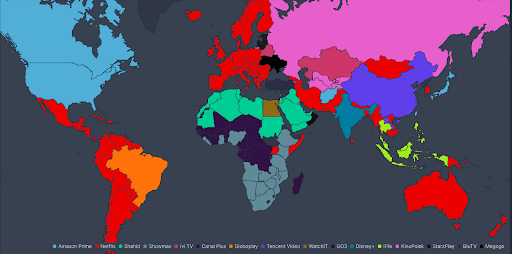
By examining the map below, you will discover intriguing statistics.
Nearly all of Europe favors Netflix for their viewing needs
Americans lean towards Amazon Prime
Local platforms like Canal Plus and Shahid enjoy popularity in African countries
Such diversity is easily explained:
One streaming service cannot provide content translations for all languages.
Each country produces a large amount of its content, and a single platform cannot accommodate all shows. Some projects are only interesting to local viewers.
The subscription cost, for example, for Netflix, may be acceptable for residents of the United Kingdom, but it can be too expensive for residents of other countries.
Several additional nuances can make a streaming service popular with a specific audience. Let’s consider a few examples.
The Apple TV service is poorly adapted for other platforms and cannot achieve global popularity. However, among Apple device owners, this platform often takes priority, especially since the subscription to the service is available in the AppleOne bundle, which grants access to TV, music, gaming content, and cloud storage.
The Disney Plus service is considered family-friendly but not universal. It offers entertaining content for the whole family, but some popular projects may not find a place on this platform. It’s also popular among Marvel fans and Star Wars universe enthusiasts.
The Paramount Plus service is popular among users who enjoy watching sports broadcasts.
The HBO Max service is known as a platform for critically acclaimed content. The Max subscription also provides access to Discovery Plus projects for documentary film lovers and Adult Swim content. Fans of classic TV shows, such as Friends, also choose this service. Also, Harry Potter fans subscribe to Max in anticipation of the series’ new reinterpretation.
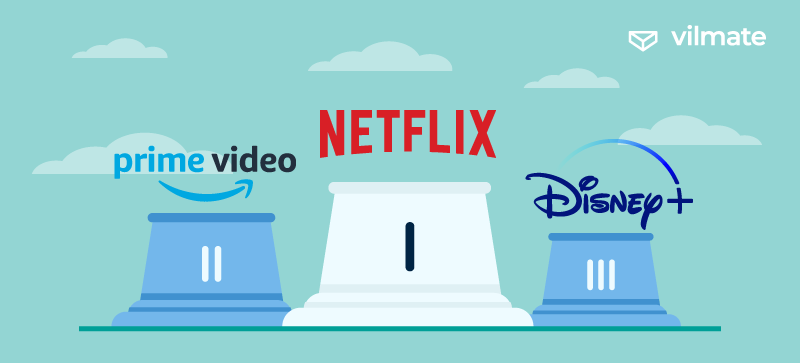
In general, the choice of a streaming service heavily depends on personal taste preferences and sometimes even the devices you own. However, we will still attempt to highlight the top 3 streaming services, taking the main criterion into account: the number of subscribers.
1. Netflix
Naturally, expecting another leader of the streaming services to top the list would be foolish. After all, it was Netflix that pioneered the world of streaming.
Let’s take a look at approximate figures.
Number of subscribers: 232,500,000+
Amount of content: around 3,700+ movies and 3,500+ TV show seasons.
Most popular shows: Squid Game, Stranger Things, Money Heist.
2. Amazon Prime
Amazon Prime is a popular streaming service in the USA, Canada, and Japan. Therefore, the service has secured the second spot on our list.
Number of subscribers: 200,000,000+
Amount of content: 26,300+ movies and 2,700+ TV shows.
Most popular shows: Reacher, Carnival Row, The Marvelous Mrs. Maisel.
3. Disney Plus
As mentioned, Disney Plus is known for releasing Marvel movies and Star Wars episodes. It’s no wonder that this service has secured the third spot in the ranking of the best streaming platforms.
Number of subscribers: 157,800,000+
Amount of content: 500+ movies and 15,000+ TV show episodes.
Most popular shows: The Mandalorian, The Simpsons, Loki, Star Wars.
Just imagine these numbers! The incredible success of streaming services might make you think competing with them is impossible. However, that’s not the case. As we have already mentioned, users can choose a platform based on multiple criteria, and it’s simply a matter of understanding which audience to cater to.
Are you interested in creating your streaming service? If so, let’s talk about how streaming services work in principle.
How do streaming services work?
Streaming services involve several components and processes to deliver content to users. Here’s a high-level overview of how streaming works:
Content Storage and Hosting: Streaming services store their content on servers or cloud-based storage platforms. These servers host the media files, such as movies, TV shows, or music, that users can access and stream.
Content-Encoding and Compression: Before streaming, the media files are encoded and compressed into various formats suitable for online streaming. This process reduces the file size while maintaining an acceptable level of quality. Different streaming protocols and codecs encode the content, such as H.264 or H.265 for video.
Content Delivery Network (CDN): To efficiently deliver content to users, streaming services often utilize Content Delivery Networks. CDNs consist of a network of servers distributed across different geographic locations. These servers store copies of the content and help reduce latency by delivering the content from a server closest to the user’s location.
User Devices: Users access streaming services through various devices, including smartphones, tablets, smart TVs, gaming consoles, and computers. These devices need an internet connection and a compatible streaming application or web browser to access and stream content.
Internet Traffic: When a user selects and starts streaming content, the streaming service sends the requested media data in small packets over the internet. These packets travel through the user’s internet service provider (ISP) infrastructure to reach the user’s device.
Adaptive Bitrate Streaming: Streaming services often employ adaptive bitrate streaming techniques. It means that the quality and bitrate of the streamed media can dynamically adjust based on the user’s internet connection speed and device capabilities. It ensures a smooth playback experience by adapting to changing network conditions.
Content Delivery Algorithms: Streaming services use sophisticated algorithms to determine the most optimal way to deliver content to users. These algorithms consider available bandwidth, device capabilities, network conditions, and user preferences to provide the best streaming experience.
User Experience and Interface: Streaming services provide user-friendly interfaces where users can browse and search for content, create playlists, and manage their preferences. Recommendations and personalized content suggestions based on viewing history and user preferences are often incorporated to enhance the user experience.
Overall, streaming services rely on a combination of storage, encoding, content delivery networks, internet infrastructure, user devices, and algorithms to deliver a seamless streaming experience to users across a variety of devices.
How do streaming services make money?
Streaming services can employ several strategies to make money:
Paid Subscriptions: Most services offer delivered subscriptions to their users. Users pay a monthly or annual fee to gain access to the content. Companies may offer different subscription tiers, providing limited or enhanced access.
Advertising: Some services incorporate advertisements that play before, during, or after video playback. In some cases, users can purchase a subscription that removes ads.
Product placement: As a prime example, we can point to Apple’s prowess in product placement. The company showcases its own devices in the hands of beloved characters. For example, in Apple’s top-rated series ‘Ted Lasso’, you can spot around 300 iPhones, 40 pairs of AirPods, and 120 MacBooks across 74 episodes. Other companies’ products, such as Nike and Doritos, also appear in Apple originals. Additionally, the company charges users for subscriptions.
In summary, streaming services generate revenue through paid subscriptions, advertising, and native advertising by leveraging their content and user base.
Streaming services can establish partnerships with large and small businesses to attract a more extensive subscriber base. For instance, Netflix collaborates with stand-up comedians, YouTubers, and film producers to bring more popular content to their platforms. The most profitable ventures are original shows that, if they gain popularity, leave users with no choice but to subscribe to a specific service.
Streaming services continuously evolve and explore new strategies to become even more successful. What lies ahead for them in the future?
The future of streaming services
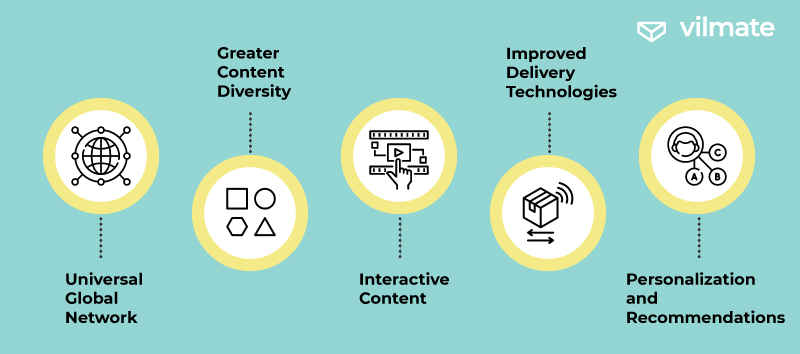
The future of streaming services promises development and evolution, but it’s challenging to predict precise scenarios and directions of growth. Nevertheless, there are several trends and potential strategies that could shape the future of streaming:
Universal Global Network: With the development of internet infrastructure and increased accessibility to high-speed internet, there may be a universal global network of streaming services. It would allow users from different countries and regions to access a shared content library without restrictions based on geographical location or licensing differences.
Greater Content Diversity: Streaming services will strive to offer even more diverse content, ranging from original series and movies to sports events, live broadcasts, news, and music concerts. The advancement of technologies such as virtual and augmented reality may also introduce new formats and possibilities in streaming content.
Interactive Content: The future of streaming may include more interactive content, where viewers can engage with the content and actively participate in the viewing experience. Interactive content could involve choosing alternative endings, influencing the storyline, participating in reality shows, or virtual interactive events. Such content already exists. Netflix released an interactive episode of the series ‘Black Mirror’ called ‘Bandersnatch’, where users could make choices for the character’s actions and explore multiple endings.
Improved Delivery Technologies: Advancements in data transmission technologies, such as faster internet speeds, enhanced video compression, better image and sound quality, and improved adaptive streaming, will help provide a better streaming experience for users.
Personalization and Recommendations: In the future, streaming services may become more intelligent and capable of offering more precise recommendations and personalized content based on each user’s preferences and interests.
And this list is far from exhaustive. We don’t yet know how artificial intelligence will impact content generation or where technology will continue to evolve. However, it can be said that streaming services will continue to grow and develop, becoming more accessible, and eventually, they may overshadow traditional broadcasting.
If you want to create a streaming service, the Vilmate team can help you bring your idea to life. There are numerous opportunities to establish a successful platform. A unique audience will always exist and you just have to find the right niche. As the saying goes, people will always want ‘bread and circuses.’
Anastasiia is a content writer at Vilmate with a focus on e-commerce, AI, and emerging tech trends. She turns complex topics into clear, practical reads — whether it’s comparing CMS platforms or unpacking how AI is reshaping online retail.
Everyone agrees that a B2B website is a must. The real stress begins a few weeks into the project. Pricing logic turns out to be more complicated than expected. Approval chains don’t fit neatly into the chosen platform. ERP integration exposes missing fields. Someone suddenly asks how repeat orders will work for multi-department accounts. And […]
Building a marketplace like Amazon is an ambitious goal—but possible. Today, there are many successful marketplaces around the world. Each follows its path, shaped by the needs of local markets and user preferences. Amazon, for example, started as a regular online store. In 1995, it sold only books. Being one of the first companies to […]
Since online presence has become vital in the 21st century, the website performance may influence the core processes of business endeavors, brand perception, conversion rates, and users’ satisfactory level. In this text, we’ll discuss why website performance is important for everyone, how it’s measured, and what one can do to improve and maintain web performance […]
Cookies help us see what's working on this site and make it better. Your call on what we track.
Functional
Always active
The technical storage or access is strictly necessary for the legitimate purpose of enabling the use of a specific service explicitly requested by the subscriber or user, or for the sole purpose of carrying out the transmission of a communication over an electronic communications network.
Preferences
The technical storage or access is necessary for the legitimate purpose of storing preferences that are not requested by the subscriber or user.
Statistics
The technical storage or access that is used exclusively for statistical purposes.The technical storage or access that is used exclusively for anonymous statistical purposes. Without a subpoena, voluntary compliance on the part of your Internet Service Provider, or additional records from a third party, information stored or retrieved for this purpose alone cannot usually be used to identify you.
Marketing
The technical storage or access is required to create user profiles to send advertising, or to track the user on a website or across several websites for similar marketing purposes.