Converting your site visitors into leads is the first step towards creating lasting and fruitful business relationships with customers. On the other hand, when it comes to building relationships between your company and a potential client, there is one thing that is often left unaddressed. This thing is a landing page. Time and again, it has been proved that, before launching your marketing campaign, what you need to do is create a landing page. Why is it so?
A landing page is a popular digital marketing buzzword – but for good reason. Do not be quick to judge landing pages from the nasty way marketers tend to use them. They are the core of an inbound marketer’s lead generation efforts, so their importance for business cannot be by any means diminished.
If you regularly surf the web, chances are you visit landing pages all the time, maybe even without knowing it.
Yet, what does a landing page do? Why are landing pages important? Why do you need one? In this article, we will give you the answers to these and other questions that usually arise when it comes to trying to understand landing pages.
Get ready to learn everything about landing pages, and let’s get started!
What is a landing page?
A landing page is a web page meant to capture the site visitors’ contact information in exchange for an offer through a so-called lead-capture form. The purpose of a landing page is to start converting anonymous visitors into qualified leads. Also, the landing page definition suggests that the page must include a call to action, such as:
Downloading an eBook
Subscribing to the newsletter
Registering for the conference or webinar
A landing page means a lot for business development. Despite the fact that the copy there should be beautifully written and the page itself should be pleasant to look at, it must serve a utilitarian purpose of lead generation in the first place. This page has objectives and KPIs, its usefulness can be measured and calculated.
The landing page can be part of an existing multi-page site, or it can be one of those landing pages without a website. Remarkably, in the latter case, it is a standalone web page that has a separate unique URL.
Users get to – or “land” on – the landing page when clicking through the contextual, banner, or targeted ads, an email newsletter, a search ad, or other digital locations. Each of these “landings” is considered part of an advertising campaign to a target audience. A landing page’s primary goal is to turn a visitor into a lead – someone interested in buying your goods or services or an actual buyer in case this visitor immediately takes the required action on the site and clicks a button.
As a rule, a landing page requires a visitor to complete only one action in order to not force them to make a choice. The more options you have, the more difficult it is to decide. That is why knowledgeable marketers do not put their leads at stake and offer one thing – let’s say an eBook – in exchange for their contact information.
There are several landing page hosting and integration options available on the market. Therefore, it won’t be too much of a problem to set up a landing page. What appears to be more controversial is the landing page structure: how different a landing page actually is from a regular website, what building blocks it must be formed from, and how to arrange these segments so that the page would be beneficial for you.
A landing page vs. website homepage
One of the biggest rookie mistakes a marketer can make is to send traffic from an ad to a website homepage, expecting these visitors to convert immediately.
Let’s now make it clear how a landing page differs from a homepage and find out if you need a website for a landing page, whether or not you can have a landing page without a website, and what landing pages vs. homepages are used for.
The main difference is that your website isn’t designed to convert, but your landing page is. That’s how landing pages work. A website’s homepage generally provides an overview of the essential aspects of your business, like what you do and what makes your business unique. Yet, if the goal you are pursuing is more specific and short-term (e.g., click-through or lead generation,) then a landing page is a better marketing channel for you, and here’s why.
Clearer design: CTA buttons are more difficult to ignore on a landing page. Before a prospect decides to take targeted action, they can spend too much time browsing a regular website. Then they would read, look, compare, choose and eventually just leave. This does not mean that your product or service does not suit them. More often than not, people just need to be guided – they need some prompt that would help them make a choice. Landing pages are excellent at this particular job, and in no small part so due to CTA buttons and lead forms that are always in sight.
More links: Calls to action can appear in the button text fields and anywhere else on a landing page. If a visitor clicks on the “Learn more” button, this does not always mean that they want to read more detailed factual information about an offered product or service. Chances are they need some more convincing reasons to take targeted action. So, when directed to a regular website, a user should navigate to a product or service page to look through the description. Alternatively, on a landing page, you can list all the benefits in as much detail as possible to turn cold leads into hot ones and convert them into buyers.
A different purpose: Landing pages shorten the conversion path. Regular websites and online stores are characterized by a complex structure and lots of internal links. It tends to distract the user from the original goal they have pursued visiting the site and therefore makes the conversion impossible. Although it is still true that time spent on a website is important for its ranking and SEO, your goal is to generate leads and sell your goods or services to them. One of the most significant benefits of landing pages is that they do not let the user get lost – all essential information is concentrated on one page, so if the decision is made, it won’t take extra effort for the user to carry out this decision.
More room for gimmicks: The landing page prevents the user from simply leaving the page. All marketers understand that letting the visitor leave the page without receiving their contact information is a failure. Yet, only professionals really know how to create landing pages that actually do that. All kinds of gimmicks come in handy when the purpose is clear. For instance, visitors can be prompted to click on a pop-up window announcing a promotion and counting down the time left before the promotion expires. This feeling of urgency can make people want to buy, order, or apply for an offer more while a discount is still in effect.
Naturally, all these factors may contribute to landing pages’ overall invasiveness, but more often than not, it all makes them far more effective than regular website homepages. Statistically, landing pages convert at least ten times more visitors into leads than traditional websites. That said, the results will vary depending on the landing page’s quality, but the positive trend remains unchanged.
Now, suppose landing pages are created for the visitor to take one targeted action. Let’s try to figure out how a landing page can be useful to you and why you should care.
Does your business need a landing page? Most probably, it does. Here’s why:
Landing pages and designed to be focused and free of distractions
They speak a specific audience’s language
A landing page shows encouragement and promises that you will walk together with your prospects in their transformation journey
They direct all of the visitor’s attention to the offer, not to the company, personality, or the website itself
Landing pages are neither intimidating nor pushy, which makes prospects like you
They show how you will help prospects meet their aspirational identity
They can collect very specific information about your visitors
There is always some kind of a thank-you to the users for their interest and involvement
A landing page is a valuable online marketing channel per se, but it also can help your prospects access other marketing channels
The way information is presented has a significant impact on how it is perceived by the audience. The logic, structure, text, and images all play an important role in converting leads. Therefore, how these components will be designed and arranged is always thought over thoroughly when a landing page is created. So, if you really want to grow your customer base exponentially and enjoy all of the above benefits of landing pages, you definitely need one.
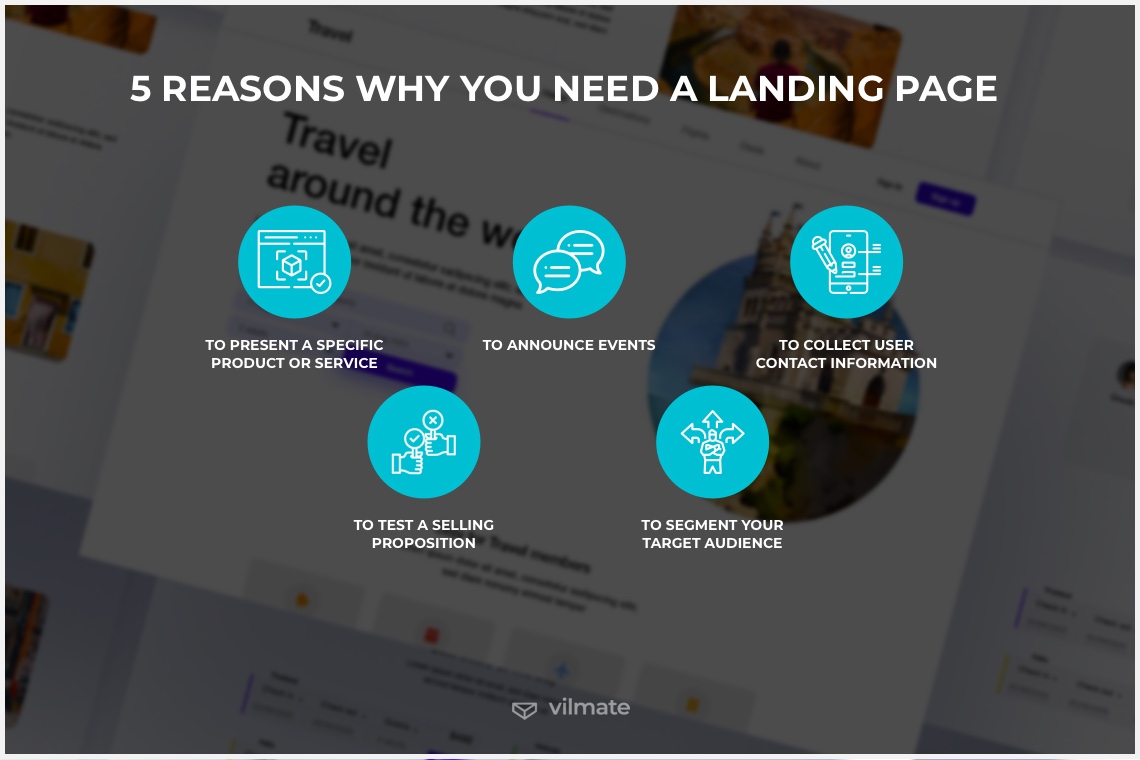
The benefits of a landing page for business are impossible to disregard. However, the question that remains is when and how to use a landing page in order to exploit its advantages to the fullest. It is not enough to create a landing page – you need to do it strategically. Without your complete understanding of what your landing page will be used for, it is unlikely to be of much help. This awareness will be instrumental in perfecting your landing page strategy later on. So, with no further ado, let’s take a look at the top 5 most popular landing page use cases.
1. You need a landing page to present a specific product or service.
Suppose you have a website. What information does it present? Chances are, it’s structured in a standard way and consists of the same set of sections: about us, benefits, catalog or portfolio, reviews or testimonials, blog, news, and promotions.
Despite the structure recognition, once a user lands on your website, it may still be challenging for them to find among this variety what you really want to offer or sell them. It is an option to add a banner prompting them to go to the page they have actually come to visit, but there is always a risk that they won’t notice it.
In order to avoid losing an interested visitor, you need to make them land on a targeted page. People will care about you only if you prove that you truly care about them. The structure, copy, and design you use for your landing page can show that. That is why a landing page is often created for a specific product or service.
It works as follows. First, you announce your marketing campaign launch, and then you start sending prospects to landing pages or using ads to convert leads. As a result, users do not get distracted by unnecessary information and finally take targeted action.
This is what most successful companies do when they present new products – they create a separate landing page within their website that instantly grabs all the users’ attention.
Landing pages are great for selling out your next event – be it a conference, seminar, webinar, talk, presentation, product launch party, leadership recognition ceremony, etc. Even if you have a fully functional website, a landing page will help make a proper announcement.
With that, an event marketing plan should introduce the possibility for users to visit an event’s landing page to learn more about it and book or buy tickets if needed. This is achieved in three ways:
On your company website: Consider including consistent calls to action all over your company website, prompting users to visit the event website. By following those links and after clicking on the corresponding CTA buttons, users would be taken straight to a landing page where they could register for an event, book tickets, etc. However, be sure to make a clear value proposition for visitors to get interested in what’s coming.
Via paid ads and social media: It is also a good idea to launch paid search ads and paid / organic social ads to announce your event. The thing to remember here is that you should choose the ad platform with due regard to what industry your business operates in. For instance, if the event you are promoting is business-to-business, then you’d better opt for LinkedIn as your primary ad platform.
As part of an email campaign: An email campaign can be launched to provide targeted sneak previews of what to expect from the upcoming event. Also, do not forget to add links to the event page so that addresses could get more in-detail information. And finally, sending event reminders to those who have already registered for the event and emailing invites to buy tickets to those who have not done that yet will make your event marketing strategy more complete and successful.
Using a landing page to announce events gives you a chance to track your users on each specific channel, attract more people and avoid overloading the sales platform – your company website – with announcements. Moreover, with the help of a landing page, you can present the event in the most favorable light, coming up with and implementing out-of-the-box solutions.
3. You need a landing page to collect user contact information.
Another reason to create a landing page is to capture users’ contact details. At some point, you may find yourself in a position where the existing contact database has not that many people left to reach out to. Sooner or later, this happens to almost every business. Therefore, one shouldn’t underestimate the risk. The good news is that with a landing page, this is not even a problem.
Besides helping you keep your leads warm, a landing page is an excellent tool for collecting users’ contact data. How to get that information? You should simply place a contact form on your landing page. It must be easy to notice – you’d better consider placing several contact forms on one page, say 3, to make it impossible for visitors to overlook the form.
4. You need a landing page to test a selling proposition.
Your unique selling proposition must stand out on your landing page. The more outstanding and convincing it is, the more visitors you will convert. But how can you be sure that your selling proposition is really like that? One word – testing.
The systematic testing of ideas is what enables businesses to perform better. To make your sales productivity increase and optimize your resources, you need to test everything and anything. Whether you are beginning from scratch or already have a page that you want to change, A/B testing won’t hurt your landing page marketing campaign anyway. Design several landing page variants and start assigning traffic to each of the page variants. Then, as a result of a testing phase, you will mitigate the risk of a complete failure and get the landing page or a web page that will sell best.
5. You need a landing page for the target audience segmentation.
Suppose you create a social media ad. Yet, you don’t want everyone to see it because, first of all, it costs money and what is more, you want to be sure that this particular ad will serve only your target audience.
It works the same way with landing pages. Chances are you want to be certain that a user that visits one of your landing pages does land on the right targeted page, the one that will speak to this particular user and allow connecting instantly. The target audience segmentation will help you achieve that. For example, let’s imagine your website performs a purely selling function, but this time, you need to hire a new qualified employee. You can create a new vacancy in the careers section on the company website. Or you can create a targeted landing page – maybe under a different domain name – that will help you find the right people.
Conclusion
The more landing pages you have, the better! Each of them will give you an extra opportunity to convert your site visitors into leads and thus make your business more successful and profitable. Performing very specific tasks – other than your regular website – landing pages can actually strengthen your digital presence as such.
Creating a landing page usually doesn’t take much time or money, while the investment you make is very likely to be recouped in the not-so-distant future. If you need a landing page that would be professionally designed and developed by a team of seasoned software engineers, do not hesitate to reach out to us using the contact form below! Let’s get talking!
AUTHOR BIO
Hanna Skryl
Web Content Writer
Hanna is a content writer at Vilmate with a background in English philology and a genuine curiosity for all things tech. She covers topics at the intersection of design, development, and emerging technologies — from UX writing and voice interfaces to AR/VR and mobile apps.
Everyone agrees that a B2B website is a must. The real stress begins a few weeks into the project. Pricing logic turns out to be more complicated than expected. Approval chains don’t fit neatly into the chosen platform. ERP integration exposes missing fields. Someone suddenly asks how repeat orders will work for multi-department accounts. And […]
Building a marketplace like Amazon is an ambitious goal—but possible. Today, there are many successful marketplaces around the world. Each follows its path, shaped by the needs of local markets and user preferences. Amazon, for example, started as a regular online store. In 1995, it sold only books. Being one of the first companies to […]
Streaming services have witnessed a remarkable surge in popularity over the years. It has become increasingly rare to encounter individuals who are unfamiliar with giants like Netflix or Apple TV. The repertoire of prominent platforms catering to people’s entertainment needs continues to expand steadily. The question arises: what makes streaming services so appealing? In this […]
Cookies help us see what's working on this site and make it better. Your call on what we track.
Functional
Always active
The technical storage or access is strictly necessary for the legitimate purpose of enabling the use of a specific service explicitly requested by the subscriber or user, or for the sole purpose of carrying out the transmission of a communication over an electronic communications network.
Preferences
The technical storage or access is necessary for the legitimate purpose of storing preferences that are not requested by the subscriber or user.
Statistics
The technical storage or access that is used exclusively for statistical purposes.The technical storage or access that is used exclusively for anonymous statistical purposes. Without a subpoena, voluntary compliance on the part of your Internet Service Provider, or additional records from a third party, information stored or retrieved for this purpose alone cannot usually be used to identify you.
Marketing
The technical storage or access is required to create user profiles to send advertising, or to track the user on a website or across several websites for similar marketing purposes.