Brands like Nike, Amazon, and Tesla often appear in the lists of companies that use headless commerce. Huge brands, huge results, headless setup—seems like an example to follow. Naturally, the temptation is to copy the homework and wait for the revenue to copy itself, too. It sounds efficient and suspiciously close to how bad architecture decisions begin.
In the real world, headless commerce architecture works when it fits your scale, channels, team, and growth plans. Otherwise, it can bring extra costs, more systems to maintain, and a launch roadmap that starts looking like a Marvel timeline.
So the real question is not “Who uses headless?” It is “Why did they choose it?”
In this article, we’ll look at when headless commerce architecture makes sense, when it may be too much, how headless vs monolithic setups compare, and which use cases justify the move.
When to say “YES” to headless commerce architecture
The benefits of headless architecture emerge when your team needs greater control over how the storefront looks, performs, evolves, and integrates with the rest of your commerce stack. So, if your brand needs to sell beyond standard storefronts, templates, and customer journeys, headless is a good fit. Let’s translate it into specific business cases.
If you sell across multiple channels (or plan to)
Headless starts to make sense when customers move across several touchpoints: a combination of social media, mobile app, marketplace, customer portal, and in-store experience.
A standard storefront can cover the basics. Add more channels, and each one brings its own layout, data, and checkout needs. Somewhere around the third workaround, a developer usually starts staring silently into the distance.
With a headless commerce architecture, you get a unified backend for all of the above, helping you:
- Keep product, inventory, pricing, cart, and order data consistent.
- Adapt content and checkout flows by channel.
- Test new touchpoints without rebuilding the whole setup.
- Reduce platform-level compromises as the channel mix grows.
For omnichannel brands, this is one of the clearest benefits of headless architecture.
If your current platform limits design and development
Some stores outgrow their platform visually before they outgrow it operationally. The backend still works, but the storefront is starting to resist every custom idea. Maybe you need a product configurator, richer editorial pages, or unusual category logic. In a monolithic setup, these changes often become workarounds with suspiciously large estimates.
Headless commerce architecture gives the frontend its own space. Designers get more freedom over the customer experience, and developers can build custom interfaces without dragging core commerce logic into every layout decision.
If you need better performance, SEO, and conversion potential
Performance often brings headless into the conversation when the storefront starts holding growth back. With a headless commerce architecture, teams gain greater control over frontend rendering, page speed, Core Web Vitals, and SEO-critical content.
Static generation, server-side rendering, and cleaner frontend logic can help product and category pages load faster and feel smoother. Headless still needs clean implementation, but if performance limits growth, it gives your team better tools to fix it.
If you’re scaling to enterprise volume or international markets
Growth adds layers. At some point, the storefront has to support a multitude of components, functionalities, and decorations:
- Larger catalogs.
- Higher traffic.
- Multiple regions.
- Multiple languages.
- Multiple currencies.
- Local tax rules.
- Local shipping options.
- Different customer groups.
- B2C and B2B experiences.
Enterprise headless commerce is useful when a single backend needs to support multiple storefronts, markets, or brands. Each region can have its own content, pricing logic, and frontend experience, while core commerce data stays connected.
When to say “NO” to headless commerce architecture
A fair look at headless commerce pros and cons should include the less exciting parts, too: development resources, maintenance, launch timelines, and the actual size of the business problem. And in some cases, refusing to replatform to or build with headless will be a smarter option.
If your store is still simple
One starts to experience the benefits of headless commerce when it comes to a certain business scale. If the store runs on one main channel and the buying journey is predictable, a monolithic setup will be a more rational choice.
Headless can wait if:
- Your catalog uses simple product logic.
- Your checkout flow is standard.
- Your content needs are easily covered with built-in CMS tools.
- Your integrations are limited and stable.
- Your team needs speed more than architectural flexibility.
At this stage, headless commerce architecture may add cost and maintenance earlier than the business can justify.
If you do not have the development resources to support it
Headless needs people who can own it after launch. Frontend, backend, APIs, hosting, testing, monitoring, releases—all these eventually become someone’s task list.
A weak technical setup can turn routine storefront updates into technical dependencies. This is one of the tricky parts of headless commerce pros and cons: greater flexibility also means greater responsibility for development and maintenance.
But a lack of internal resources does not always close the door. If the business case is strong, the missing development capacity can be covered with the right partner. Yes, that is a small wink from our side if you want to discuss headless in more detail.
If speed to launch matters more than long-term flexibility
Headless commerce architecture usually needs more decisions before launch: frontend framework, hosting, APIs, CMS, integrations, deployment flow, testing, and ownership. Useful decisions, sure. Also, quite a few decisions.
If the goal is to launch quickly, validate demand, or get a simple store live with minimal technical setup, a monolithic platform may be the better choice—at least for now.
Headless vs monolithic: which setup fits your store?
Decision-making experts often recommend putting options side by side before choosing. So we did the responsible thing and made the table for you. A clear headless vs monolithic comparison helps show which setup fits the business problem, team, and growth stage.
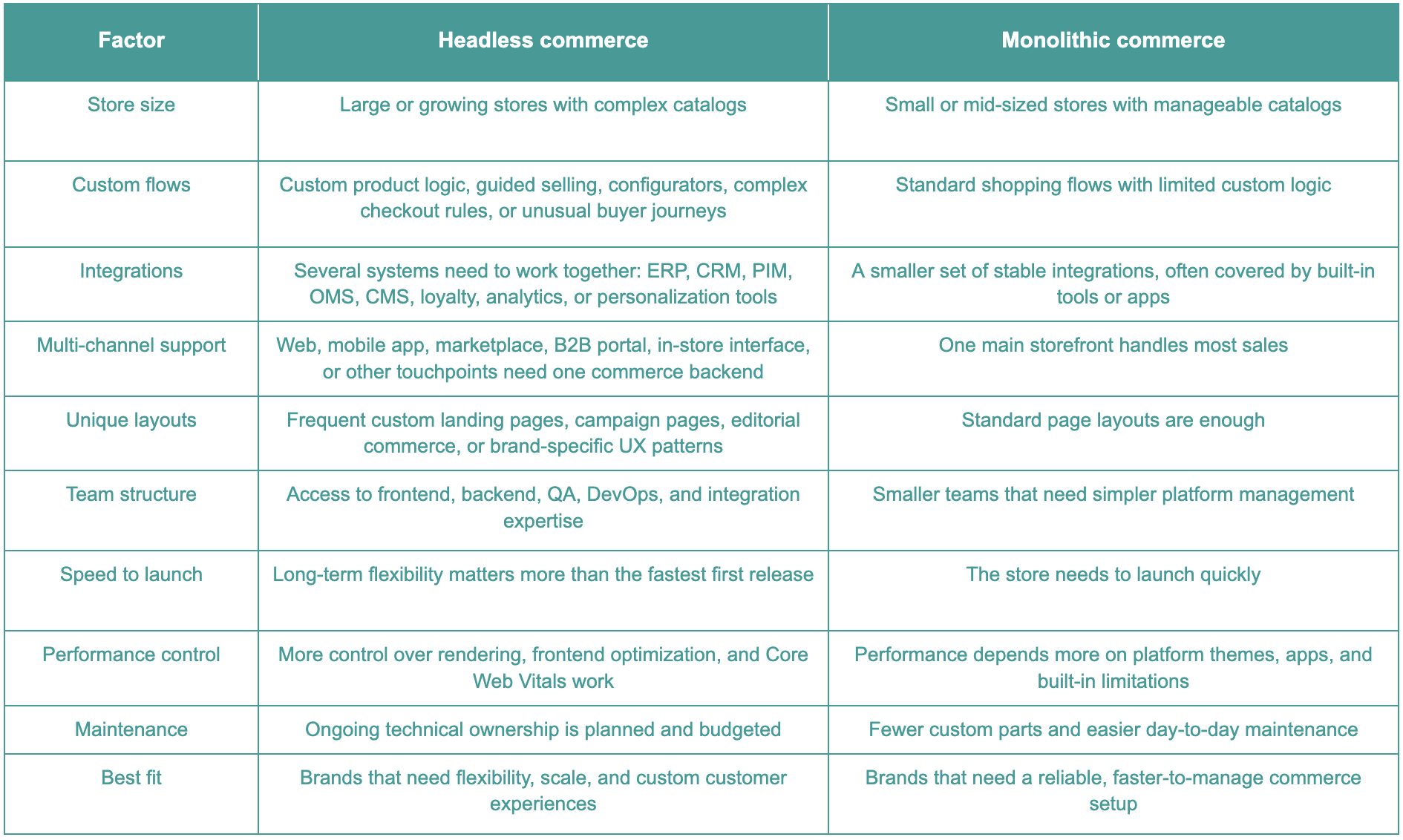
Think of it like dressing for the occasion. Headless is your custom Met Gala look: tailored, expressive, and expensive to maintain. Monolithic is a well-chosen store-bought outfit for a regular business dinner: it fits, looks good, and does not require a personal atelier. The point is to match the setup to the event, not to overdress because someone famous did.
Use-case patterns for headless commerce architecture
Since we work with both traditional and headless commerce, the patterns are easy to spot. Here are the use cases where headless commerce architecture usually earns its place:
- Omnichannel with one commerce backend. A typical setup connects a web store, a mobile app, an in-store kiosk, and a B2B portal to a single backend for products, carts, inventory, prices, and orders.
- B2B complex commerce. Enterprise headless commerce often fits companies with contract pricing, bulk ordering, custom catalogs, approval flows, quote requests, buyer roles, and ERP or CPQ integrations.
- Content-first commerce. Beauty, fashion, furniture, wellness, and electronics brands often sell through guides, lookbooks, comparisons, tutorials, or expert recommendations. Headless lets content lead the experience while product data, pricing, cart, and checkout stay connected.
- Marketplace and multi-vendor commerce. Marketplaces have many sellers, catalog structures, vendor profiles, commission rules, fulfillment logic, and filters. A flexible frontend helps organize that complexity into a buying experience people can actually use.
- Internationalization and localization. Global stores may need different languages, currencies, tax rules, shipping logic, promotions, and content by market. Headless helps localize the frontend while keeping the commerce core connected.
- Performance and scale. High-traffic launches, flash sales, SEO-sensitive pages, and content-heavy storefronts often need stronger control over frontend rendering. Static generation, server-side rendering, and careful page-level optimization become easier to manage outside a rigid theme.
The list above is a good starting point. The final verdict needs context. Your store may fit one of them clearly, combine several at once, or have its own special flavor of commerce complexity.
Conclusion
Lists of famous brands using headless commerce architecture may look inspiring and sufficient to make the next step. And yet, headless makes sense when you need more frontend freedom, performance control, multi-channel flexibility, or complex integrations. When a store is simpler, launch speed matters more, and standard platform features already do the job, a monolithic setup is still a go-for option.
So, is headless right for you? Hopefully, you can understand it with certainty by now.
Among all this uncertainty and “it depends,” there’s some good news: Vilmate works with both traditional and headless commerce setups. We can help you look at the trade-offs without pushing the trendiest option by default and support during e-commerce development, regardless of the architecture you choose.