Headless Commerce for Stores That Outgrow Standard Setups
In this article
SHARE TO:
Headless commerce is often sold as the hype train every ambitious store should board: nice seats, loud promises, suspiciously vague destination. It can give commerce teams more flexibility, speed, and control, as well as extra ownership, planning, and technical responsibility.
So before jumping in, it’s worth understanding what you’re actually choosing. In this article, we’ll look at how headless commerce works, where it helps, where it gets complicated, and which use cases make the decision easier to justify.
What is headless e-commerce?
To answer the question without turning this into a software architecture lecture: headless commerce separates the storefront from the commerce backend.
The storefront is the “head”: everything customers see and use, including the UI, product pages, navigation, cart, and content. The backend is the “body”: commerce logic, product data, pricing, inventory, checkout, orders, customer accounts, and databases.
APIs connect these two parts. The frontend requests product data, cart details, checkout information, or content, and the backend sends back what the storefront needs.
How does headless commerce architecture work?
Headless architecture comprises three layers: the frontend, the API layer, and the backend. Each has a separate job, and together they let storefront updates move at their own pace, with core commerce operations staying stable.
Frontend layer: the storefront customers see and use, including product pages, navigation, cart, content, and checkout flow. It can be built with React, Next.js, Vue, Shopify Hydrogen, or another frontend framework.
API layer: the messenger between the storefront and backend systems. REST or GraphQL APIs pass requests and data back and forth, so the frontend can show the right products, prices, availability, content, and cart details.
Backend layer: the commerce engine room, where products, prices, inventory, orders, customer accounts, CMS, OMS, PIM, search, and payments are handled. During headless commerce development, tools such as Contentful, commercetools, and Algolia are often used.
In practice, it is pretty straightforward: the frontend requests product data, the API handles the request, and the backend sends back what the storefront needs.
How is headless commerce different from traditional e-commerce?
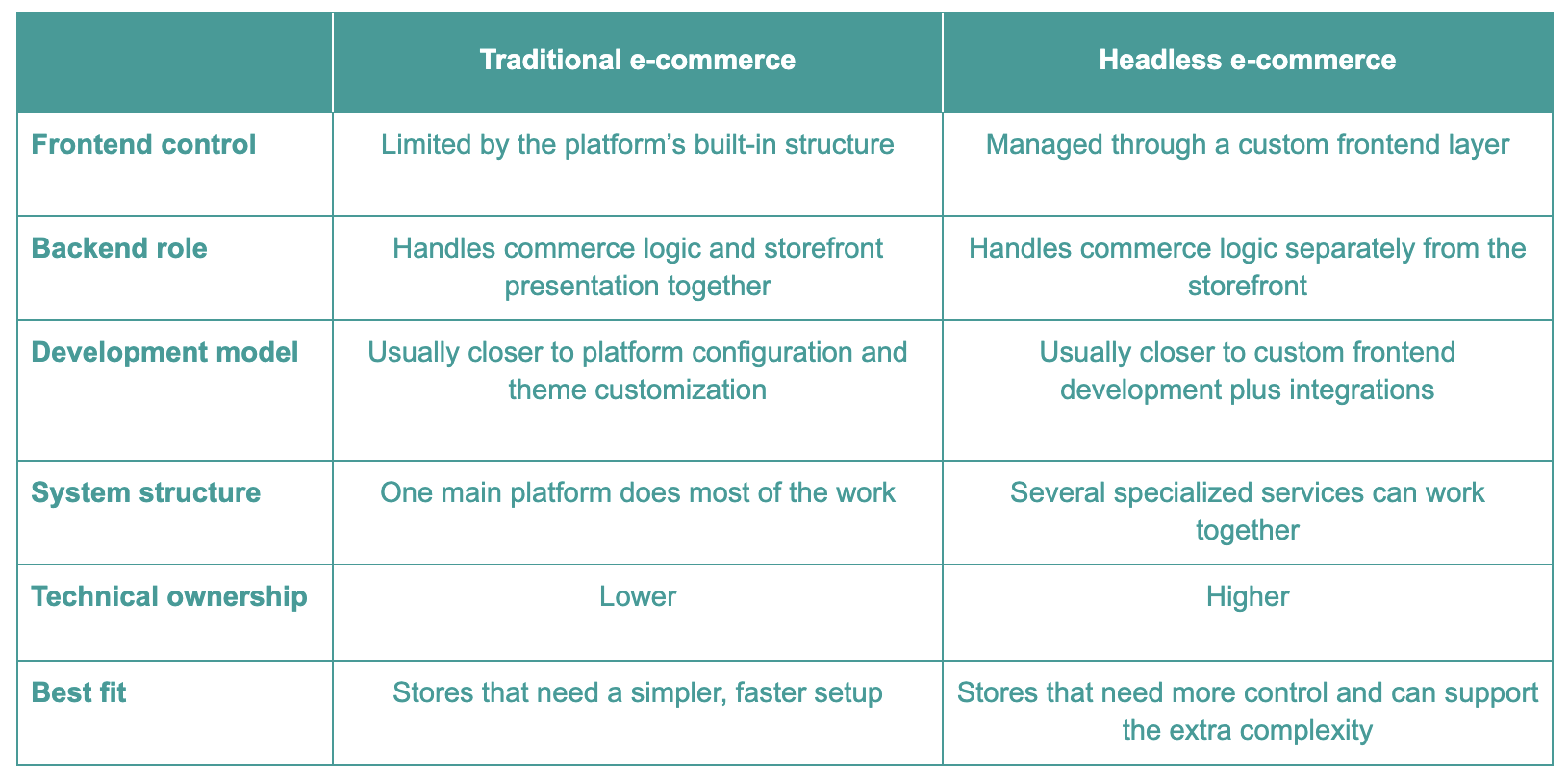
In traditional e-commerce, the storefront and backend usually come as a single, connected system. In headless commerce, they are separated and connected through APIs. And this difference changes how the whole setup behaves:
The table makes headless commerce look like the option with extra homework. So why do teams keep choosing it? The reason is simple: the main benefits come from that extra ownership. Now, let’s unpack what that actually means for the business.
What are the benefits of headless commerce?
Headless commerce benefits stem from the same architectural choice we discussed earlier: the storefront and backend can be deployed separately. Once you get to experience how this setup behaves in your daily work, the value becomes easier to see:
Omnichannel delivery. One backend can serve multiple customer touchpoints simultaneously: web store, mobile app, kiosk, voice interface, or IoT device. Product data, pricing, inventory, and orders stay consistent across channels, and each touchpoint gets its own frontend experience.
Frontend freedom. Teams can build product pages, landing pages, and content flows around the brand rather than using platform templates.
Better performance control. The frontend can be optimized separately for speed, responsiveness, and Core Web Vitals.
Independent scaling. Headless commerce architecture lets teams scale the storefront during traffic spikes while keeping backend operations under control.
Faster iteration. Frontend updates, A/B tests, and campaign changes move with lighter backend coordination.
Future-proofing. Teams can replace a CMS, improve search, add a frontend, or update services without rebuilding the whole setup.
The points above illustrate why the architecture gets so much attention. They also clarify why the decision needs a clear technical plan: more control comes with more responsibility. That brings us to the less pleasant part.
What are the potential challenges and concerns?
Everyone wants the ideal commerce setup: flexible, fast, scalable, easy to update, and somehow still simple to maintain. Headless commerce can address much of that. The catch is that flexibility has to be built, connected, tested, and supported.
That is the part worth looking at before the decision is made:
Higher upfront cost and timeline. Headless commerce needs more work before launch: custom frontend, integrations, and proper testing.
More team coordination. Frontend and backend teams must stay aligned, especially around product data, cart logic, checkout, and content.
More vendors to manage. A headless stack can include separate tools for CMS, commerce, search, payments, and support.
Ongoing maintenance. APIs, integrations, performance, and service updates need regular attention, so headless commerce development continues after launch.
Higher technical ownership. Headless works better with internal engineers or a reliable development partner who can keep the setup clean and maintainable.
These concerns put headless commerce in the category of serious architecture choices. It needs a clear business case, a capable team, and realistic expectations. With those pieces in place, the model works well for brands that need more control over the customer experience. A few examples make that easier to see.
What are some headless commerce examples?
When looking at what brands use a technology you’re considering, pay attention to why they do it, too. Here are some headless commerce examples that make the architecture in question make sense.
Gymshark—a strong example for high-traffic retail. Gymshark moved from a monolithic setup to headless commerce and used Algolia, Shopify, Contentful, React, and AWS in its stack. For a brand built around drops, product discovery, and global traffic peaks, the storefront needs to stay fast and flexible.
Tesla—a useful example for non-standard buying flows. Buying a Tesla is closer to configuring a product ecosystem than shopping from a regular cart: vehicle options, financing, delivery, account logic, and hardware-linked experience all matter. Headless commerce fits that kind of controlled, product-led journey.
DTC brands. Companies like Allbirds, Rothy’s, and Kotn are illustrative as well. DTC storefronts depend heavily on brand feel, content, localization, and campaign flexibility. Product pages, collections, and landing pages can follow how the brand actually sells.
After looking through a longer list of brands using headless and comparing that with real client requests, we can distinguish several repeated use cases that keep showing up:
A retailer runs a web store, a mobile app, and an in-store kiosk from a single backend.
A B2B company builds a custom buyer portal on top of a commerce engine.
A media brand adds shopping to editorial content.
So yes, headless commerce is often a fit for brands that do not plan to look, sell, or scale like a standard or small online store.
Conclusion
The headless hype train still has nice seats and loud promises. The difference now is that you can see where it goes, what the ride involves, and why some brands buy the ticket on purpose.
Headless commerce makes sense when the architecture supports a real goal: more control over the storefront, more complex customer journeys, or growth across several channels. When the goal is vague, the setup quickly becomes an expensive decoration.
If you are considering headless commerce development, start with a consultation. We can review your current platform, goals, constraints, and technical risks, then help decide whether headless is worth it. And if the answer is yes, we can handle the rest too: architecture, frontend, integrations, testing, launch, and support—your personal crew for the Headless Express.
AUTHOR BIO
Anastasiia Rezinkina
Copywriter / Content manager
Anastasiia is a content writer at Vilmate with a focus on e-commerce, AI, and emerging tech trends. She turns complex topics into clear, practical reads — whether it’s comparing CMS platforms or unpacking how AI is reshaping online retail.
Somewhere between a board meeting and an e-commerce roadmap, “we need AI” becomes a non-negotiable business requirement. The pressure is real. In Dataiku’s 2026 survey of 900 enterprise CEOs, 80% said their role could be at risk if their company failed to show measurable AI gains by year-end. These circumstances can move an AI project […]
An order splits into two shipments, and no system flags it in advance. The warehouse shows stock that’s actually gone. A customer returns one item out of three, and accounting still doesn’t see that the return ever happened. Support pulls up the customer’s record and can’t tell what stage the order is at—because that stage […]
When order management in a Google Spreadsheet becomes problematic, most small business owners usually do the same thing: type “10 best OMS” in Google search, open up several tabs, and try to choose the winner by the number of stars on review pages. These rating tables, however, rarely take into consideration your particular characteristics, such […]
Cookies help us see what's working on this site and make it better. Your call on what we track.
Functional
Always active
The technical storage or access is strictly necessary for the legitimate purpose of enabling the use of a specific service explicitly requested by the subscriber or user, or for the sole purpose of carrying out the transmission of a communication over an electronic communications network.
Preferences
The technical storage or access is necessary for the legitimate purpose of storing preferences that are not requested by the subscriber or user.
Statistics
The technical storage or access that is used exclusively for statistical purposes.The technical storage or access that is used exclusively for anonymous statistical purposes. Without a subpoena, voluntary compliance on the part of your Internet Service Provider, or additional records from a third party, information stored or retrieved for this purpose alone cannot usually be used to identify you.
Marketing
The technical storage or access is required to create user profiles to send advertising, or to track the user on a website or across several websites for similar marketing purposes.