Creating an AI Assistant: Handy Insights from Vilmate
In this article
SHARE TO:
Artificial intelligence will be in our discussions for a long time. It’s time to acknowledge that we are in a new world full of exciting possibilities. The digital era is evolving, and living without artificial intelligence is hard to imagine even now.
It’s essential to focus on AI to maximize its potential. By embracing this technology today, you’ll have a significant advantage when it becomes even more widely adopted. The rapid development of AI is evident. Large and small companies will soon be competing to leverage its benefits effectively.
Here, at Vilmate, we always keep our hand on the pulse and implement our knowledge in practice. Today, we’ll try to encourage even more interest in this technology. We’ll see why businesses aren’t afraid to make outstanding investments in AI research, give you a comprehensive picture of what you should keep in your mind before diving deeper into the topic, and even guide you in the process of developing your first simple AI assistant.
Implementing AI in Business: Benefits and Drawbacks
Research indicates that 35% of global companies use artificial intelligence in their business operations. Let’s delve into the advantages this technology can offer to businesses.
1. Process Automation
Recent research by Accenture indicates that incorporating artificial intelligence boosts company productivity by 40%. According to the same study, utilizing AI for tasks such as automation, decision-making, and ensuring data security can increase your business profitability by 38%.
Employees can shift away from tedious, repetitive tasks and delegate them to computers. Instead, people can focus on creative tasks or use artificial intelligence as an assistant. Artificial intelligence drives innovation in products and services and efficiently identifies threats to the information environment.
2. Data analysis
Computers can process data much faster and more efficiently than humans, with artificial intelligence (AI) leading the way by processing information a million times faster than the human brain. This capability enables AI to make smarter decisions at a significantly faster pace.
Companies are already harnessing the power of AI in marketing to enhance audience engagement and simplify logistics. Predictive analytics, driven by AI, is crucial in forecasting trends, stock market processes, and crises. Consequently, businesses can mitigate numerous risks or seize new opportunities ahead of competitors.
AI’s rapid and efficient analysis capabilities contribute to optimizing inventory, boosting sales, and reducing operational costs. This new technology empowers businesses to implement innovative strategies to generate additional revenue.
3. Improved service
It’s widely known that providing a personalized customer experience builds trust in a brand and significantly boosts a company’s profitability. However, keeping track of the preferences of thousands of customers and providing service around the clock is challenging for humans. Artificial intelligence (AI), on the other hand, excels in quickly gathering and analyzing data to understand each user’s unique preferences.
AI can swiftly collect information from various databases, such as tracking a customer’s past purchases and suggesting products that align with their interests. It can also analyze the target audience based on social media and demographic data. Moreover, machines can serve multiple customers simultaneously, 24/7.
Chatbots play a crucial role in this landscape as simple yet effective AI tools for businesses. We’ll delve into this technology later when discussing the AI-based chatbot we’ll develop together.
Artificial intelligence is capable of almost anything. Your imagination solely defines the boundaries of its use. Consider how your business could leverage such a valuable asset as a machine. You can entrust AI with customer communication, optimize data on your website, and plan logistics routes.
Of course, you can delegate more significant tasks to AI, such as forecasting the financial market or developing a company promotion plan. However, remember that behind every artificial intelligence, an experienced professional should oversee the machine’s actions. The new technology is still imperfect – we’ve discussed this in more detail in our other articles.
Among the drawbacks of artificial intelligence, several key points stand out:
Privacy and security concerns. As AI becomes an integral part of business setups, it becomes a potential target for cyberattacks, posing challenges in terms of confidentiality and security.
Ethical concerns. There’s an ongoing global debate among experts about the ethical implications of AI usage. The question remains whether we can trust artificial intelligence with critical data.
Dependency on AI. The swift integration of AI into business processes may create a situation where it’s hard to imagine operations without a reliable AI assistant. However, as technology isn’t entirely foolproof and may experience glitches, disruptions could lead to the need to rebuild processes, causing significant time and financial losses.
Implementation costs. Developing artificial intelligence is currently an expensive endeavor. AI demands considerable computational power, and the scarcity of proficient AI specialists adds to the financial investment required for its integration into business.
Despite these drawbacks, we expect they will diminish over time, especially considering the substantial advantages of AI. As we focus on introducing new technologies into businesses today, let’s explore what AI is.
Understanding Artificial Intelligence
The internet is buzzing with news about artificial intelligence. Experts often discuss artificial intelligence, AI models, and AI assistants. What sets these terms apart, if anything? And when we talk about integrating AI into business, what exactly are we referring to?
What is Artificial Intelligence?
Artificial Intelligence (AI) is an idea introduced by Alan Turing. It involves creating a computer that can work like the human brain. AI is a field of computer science and, in a broader sense, a philosophy. It covers the entire area of developing computer systems that can imitate human intelligence. This field includes various methods and technologies like machine learning, natural language processing, computer vision, and more. The goal is to build programs capable of learning, adapting, and performing tasks that require intellectual abilities.
Artificial intelligence can be classified into three main types:
Weak AI (Narrow AI). This type refers to systems designed for specific tasks without having a broad range of intellectual abilities. These systems can handle limited tasks but lack an overall understanding and self-awareness. Examples include voice assistants, speech recognition systems, and algorithm-predicting outcomes.
Strong AI (General AI). It is a more advanced form of artificial intelligence comparable to human intelligence. Systems with strong AI can handle specific tasks and learn new ones, possess a general understanding of the world, and make decisions in different situations. Developing strong AI involves creating artificial intelligence with consciousness and self-awareness.
Superintelligence. This concept envisions artificial intelligence surpassing human intelligence in all aspects. It’s a hypothetical level where the abilities and comprehension of artificial intelligence go beyond human perception. Discussions on ethics and safety related to the development of superintelligence have become crucial in contemporary artificial intelligence research.
Currently, we are mainly implementing weak AI. Some experts, however, argue that we are getting closer to creating strong artificial intelligence. This idea stems from observing how modern AI models learn to understand jokes or share their experiences.
What is an AI Model?
Now that we’ve touched upon AI models, let’s discuss them in simpler terms. An AI model is a specific and tangible program or algorithm in the vast field of artificial intelligence. It’s usually designed to tackle a particular task, like a neural network recognizing images, a classification algorithm identifying objects, or a natural language processing system analyzing text.
Classic examples of AI models include ChatGPT, DALL-E, Bard, and others. When discussing implementing AI in business, we typically refer to using an AI model.
What is an AI Assistant?
In the realm of artificial intelligence, you might also hear about AI assistants. An AI assistant is a specific type of artificial intelligence designed to interact with users and handle various tasks. Typically equipped with a voice interface, these assistants can follow commands, answer questions, and manage devices. Examples include Apple’s Siri, Google Assistant, and Amazon Alexa.
We can divide AI assistants into different categories:
unordered list
Voice Assistants. Examples like Siri or Alexa respond to voice commands and handle various tasks, such as setting alarms, playing music, or managing smart home devices.
Task-Based Assistants. These assistants are designed for specific tasks like scheduling meetings, sending emails, or organizing documents.
Prediction Assistants. Examples like Google Now or Cortana use machine learning algorithms to predict user needs and provide relevant information and services before the user requests them.
AI assistants are a specific kind of virtual assistants, distinguished by their use of artificial intelligence.
Lately, the term “Personal Artificial Intelligence” has become quite popular. Let’s discuss it a bit.
Personal Artificial Intelligence represents the next step in the evolution of virtual assistants. This technology offers unique capabilities:
Understanding the User. Personal AI understands how its owner thinks, sees the world, and expresses thoughts in their way.
Finding Information. This AI can search and provide information and perform tasks using the owner’s language, considering their context and current situation.
Discovering Resources. Personal AI locates and provides all necessary resources, such as information, people, other assistants, services, and products, matching the context.
Instant Translation. It can instantly translate from any foreign and specialized language into the owner’s language
Teaching and Guidance. Personal AI can act as a teacher, mentor, guide, or coach, offering education and support in various fields.
This assistant isn’t limited to serving individuals. It can represent a group of people, a company, or another organization, providing personalized assistance in various scenarios.
The concept of such technology was explored by the popular series “Black Mirror” writers in the episode titled “White Christmas.” In this episode, experts replicate a person’s consciousness and place it into a device, allowing the owner to receive personalized services. The digital counterpart of the person manages tasks like adjusting the home temperature, pouring coffee upon waking and preparing perfect toast.
Personalized AI operates in a much more humane way than depicted in the series.
While Siri provides assistance somewhat uniformly to everyone, personalized artificial intelligence tailors its responses to specific individuals or groups’ preferences, requests, and habits. This AI evolves alongside the user, adjusting to their communication style, curating relevant news and entertainment content, and managing specific daily tasks, such as grocery shopping based on regular dietary preferences.
There are some risks associated with the development of Personalized Artificial Intelligence:
While highly effective, PAI might unintentionally lead users to isolate themselves, as it becomes their primary communication channel, reducing the need for direct interaction with others.
A specific risk is related to language learning. PAI’s ability to understand and translate any language could reduce the incentive for users to learn foreign languages. Users might rely too much on PAI for communication, resulting in a loss of language skills.
Another significant risk involves the possibility of being trapped in an “information bubble” created by PAI. It means that users receive information from limited sources selected based on their preferences, potentially leading to a narrow perspective. In the context of PAI, users might become overly dependent on it and face challenges in communication without its assistance.
Now that we’ve looked at the different types of artificial intelligence let’s draw some conclusions. Artificial Intelligence, essentially, is a field, an idea, a philosophy. So, when thinking about using AI for your business, you can focus on either AI models or AI assistants.
An AI model is like a tech tool that answers business questions, while an AI assistant makes it easier for customers to communicate with a business.
For our article’s context, it’s more relevant to consider AI models as technologies that can bring in profits. But can you create AI for your business on your own, and how would you go about it?
Creating Your Own AI: A Simplified Guide
If you’re considering bringing artificial intelligence (AI) into your business, you might need to start from the ground up. Finding a universal solution that fits your needs and smoothly integrates into existing processes is challenging.
The good news is that building a custom AI model is entirely possible, and you can achieve it with the help of specialized professionals. However, before you dive into AI creation, there are a few preparatory stages to navigate.
The beginning of the path to creating an AI model
Creating your own AI model involves a step-by-step process. First, identify the tasks you want your artificial intelligence to handle for your business. Conduct some research to understand the needs of your target audience.
Once you have a list of tasks that you’re ready to delegate to AI, the next step is to decide which tasks are feasible and which are not. Keep in mind that some actions might be beyond the capabilities of current technology, and specific processes might be better suited for human intervention.
Set clear, practical, and achievable goals. Seek guidance from an IT company consultant who can assist you in bringing your idea to life.
Next, you should choose the platform for your AI. An AI platform is software and infrastructure designed for developing, training, deploying, and managing AI-related applications and models. It provides tools and services for working with data, training models, and integrating AI into practical applications.
There are different platforms available for building artificial intelligence (AI):
TensorFlow (by Google). It’s an open-source framework for making and training deep neural networks.
PyTorch(by Facebook). It’s widely used for developing deep neural networks and is known for being user-friendly.
Microsoft Azure ML. Microsoft’s cloud platform provides tools for developing, training and deploying machine learning models.
IBM Watson. IBM’s cognitive platform offers various services and APIs for building AI-enhanced applications.
Amazon SageMaker. This Amazon Web Services (AWS) cloud platform is designed for developing, training, and deploying machine learning models.
OpenAI. OpenAI develops innovative AI models and tools like GPT (Generative Pre-trained Transformer).
Consider things like scalability, user-friendliness, cost, and compatibility. Look into the platform’s capabilities in natural language processing, speech recognition, and machine learning – these are crucial elements for AI development.
Creating your own AI assistant involves several key steps:
Define AI Logic. Develop algorithms and decision-making processes for how your AI will respond to user data. Consider different user scenarios and plan appropriate responses.
Incorporate Machine Learning. To enable your AI to evolve, implement methods for continuous training in new skills, known as machine learning.
AI Training. Provide a substantial amount of necessary data to teach your artificial intelligence to perform specific tasks. More data leads to better AI performance.
User Interface Design. Create an intuitive interface to facilitate easy interaction between users and AI. Test the interface with a diverse group of users to ensure user-friendliness.
Develop and Test AI. Implement your AI model and conduct testing with both specialists and users.
Deployment. The final stage involves putting your AI into operation. Continuously test and monitor AI performance to ensure its effectiveness.
As you can see, building your AI assistant requires programming skills and a thorough understanding of artificial intelligence concepts.
There are platforms available that make it possible to create and use artificial intelligence without needing extensive programming knowledge. These platforms cater to users with various technical backgrounds, allowing them to build applications and models using easy-to-understand interfaces. Here are a few examples:
Bubble lets you create web applications without any coding. It supports different functions, including adding elements of artificial intelligence.
Adalo provides tools for making mobile apps without the need for programming. The process includes integrating machine learning and other AI features.
Wix Code, part of the Wix website creation platform, allows users to add advanced features without coding, including some aspects of artificial intelligence.
OutSystems offers tools for building applications without needing to code, and it may be used to integrate with some artificial intelligence services.
Zoho Creator is a tool for creating applications without programming, and it can be used to integrate elements of artificial intelligence.
Practical instance of creating a basic AI chatbot
Before delving into our narrative, let’s clarify a few key points.
Why focus on creating an AI chatbot?
Firstly, the process is relatively straightforward compared to developing other AI models. Secondly, chatbots offer a versatile solution for any business. Picture having a chatbot on your website that promptly, professionally, and accurately addresses user inquiries 24/7, equipped with comprehensive knowledge about the company and its products.
Statistics show that 62% of respondents prefer interacting with digital customer service assistants over waiting for a manager’s response. Additionally, 65% of users feel at ease resolving issues without human intervention. A chatbot emerges as an excellent solution, enhancing user experience, contributing to customer retention, and boosting sales through a personalized approach.
Which programming language is the best choice for creating an AI chatbot?
We recommend using Python for artificial intelligence tasks. Python is often considered one of the most suitable programming languages for AI due to several reasons:
Extensive machine learning libraries. Python has a strong community and a variety of machine-learning libraries like TensorFlow, PyTorch, Keras, and others. These libraries offer many tools for building and training machine learning models.
Easy learning and usage. Python is known for its readability and straightforward syntax, making it accessible to beginners.
Versatile capabilities. Python is not limited to machine learning; it’s used in various fields, including web development, data analysis, scientific research, and more.
Integration with other technologies. Python seamlessly integrates with other technologies and programming languages, allowing developers to use it in different parts of a tech stack for creating complex applications.
Popularity in data science. Python is widely used in data science, making it a natural choice for machine learning, statistics, and data analysis tasks.
While Python isn’t the only language for AI, its user-friendly nature and adaptability have made it a popular choice among developers in artificial intelligence. For these reasons, we chose Python to create our chatbot.
Now, let’s take a closer look at the actual creation process.
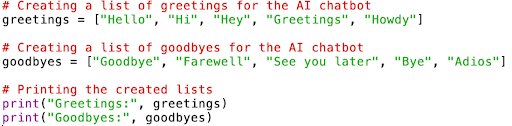
Step 1: Let’s set up greetings and goodbyes for our AI chatbot.
In Python, we can create lists that hold various elements. Make two lists named “greetings” and “farewells.” Inside the square brackets ([]), give your AI chatbot a few greetings and goodbyes.
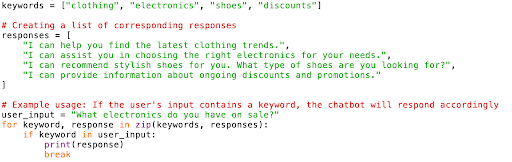
Step 2: Create keywords and responses that your AI chatbot can understand.
We will make a couple more lists, one for keywords and another for responses. Name these lists “keywords” and “responses.” Make sure that the keywords and responses are in the same order. For example, if a user types something with the keyword “electronics,” the AI chatbot replies, “I can help you choose the right electronics for your needs.”
Step 3: Incorporate the random module.
To add a touch of variety, you can have your AI chatbot select a random greeting and farewell every time a user engages with it. You’ll need to import the random module into our program to make this possible. Simply include the following line at the beginning of your program (the very first line):
Now, let’s select a random greeting from the list of greetings. After the lists you created, add:
This line will pick a random greeting from the list and display it.
Let’s also ask the user to input something. We can use the input function to show a request to the user and get their response. We should store their answer in a variable to utilize it in our program.
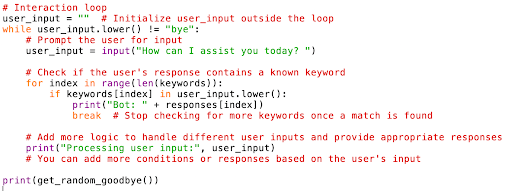
Step 4: Continue interacting with the user until they say “goodbye.”
We can use a while loop to keep engaging with the user until they mention “goodbye.” This loop will repeat its set of instructions as long as the user’s response is not “goodbye.”
Stage 5: Check if the user’s response includes a keyword the AI chatbot recognizes.
In the while loop, we need to check if the user’s reply has a keyword the AI chatbot already knows. We used a for loop to go through the whole list of keywords. If the keyword at the current position matches any part of the user’s response, we’ll print the corresponding reply from the response list.
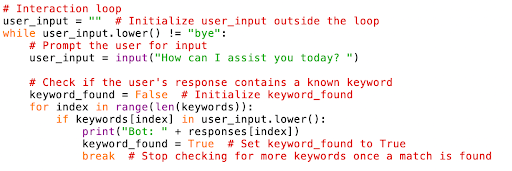
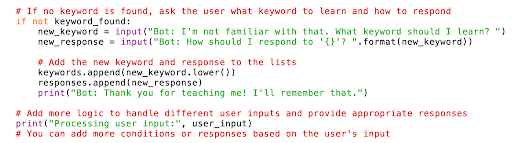
Step 6: Introduce a new keyword and response to the AI chatbot.
If the user’s response doesn’t include a keyword already known by the AI chatbot, we need to teach it how to answer. Let’s start by updating our while and for loops using a variable named “keyword_found.” At the beginning of the while loop, we’ll set it to false, indicating it hasn’t been found yet. We’ll set the “keyword_found” variable to true in the if statement within the for loop.
We’ll include an if statement inside the while loop but outside the for loop to check if “keyword_found” is false. If the user’s response doesn’t include a keyword that our AI chatbot already knows, we’ll ask the user which keyword we should learn and how to respond. Then, we’ll add the new keyword and response to the lists using the append function.
Step 7: Choose a random farewell when the user says “bye.”
When the user says “bye,” the while loop will end. Outside of the loop, let’s pick a random farewell to show the user as a goodbye message.
So, now we have our chatbot that can help users choose products. Of course, its features are limited, and we can’t cover how to add all possible options in a single article. Once you’ve written the code, you’ll need to import the bot correctly in the website or the application. Most likely, you’ll still need to enlist the help of a specialist.
Final words
We’re glad that this article has clarified your understanding of artificial intelligence a bit more! Take a look at your handheld devices, TVs, laptops, PCs, etc., and at least try to imagine the volume and intensity of what’s happening hidden from our sight.
It was just a tiny glimpse at what can be done with the emerging AI technologies. The Vilmate specialists are always eager to delve deep into each aspect of the project. We have proficient specialists who can integrate third-party technologies smoothly into your service, product, or business.
Stay tuned with Vilmate! It’s just the beginning of a global technological breakthrough.
AUTHOR BIO
Anastasiia Rezinkina
Copywriter / Content manager
Anastasiia is a content writer at Vilmate with a focus on e-commerce, AI, and emerging tech trends. She turns complex topics into clear, practical reads — whether it’s comparing CMS platforms or unpacking how AI is reshaping online retail.
Somewhere between a board meeting and an e-commerce roadmap, “we need AI” becomes a non-negotiable business requirement. The pressure is real. In Dataiku’s 2026 survey of 900 enterprise CEOs, 80% said their role could be at risk if their company failed to show measurable AI gains by year-end. These circumstances can move an AI project […]
By now, the case for personalized search in e-commerce has been made loudly enough. Vendors praise it, reports measure it, case studies add conversion lifts, and we have already covered the theory in our guide to e-commerce personalized search and the scenarios in e-commerce personalized search examples. So yes, the point has landed. Personalized search […]
Personalized search is easy to like in theory. Better results, smarter product discovery, more relevant buying journeys—all sound great. Also slightly abstract, until you see what can happen when a real shopper types a real query, and the store uses the context already sitting in front of it. Theory still matters. That is why we […]
Cookies help us see what's working on this site and make it better. Your call on what we track.
Functional
Always active
The technical storage or access is strictly necessary for the legitimate purpose of enabling the use of a specific service explicitly requested by the subscriber or user, or for the sole purpose of carrying out the transmission of a communication over an electronic communications network.
Preferences
The technical storage or access is necessary for the legitimate purpose of storing preferences that are not requested by the subscriber or user.
Statistics
The technical storage or access that is used exclusively for statistical purposes.The technical storage or access that is used exclusively for anonymous statistical purposes. Without a subpoena, voluntary compliance on the part of your Internet Service Provider, or additional records from a third party, information stored or retrieved for this purpose alone cannot usually be used to identify you.
Marketing
The technical storage or access is required to create user profiles to send advertising, or to track the user on a website or across several websites for similar marketing purposes.