Telemedicine is becoming a hot trend in the shifting landscape of 2022. It is due in no small part to the coronavirus that people are getting to finally embrace virtual health care. Billions are now being quarantined, which may become the reason for telemedicine to gain widespread acceptance worldwide.
In the year 2019, the global telemedicine market was valued at USD 30.7 billion. Amid the pandemic crisis of 2020, it is already estimated at USD 31.4 billion and is expected to reach USD 75.2 billion by 2027. Most experts agree that telemedicine will give a new dimension to the healthcare sector in the nearest future. So, while this industry is still at its early stages of development, it is a good idea to attempt to become part of it. In our article, we are going to discuss what telemedicine is, what benefits it has to offer, why one has to consider the development of a telemedicine app in 2022, how to do that and how much it can cost.
What is telemedicine?
Telemedicine is a practice and a set of services provided by healthcare employees through the application of information technologies. The end goal of telemedicine is to enable the efficient evaluation, diagnosis, and treatment of a patient from a remote location unless there are urgent symptoms requiring an in-person evaluation. Essentially, the most common telemedicine use cases include:
Interactive real-time virtual consultations
Online follow-up visits
Remote health monitoring
Test results exchange and discussion
Prescription of medicine or prescription renewal
As a result, under certain circumstances, patients can get a chance to receive the medical care they need without leaving the comfort of their homes. Being present at the hospital to be diagnosed and treated, thus, becomes unnecessary. Now, healthcare specialists can provide remote care to people using modern telemedicine solutions in the form of mobile apps and software for PCs.
The telemedicine services delivery is mediated by so-called doctor-on-demand apps. As time goes by, they are growing to be ever more widely appreciated as a way to connect healthcare services providers with patients. On-demand software platforms like streaming services, taxi mobile apps, or food-delivery applications are becoming a new normal. So, telemedicine apps have also embarked on this path. Even more, everything that is going on on the world scene in 2022 contributes to the accelerated growth in telemedicine applications’ popularity. As a result, telemedicine applications that used to target a rural population, physically disabled, corporate employees, or some other particular social groups are now becoming a service for everybody.
Benefits of a telemedicine app
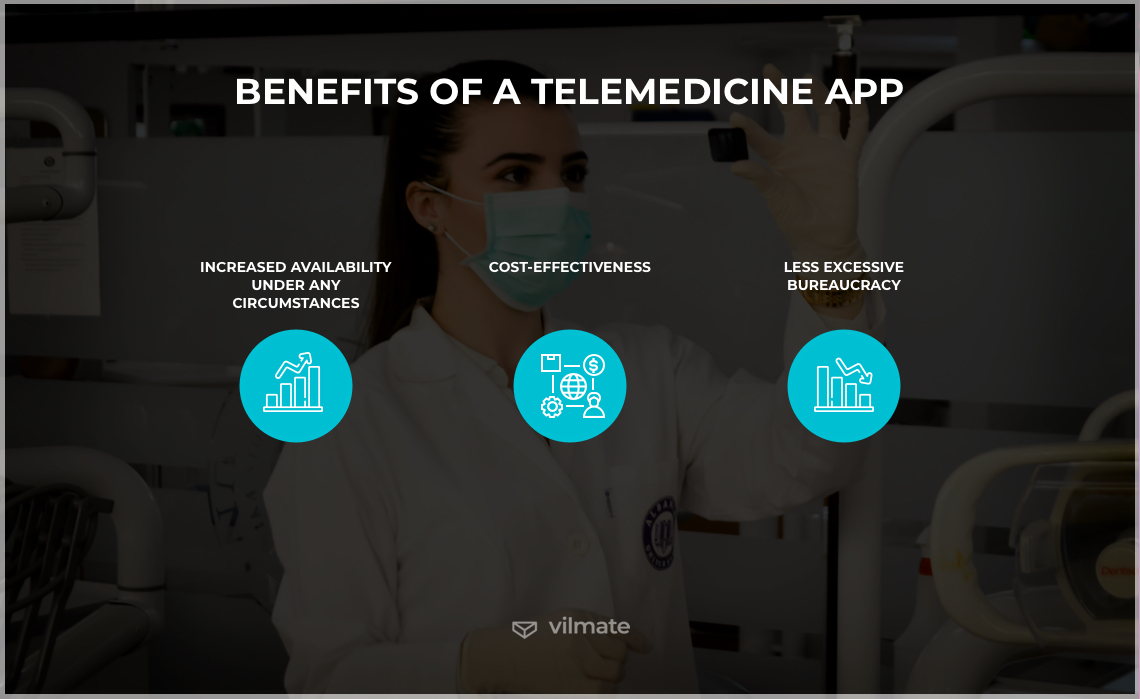
Telemedicine software solutions allow managing the multiple aspects of healthcare operations on a single platform. Thus, both doctors and patients are in a position to derive numerous benefits from using them regularly. In particular, telemedicine apps make healthcare services more available, cost-effective, and less bureaucracy-ridden.
1. Increased availability under any circumstances. Telemedicine apps empower patients to reduce their in-person follow-ups. It helps people virtually connect with their physicians through an app installed on a device of users’ choice any time they need this. People tend to postpone doctor visits until they can. They have many other things going on in their lives, so they see no point in changing their schedule because of a minor health problem.
However, such a habit has the reverse side, too. When this problem gets truly nagging (and this can happen unexpectedly), there can be no chance to book an appointment with a specific healthcare provider. A shortage of doctors is a problem in developing countries and advanced economies as well. For example, the United States is reportedly expected to see a shortage of 54,100 to 139,000 physicians by 2033. Telemedicine apps can partially ease the burden – doctor appointments via an app take less time and effort; they are generally easier to arrange and, therefore, more accessible.
2. Cost-effectiveness. Telehealth applications can be profitable for practitioners and, at the same time, they have the power to allow patients to save their money. It is widely believed (and not for nothing) that telemedicine is not only a more efficient way to treat patients, but it’s also a handy way to expand a clinic’s or specific practitioner’s revenue stream. Reduced staffing costs, a larger patient pool, and an expanded selection of health specialists are all the distinct features that are associated with telehealth apps and contribute to the cost-effectiveness of a telemedicine app.
One of the possible and the most viable options is when a healthcare business already has a physical facility associated with it. It can be a hospital, clinic, or medical center. Then, telemedicine will seamlessly become an additional source of revenue for this place. An mHealth application will help doctors serve more patients daily. Medical facilities will save money on nurses’ salaries, as an app with the right technologies in place will complete those tasks even more accurately and efficiently. And patients will get an opportunity to receive better services at a lower price.
3. Less excessive bureaucracy. Most businesses avoid red tape like the plague. However, the healthcare industry is such a sector of the economy that has a historically close relationship with the red tape. In fact, there are regulations like HIPAA standing in the way of delivering quality healthcare services via apps. Nevertheless, everything is changing nowadays. Some extensive telehealth restrictions are being lifted, payments for telemedicine services are being expanded, and policymakers are generally ready to modify established regulations in this field.
Mobile iOS and Android telemedicine apps send all incoming data to servers. Conversation recordings, patients’ health records, and other private data are potentially at risk of being illegally (either accidentally or purposefully) disclosed. However, all that data normally makes interactions between doctors and patients more fruitful. And suppose sufficient security measures are taken to protect that information. In that case, a telemedicine software platform will actually help optimize the process, only requiring the essential data to be put in by a patient and a healthcare provider.
Telehealth app features
During the coronavirus, doctors urge patients to replace in-person visits with apps. Telemedicine applications that were initially invented to serve rural patients have become the tool for connecting those two parties: patients and healthcare workers. They keep people at a safe distance from each other and, by doing so, no doubt, play a critical new role at the time of the COVID-19 pandemic.
But what features do these telehealth apps need to fulfill their purpose effectively? First of all, there certainly must be a distinction between an app for patients and an app for doctors. Besides, there is quite a difference between the must-have features of a telehealth app and its advanced features. Let’s look into this matter and find out what a telemedicine app has to include.
Must-have features of a patient app
Patients who face difficulty when attempting to visit their doctor’s office in-person are the first to benefit from telemedicine. A telehealth app helps build and cultivate an excellent patient-provider relationship, which is fundamental to ensuring advanced patient care and enabling the seamless reduction in the average cost per visit to a primary care physician. A telemedicine app for patients allows people to see their doctor even when they are physically in different places. The expertise specialists’ expertise is thus being leveraged remotely, supported by the following features:
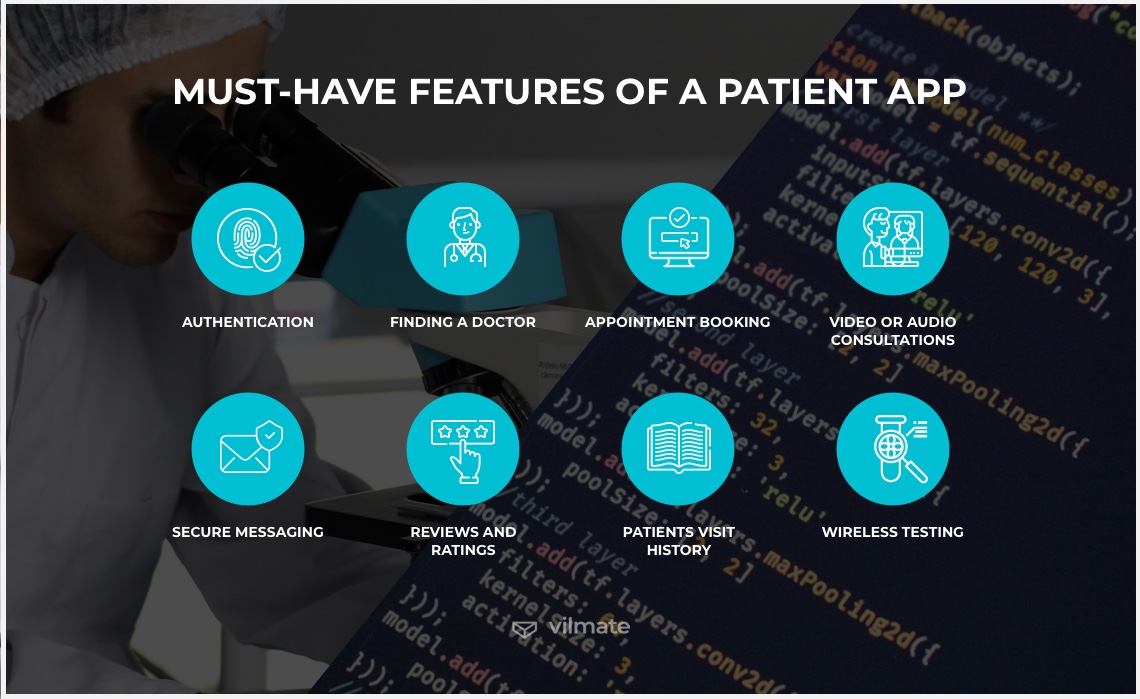
Authentication. Security and usability are the top priorities in software development. For an app to be useful (and especially it is the case for the one concerned with your health issues), it must be easy to use and secure enough to be entrusted with one’s private data. An authentication process must be designed in exactly the same manner. Patients should be able not only to sign up and log in but also to do it without hazarding security. Multi-factor authentication and biometric identification will help secure login credentials and verify a patient.
Finding a doctor. The importance of search functionality in mobile apps cannot be overstated. A telehealth app is no exception. In telemedicine applications, patients must be offered a convenient tool for not only connecting to a doctor on demand but also for finding the right specialist to get assistance from. Using filters, like specialization, language, gender, or insurance provider, patients must be able to find a doctor who will be qualified to solve the problem.
Appointment booking. A patient app has to allow for effortless and intuitive appointment booking. After the filters are applied, and a user gets the selection of specialists that meet the chosen criteria, they should encounter no obstacles in scheduling their appointment.
Video or audio consultations. Telemedicine apps are often used for consultations and ongoing disease management. In order to consult, make diagnoses, monitor the remote patient’s condition, primary care providers or specialists have to get access to the audio or video chatting feature. During these real-time virtual visits, patients should be able to freely interact with doctors via video or audio that are of high quality with low latency. Ideally, after the call ends, a patient has to be in a position to, at most, start treatment right away (with a clear diagnosis, treatment plan, and other useful recommendations) or, at least, have a list of tests to run to specify the diagnosis.
Secure messaging. Visual cues have the power to make a big difference in identifying signs of disease. A live chat feature can provide the means to exchange visual information. Providers and patients must be able to exchange information before, during, and after a call via a communication channel protected by end-to-end encrypted messaging protocols like Curve25519, AES-256, and HMAC-SHA256. A chat feature is a useful tool for healthcare providers to give written instructions and for their patients to ask for online assistance or provide more details regarding their treatment when there is no possibility to call.
Reviews and ratings. According to the findings of the Software Advice survey, 90% of respondents use online reviews to evaluate physicians, 71% of respondents use online reviews as their first step in choosing a new doctor, 43% of respondents are ready to go out of their current insurance network for a provider with more favorable reviews, and 1% believes it’s important for a healthcare provider to respond publicly to negative feedback. So, ratings and reviews matter. Give patients a convenient tool for expressing their opinion and writing reviews upon virtual consultations with doctors on a telemedicine app.
Patients visit history. Patients and doctors should be able to access their past medical records from a telemedicine application. Information about previous visits must be confidential but still easily accessible by the doctor and patient. That will help doctors make informed decisions more quickly and allow patients to avoid trouble when changing their provider. Consulting new medical providers will be more effective when they can access patients’ medical records rapidly.
Wireless testing. Virtual doctor appointments are not the only possible way in which telemedicine can work. There is a variety of healthcare services enabled by health informatics. Thus, patients can benefit from a telehealth app as a way to run wireless testing for remote health monitoring. IoT devices connected to the Internet can transmit information on blood pressure, glucose levels, ECG results, etc. to a diagnostic facility so that a patient and his or her healthcare provider could receive the results once they are ready and view them using a telemedicine app. As the number of health apps and monitors for smartphones increases, wireless testing becomes easier for everyone.
Telemedicine software development not only helps patients to see the healthcare specialist and get treatment as a result of the consultation, but it also empowers providers to strengthens the relationship with their patients and expands the existing patient base. A doctor’s dashboard is a type of telemedicine software and a place where medical providers can find all the necessary functionality to support them in achieving their professional goals. The dashboard will enable physicians to connect with their patients remotely to provide care, thus taking advantage of the following features:
Appointment management. In addition to having a needed functionality to create a doctor’s profile (which is a matter of course in a telemedicine app), there must be features allowing doctors to manage their schedule and set reminders for their appointments. Like in the case with any on-demand service app, doctors should be able to accept or reject appointment bookings and keep track of their schedules.
Patient management. Telemedicine is used for ongoing health monitoring, initial consultations, wellness checks, and many more. And regardless of what particular goal a patient pursues when using a telehealth app, the best results are achieved when the outcomes of their visits and all the rest of the information circulating around are accurately recorded and kept in a neat order so that no outsider could get access to the records.
Prescription management. Doctors should be able to issue their prescriptions digitally and share them with the patient following the same standards of appropriate practice as those in traditional in-person settings. Remote prescribing is becoming standard practice, but for it to be legal, a doctor-patient relationship must be valid. For instance, in most cases, issuing a prescription based only on an online questionnaire does not constitute an acceptable standard of care.
Billing. First and foremost, in-app medical billing is convenient. Besides, if a telemedical application has the functionality to collect insurance information, the billing process will be as seamless as possible. Payments for each visit will thus be automatically collected from patients. Doctors will be able to track their personal earnings on a dashboard, and hospitals will see the income flow with all the details involved.
Feedback monitoring. As we mentioned before, reviews and ratings are of enormous importance to patients. They rely heavily on what others say about a given healthcare specialist and usually choose the doctors who have a higher rating than others and a larger number of reviews than others. Therefore, doctors need to keep an eye on patients’ feedback about them, encourage them to leave reviews, and respond to all the comments, whether positive or negative.
Advanced features of a telemedicine app
Those were some must-have features that could turn an app into a telemedicine solution. But if one wants to stand out from the competition, it is a good idea to give zest to the product and provide advanced features along with the regular ones. Check out the list of premium features that one should consider adding to their custom telemedicine app solutions and see what benefits they can bring to their business.
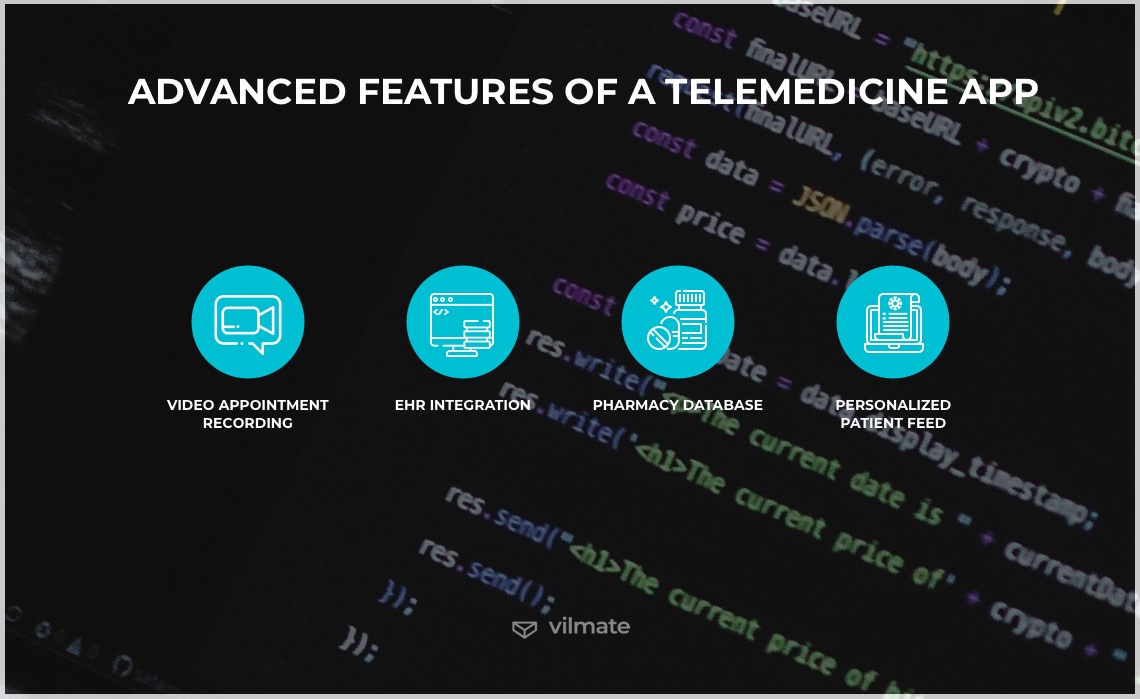
Video appointment recording. Having remote appointments with doctors is what users expect by default from a telemedicine app. However, providing them with recordings and transcripts of their visits is a rather unique feature that can either become a way to monetize your application or build trust. All users have to do is find the booked telemedicine visit, review instructions, start a visit, and, when prompted to allow recording, choose if they want to grant the access.
EHR integration. Electronic health records or EHR can be a standalone solution for storing patients’ medical history. It is typically maintained by a healthcare provider and includes all administrative, clinical data associated with a patient. The main benefit of EHR is that it automates access to information and thus streamlines workflow. Therefore, EHR integration, introducing increased clarity and accuracy, can become another monetization method for a telehealth app and a significant advancement. It will be a telemedicine module that may require additional fees to be applied.
Pharmacy database. To allow users – both doctors and patients – to more easily navigate medication prescriptions, a telemedicine app should include a library of online resources explaining specific medical issues, active pharmaceutical ingredients and products. This knowledge database is intended to help physicians or nurses explain healthcare-related phenomena and treatment plans to patients. They will then be able to refer a patient to that in-app database or a website where all necessary information can be found.
Personalized patient feed. A customized feed for patients can serve as a place to seamlessly view their medical records, updates from doctors, and other important health information. It should be the first thing users see when they open a telemedicine app. It is an excellent practice to create the conditions for a user under which no update can be possibly missed.
Conclusion
Telemedicine has genuinely taken off during the pandemic, and it is definitely here to stay. The telehealth era is upon us, and it will only continue to drive improvements in the healthcare industry. Patients will be able to seek out the best providers, regardless of how far they are from each other. The health practitioners will keep embracing new technology on an ever broader scale and thus become empowered to deliver higher-quality service to more people.
So, the right time to create a telemedicine app is now! Become one of the first to benefit from telemedicine app development! Be it an application for a physician in private practice, for a hospital, or an app to support any other type of telemedicine services – the Vilmate team will do its best to meet the needs of your business! Contact us, and let’s discuss the details!
Hanna is a content writer at Vilmate with a background in English philology and a genuine curiosity for all things tech. She covers topics at the intersection of design, development, and emerging technologies — from UX writing and voice interfaces to AR/VR and mobile apps.
For most private clinics, digital transformation in healthcare has quietly turned from a nice idea into a survival question. It’s not about following trends – it’s about keeping patients, doctors, and processes in sync. Patients now expect the same simplicity they get from any other service: book an appointment online, get test results without calling […]
Technology is quietly changing the way healthcare works. What once took endless paperwork and phone calls now happens inside healthcare software – from patient scheduling and billing to secure data management and modern telehealth software solutions. These digital tools have made medicine faster, more organized, and in many ways, more accessible. Still, if you ask […]
Starting a healthcare startup is exciting, but it can also be overwhelming. You’re dealing with patient privacy, strict rules like HIPAA and GDPR, and the challenge of integrating with hospital systems that often feel far from modern – all while investors push for quick results. Many founders encounter the same problem: work is split between […]
Cookies help us see what's working on this site and make it better. Your call on what we track.
Functional
Always active
The technical storage or access is strictly necessary for the legitimate purpose of enabling the use of a specific service explicitly requested by the subscriber or user, or for the sole purpose of carrying out the transmission of a communication over an electronic communications network.
Preferences
The technical storage or access is necessary for the legitimate purpose of storing preferences that are not requested by the subscriber or user.
Statistics
The technical storage or access that is used exclusively for statistical purposes.The technical storage or access that is used exclusively for anonymous statistical purposes. Without a subpoena, voluntary compliance on the part of your Internet Service Provider, or additional records from a third party, information stored or retrieved for this purpose alone cannot usually be used to identify you.
Marketing
The technical storage or access is required to create user profiles to send advertising, or to track the user on a website or across several websites for similar marketing purposes.