Payment Gateway Integration in a Mobile Application
In this article
SHARE TO:
When it comes to e-payment systems in general and specifically to mobile commerce, processing of digital transactions is the first and foremost concern of online merchants. This brings us to the next question: How to add payment gateway in an app? Below, we will try and answer some clarifying and probing questions to get at the reasons behind the popularity of a payment gateway as such and the fundamental principles of its integration in mobile apps.
What is a mobile payment gateway?
A payment gateway is a service that makes the purchase of goods online safe and secure for users. Throughout the process of buying things right on their mobile devices or desktop computers, users have their money wired to a payment gateway-enabled merchant’s account. Among all other things, it can be done via credit cards or involve other types of internet transaction processing.
Payment gateways are very similar to electronic funds transfer at point of sale (EFTPOS.) Just like EFTPOS, a built-in gateway is a system that helps mobile or web app users make digital fund transfers and buy things safely and quickly.
Understanding how a payment gateway works
It is hardly thinkable that a mobile application that regularly accepts in-app payments at the same time manages to get along without a payment gateway and app payment system integration. In essence, a gateway is a mediator that authorizes the transaction, helps encrypt the data and fill the order. It is also a link that connects the merchant’s app, the user’s shopping cart, the acquiring (merchant’s) bank that usually acts as a payment processor, and the issuing (cardholder’s) bank. Below, you will find the suggested sequence of events that make up the payment gateway-driven online payment process:
A user browses a merchant’s store online, chooses what he or she needs and adds it to the shopping cart.
The chosen goods have to be paid for now. Yet, so that the card could be charged, it has to be authorized first.
Credit or debit card information and other transaction details entered on an app go to the payment gateway.
It forwards the received data through the payment processor to the cardholder’s bank.
If the verification is successful, information is sent back via a payment gateway to the app.
Finally, the gateway initiates a payment settlement and money shows up in the merchant’s bank account.
Steps of mobile payment gateway integration in Android and iOS applications
There is one thing worth mentioning before we go into detail of how to implement a payment gateway in a mobile app. Now and then, you may hear about the Google Play Billing solution and In-App Purchase from Apple. These are services for selling digital content on mobile devices. As purchasing mechanisms, they allow buying content that is only found inside your Android or iOS app. Interestingly, Google Play Billing and In-App Purchase take a big bite out of the merchant’s gains charging 30 percent transaction fees. So, when selling this type of in-app products, a merchant will receive only 70%.
On the other hand, the third-party payment gateways have nothing to do with the digital purchases but they open the door for selling physical goods and services outside an Android or iOS app. Unfortunately, there is no magic button, by pushing which, you can turn on your payment gateway. Instead, you have to make an effort and integrate it into your application. This integration is made in several steps and involves the use of the following components:
Client and server SDKs. Every payment gateway provider offers its own software development kit, or SDK. They can be found on the providers’ official websites and used by the developers to connect the existing app functionality and facilitate work. The provider’s client and server SDKs act in concert to enable collecting and handling payment information.
APIs. The gateway API keys help configure SDKs and libraries as an important part of building your payment gateway integration in mobile applications. That is, organized around REST, if sellers are eager to exercise more control over the checkout experience, they have to go for APIs.
Third-party apps. By using them, you can integrate with a gateway provider with nearly no previous programming experience.
How to choose the right payment gateway
When dealing with the configuration and implementation of a payment gateway, every merchant faces the difficult decision of choosing a better option. For this decision to be informed, you should know the answers to the following questions:
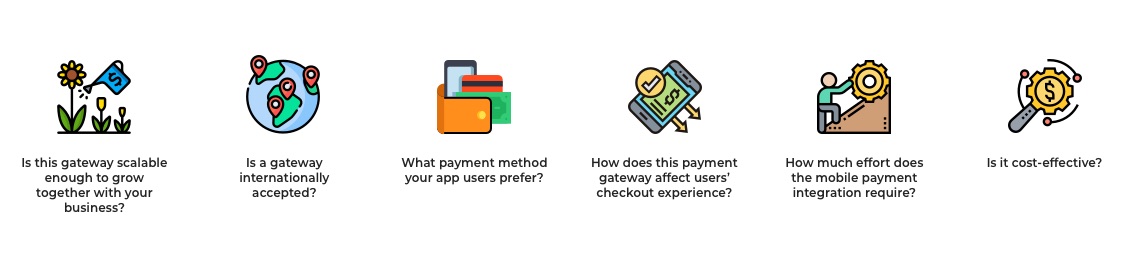
1. Is a gateway internationally accepted?
If you are a local business and there is a provider available in your region, then you can go with an equally local solution. However, when you feel more excited about cross-border trade, then international payment gateways will make the global marketplace more accessible for you. Besides, the latter option allows for supporting more customers.
2. Is this gateway scalable enough to grow together with your business?
In case you had expanded to be involved in international business activities, chances are your customer base will grow faster than the one of a local company. So, to prepare for an increase in sales volume, you had better check how drastically the transaction fees may change affected by this growth.
3. What payment method your app users prefer?
To not lose your potential clients, you should ensure there are as many payment methods supported on your mobile app as possible, or at least provide those that are the most popular among your app users.
4. How does this payment gateway affect users’ checkout experience?
The availability of the preferred payment method is a specific instance of the generally good checkout experience. Still, there are some other parameters to consider. It is vital to make the provided checkout experience fast and seamless, too. The credit card payment can be integrated faster with a gateway in your app and users can check out almost in one click of a button with the help of APIs and other tools aimed at the process optimization.
5. How much effort does the mobile payment integration require?
Ideally, payment gateway integration in Android and iOS applications does not take too much time and effort. However, great outcomes demand complex solutions, and such a thing as a customized nature that some gateways possess may involve extra development effort to be taken full advantage of.
6. Is it cost-effective?
Above, we have mentioned that Google and Apple charge fees for digital in-app purchases. Similarly, the use of payment gateways suggests that there are transaction fees to be paid. How big these fees will be depends on many factors and usually equals a percentage of the amount processed plus a flat fee.
What to consider before mobile payment gateway services implementation
You need to think all the details through before you start putting your plan into execution. So, we have come up with a list of issues to take into account during your strategic planning phase, so that you could witness its rewarding effects afterward:
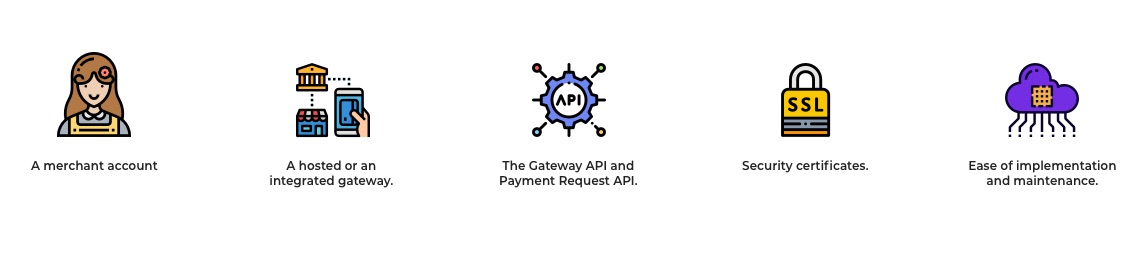
1. A merchant account.
Merchants are expected and sometimes required to have a bank account. These accounts allow accepting payments that go through payment gateways and payment processors settling your transactions.
What you should know is that there are two main types of merchant accounts: dedicated and aggregate. The former type provides its owners with the corresponding Merchant ID numbers that make their businesses easier to identify, more stable and protected from all kinds of fraud. Then, account owners get more control over transactions, which also take less time to complete with the dedicated account. But these advantages will come after paying extra.
The latter model, in turn, affords you the privilege of not paying account fees and not dealing with prolonged contract terms. The aggregate account, reasonably enough, turns a payment gateway into an aggregator shared by several businesses. Also, it is granted to them all by the same payment gateway provider.
2. A hosted or an integrated gateway.
Payment gateways can be either hosted off-site or integrated into your store. In simple terms, hosted gateways redirect customers to online payment service providers’ platforms where payment information is collected and processed. This method is viable if the provider is well-known to your customers and they will not be frightened away when directed off your website or app. Integrated payment gateways, in their turn, are connected to your website or mobile app through APIs, which creates a smooth user experience but still involves more development effort.
3. The Gateway API and Payment Request API.
While on the subject of the integrated gateways, we cannot but mention the payment request API. It improves the process of checkout, helps make a purchase in one API call and requires that your mobile app users complete fewer steps. Besides, online payment service providers can offer their own payment APIs (like Square does), which is another great option you can benefit from.
4. Security certificates.
Payment gateways operate with sensitive data, namely credit or debit card numbers and other personal information that cannot be disclosed. That is why the term Payment Card Industry Data Security Standard (PCI-DSS) has to be no strange to those who want to implement a payment gateway. Being compliant with this set of policies and regulations is a must for sellers handling transactions online. Some payment gateways can help you and make it easier to get PCI-DSS compliant but the others cannot. With or without this support, you have to avoid keeping the sensitive data outside your app server and storing it in your databases after a transaction is completed.
5. Ease of implementation and maintenance.
And last but not least, the ease of integration can be an important consideration from the developers’ perspective. How easy-to-use SDKs are, whether they are mobile platform-specific or allow implementation in a programming language of your choice — these are some of the key factors motivating the decision to work with a particular online payment service provider.
Of course, the list can go on and there are some more criteria to keep in mind and that differ from one provider to another:
Cost
Location
Compatibility
Customer service
Payment methods accepted by a gateway
Most popular mobile app payment gateways
1. Stripe
In itself, it is a payment service provider and a payment processor. What is important for us here is that Stripe offers its own payment gateway. The gateway accepts foreign payments in over 100 different currencies. This and the fact that Stripe delivers excellent customer service helps it win predominantly positive reviews from middle-sized and big businesses for which it is better-equipped.
2. Square
Square is a financial services provider and a mobile payment company that among others allows merchants to accept payments on a mobile app by integrating Square’s payment gateway in it. They offer a comprehensive solution with the built-in secure payment APIs, payment gateway and merchant account.
3. PayPal
Payflow is the payment gateway from PayPal. Payflow Link and Payflow Pro are the two options provided by PayPal. Every prospect Payflow user must have either a traditional merchant account with a bank or a merchant account with PayPal Payments. Payflow permits currency conversions and receiving payments from another country but merchants are charged additionally for these features. Besides, users have an array of payment methods to choose from and are assisted in steadily proving PCI compliance.
How much does it cost to get a payment gateway?
Even though Stripe, Square, and PayPal are the biggest players that serve the majority of the merchants present on the market, there are other online payment service providers. They can be distinguished by what payment methods their gateways accept, what regions and countries they work in, what perks they have in store for their clients, and naturally, how much they cost.
Stripe: 2.9% + 30¢ per each successful card charge. There are general rules like 1% of the transaction charged if money is transferred internationally, but also Stripe offers various customizable packages to satisfy every business’s needs.
Square: 2.75% per transaction, 3.5% + 15¢ per in-person payment. Square imposes no monthly or other additional fees. Account signup and payment activation are free of charge.
PayPal: $0.10 per transaction. To get started, businesses or single individuals who have opted for Payflow Link do not pay any entry fees. Pro users, in turn, pay $99 for set-up and $25 as a monthly fee.
SecurePay: 1.75% + $0.30 AUD per domestic transaction
Payline: $0.10 per transaction fee or $10 monthly fee
Finding a payment gateway solution that meets your needs takes time and effort, as does a payment systems integration itself.
Yet, now you know how to integrate a payment gateway in your app, where to start once your requirements are clearly stated, and what your essential first step should be towards safety and security, so important when selling goods and completing transactions on a mobile app. In case you need more details, do not hesitate to contact us. Our experience in implementing payment gateways will come in handy if you want to give your users the option of integrated payment processing!
AUTHOR BIO
Anastasiia Rezinkina
Copywriter / Content manager
Anastasiia is a content writer at Vilmate with a focus on e-commerce, AI, and emerging tech trends. She turns complex topics into clear, practical reads — whether it’s comparing CMS platforms or unpacking how AI is reshaping online retail.
At WWDC 2025, Apple introduced iOS 26. As always, there’s a lot of talk about the new design, AI-powered features, and improvements for gamers. The good news for app owners is that there are no significant disruptions this time. However, there are still some details to consider. They will help your app stay modern, easy […]
A smartphone is an essential accessory in the modern world. People use mobile devices to communicate, learn, work, and entertain themselves. Of course, shopping has also moved to smartphones. If you own a retail store, making it easily accessible on your customers’ smartphones should be a top priority. But it’s not just about having a […]
Mobile and web app distribution is crucial as it ensures widespread availability and accessibility, reaching a vast user base. It facilitates app discovery, enhances user engagement, and contributes to the app’s overall success by making it available on various platforms. Recently, our CTO Igor Bagayev held an internal townhall, where he presented some vital points […]
Cookies help us see what's working on this site and make it better. Your call on what we track.
Functional
Always active
The technical storage or access is strictly necessary for the legitimate purpose of enabling the use of a specific service explicitly requested by the subscriber or user, or for the sole purpose of carrying out the transmission of a communication over an electronic communications network.
Preferences
The technical storage or access is necessary for the legitimate purpose of storing preferences that are not requested by the subscriber or user.
Statistics
The technical storage or access that is used exclusively for statistical purposes.The technical storage or access that is used exclusively for anonymous statistical purposes. Without a subpoena, voluntary compliance on the part of your Internet Service Provider, or additional records from a third party, information stored or retrieved for this purpose alone cannot usually be used to identify you.
Marketing
The technical storage or access is required to create user profiles to send advertising, or to track the user on a website or across several websites for similar marketing purposes.