How to Build a Custom Electronic Health Record System
In this article
SHARE TO:
The healthcare industry is complex. It has to be always focused on patient safety and quality of care, which is much more challenging today than ever before. Therefore, healthcare professionals and patients are getting to use telemedicine technology, with electronic health record systems being an inherent part of it.
EHR systems help to bridge the pursuance of high-quality care and advancements in technology. They are meant to provide a usable, consistently reliable, and convenient solution to the problem of health record management. Many might have known or guessed that they are not easy to build and support. But what is an EHR system essentially?
In this article, we are going to go deep into the subject of electronic health record systems. We will give the definition of an EHR, learn more about the benefits of EHR systems, discover what features every EHR system must have and how you can achieve that.
What is an Electronic Health Record system?
An electronic health record system is a digital version of the paper charts. Unlike paper versions that patients have grown used to, electronic health records are considered more efficient, effective, and accessible to the patient and medical personnel alike.
EHR systems are designed to store patients’ medical and treatment histories, providing a broader view of a person’s health. Records can be shared with authorized providers like healthcare specialists, pharmacies, laboratories, emergency facilities, medical imaging centers, and more.
Sometimes, one can get confused over the EMR vs. EHR juxtaposition. Essentially, an EMR – an Electronic Medical Record – is less advanced than an EHR and refers to anything that could be found in a paper chart, including medical history, diagnoses, allergies, and immunization dates. In turn, the term EHR is used to store all the above data and more. An EHR system also allows sharing up-to-date information, retrieving information outside the individual practice, and using built-in tools to streamline decision-making. A regular EMP is designed to perform these tasks.
When choosing an EHR system, it is necessary to know what types are on the list. Accordingly, the standard approach to differentiating types of EHR systems is by considering where the servers storing data are located – who owns the data. These types include:
Physician hosted – the EHR data is on the physician’s server, which means they have purchased the required hardware and software and are responsible for data maintenance and security.
Remotely hosted – the EHR data is on the third-party server, which means that server maintenance and data security are the responsibility of the third-party owner of the server. The remotely hosted system can be further divided into three groups:
Subsidized – the EHR financing is subsidized by another entity, such as a hospital, with whom a physician enters into a legally binding relationship.
Dedicated – the data on electronic health records are stored on the vendor’s dedicated servers.
Cloud – the EHR data is stored in the cloud, meaning that the EHR software is not installed on the physician’s computer, but instead, it is accessed through the vendor’s website.
Despite all the good that EHR systems are generally expected to bring to the table, electronic health records have been by many regards considered imperfect. Yet before the Covid-19 coronavirus struck, they had been known to be the source of much extra work and relatively few benefits.
However, after the pandemic highlighted those flaws even more brightly, the direct pathway to the long-needed transformation also got clearer. In particular, this ongoing transformation means the shift of focus from keeping track of what happened to the patient to offering healthcare workers the means to better address the health issues. Useful EHRs must help providers make diagnoses and plan treatment. So, let’s discuss in more detail what can be done during the EHR system development process to make this change happen.
Benefits of EHR systems
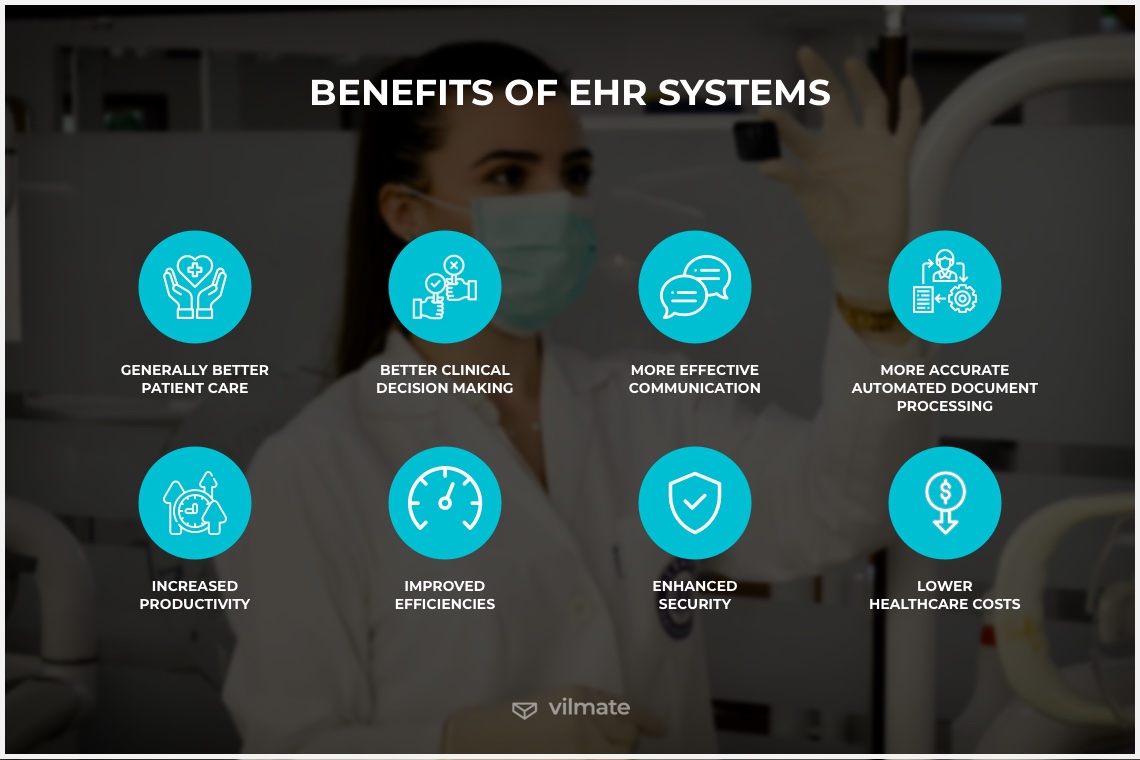
Electronic health record systems ensure a number of advantages to their users. Thus, implementing an EHR system in a hospital, one takes a massive step towards improving document management in the organization and thus transforming health care. EHR system’s key capabilities allow managing patient-centered records in real-time, making needed information instantly available to authorized users, and much more. Let’s take a look at the most outstanding benefits of EHR systems in healthcare.
Generally better patient care. EHR solutions can substantially improve health care quality. First and foremost, they enable quick access to patient records, which makes healthcare more convenient for patients and providers alike. Processes become more coordinated and efficient as authorized individuals can get reliable access to accurate, up-to-date, and complete information about patients at the point of care.
Better clinical decision making. EHR products, by integrating patient information from multiple sources in one place, help streamline diagnostics outcomes. When the patient’s medical history, all their diagnoses, treatment plans, subscribed medications, allergies, immunization dates, medical images, and test results orderly appear in a single patient account, practitioners can more effectively diagnose patients and provide safer care. Advanced EHR systems even grant access to evidence-based tools that providers can use to reduce medical errors and make better decisions about a patient’s care.
More effective communication. EHRs help improve interaction and communication between a patient and a healthcare provider, which results in increased patient participation in their care and enhanced health care convenience. As both a patient and a doctor have access to electronic health information, it is easier for them to connect and understand each other. It is especially important to be able to communicate quickly and efficiently when it comes to managing chronic conditions or providing follow-up information after an appointment or hospital stay. Besides, practitioners’ communication with other clinicians and labs can also be enhanced through the use of an EHR system.
More accurate automated document processing. EHRs bring improved documentation and automated coding capabilities to the table. They not only automate and streamline provider workflow but also help promote and foster legible, complete documentation based on accurate billing and streamlined coding.
Increased productivity. EHR systems help providers improve their productivity. When all the information is accurate and easy to find, the care coordination becomes less cumbersome, and healthcare providers’ productivity starts to increase. Better patient information availability can help avoid unnecessary tests and reduce medical errors that can occur when the healthcare team’s view of a patient is fragmented due to limited interactions with them. As a result, it is nearly impossible, with an EHR system in place, to imagine the bottlenecks occurring when treating patients seeing multiple specialists or making transitions between care settings.
Improved efficiencies. A medical EHR system empowers healthcare providers to improve practice efficiency due to streamlined medical practice management. Electronic health records contain information useful for specifying queries based on patient’s conditions. It helps save time due to easier disease management and educate patients for their own good. All these aspects contribute to the structural integrity and cohesion of information and allow centralized chart management. This way, the whole workflow becomes more efficient.
Enhanced security. EHR development means that patients, practitioners, and all other actors in the care delivery process will get a chance to securely access medical records. An EHR system enables the secure sharing of electronic information with patients and other clinicians. It makes it safer and more reliable to prescribe medications and manage prescriptions. Deciding to create an EHR, one chooses to enhance the privacy and security of patient data.
Lower healthcare costs. Cost reduction is one of the most significant benefits of EHR systems. In particular, costs can be reduced through decreased paperwork, improved safety and health, and reduced duplication of testing, which can happen when communication is troubled. First of all, the costs of chart pull, data storage, and re-filing misfiled documents can go down. Moreover, an EHR user will need much less time and resources for manual charge entry, resulting in more accurate billing and reduced charges.
Must-have features of an EHR system
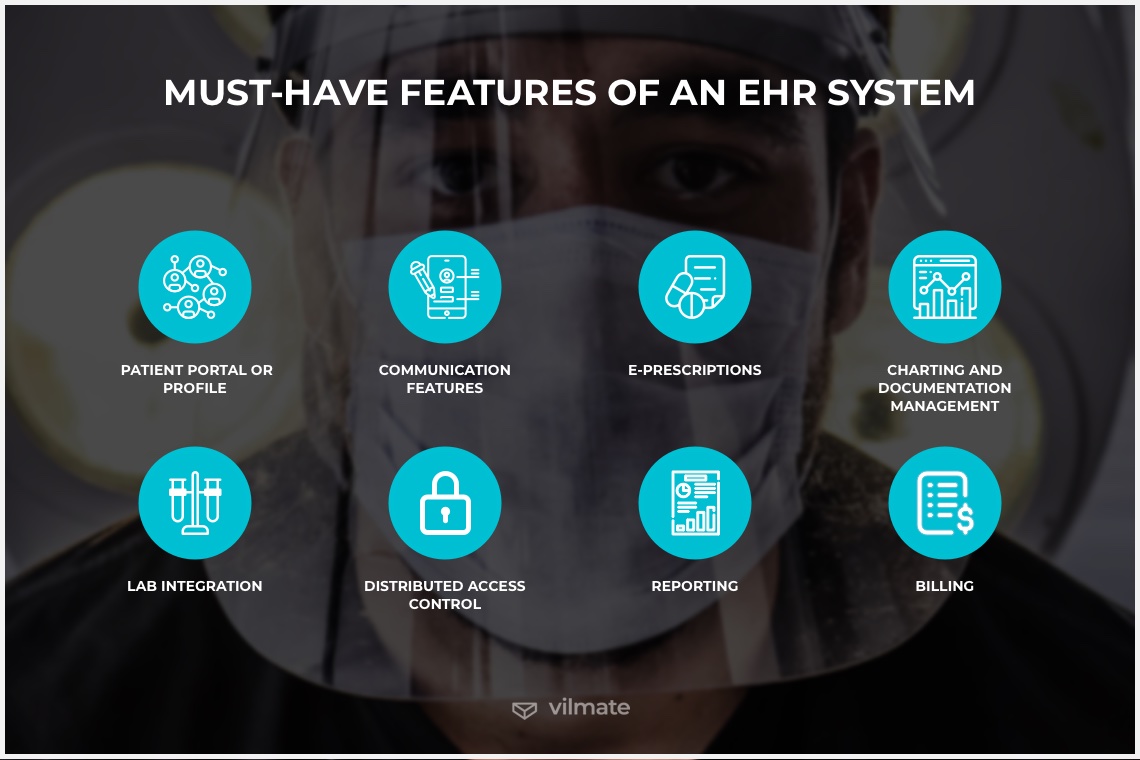
Well, the advantages of implementing an EHR system in a hospital or private practice are plentiful. Yet, what are the components of a fully functional EHR? Let’s briefly discuss the top nine features of an electronic health record system.
1. Patient portal or profile: A medical patient portal can work as a stand-alone app or be an extension to an EHR system. To set up a patient portal account, patients usually should receive corresponding documents like an activation code or instructions for activating and using the portal from their healthcare provider. EHR patient portals provide means for patients to:
Access personal health data published there by a healthcare facility
Schedule in-person or virtual doctor’s appointments online
View past appointments, as well as view, reschedule or cancel future ones
Download and complete registration forms prior to an appointment at the comfort of their homes
View diagnostic test results or medical images online 24/7
Update contact and other personal information
Receive notifications when new information is available: test results, medical documents, prescriptions, or bills
2. Communication features: Clients can use a patient portal or profile to efficiently and productively communicate with their health care providers and vice versa. Messaging the health care team with patients via the portal is an easy way to provide appointment follow-ups, ask questions and quickly receive answers from healthcare specialists to one’s inbox. The ability to directly and securely message with the health care team is one of the most game-changing features that make EHR systems appealing to patients and healthcare workers alike.
3. E-prescriptions: Electronic prescribing is another feature that must be supported by EHR software systems. Most treatment-seeking patients are used to making an appointment with a doctor who, as they finish up their meeting, will give them a hand-written prescription that they, later on, will give to their pharmacist to get a drug. Although this approach is time-tested, it may have some downsides that are otherwise eliminated with e-prescriptions. Not only is it easier for users to request prescription refills, but also an authorized person can view what other medications a patient takes to prevent potentially dangerous drug interactions. Besides, when all the information is readily available in electronic health records, incorrect dosage amounts are not an issue anymore, and a patient can clarify prescribing instructions or report side effects once if and when they occur.
4. Charting and documentation management: One of the main reasons to use EHR systems is to manage the abundance of medical documentation. A medical charting feature allows viewing detailed systematic information about doctors’ interactions with patients, the patient’s conditions, care, and treatment. All charts and documentation have legal force and are legally binding. It is the medical providers’ responsibility to keep detailed charting documentation, which allows them to better manage claims reimbursement in the future and eliminates the need to navigate away from the patient’s chart to prescribe medication or complete any other routine tasks – everything is in the charts. With a custom charting module, the provider has the power to seamlessly manage documentation using the following subfeatures:
Medical history and appointments monitoring
Electronic prescription management
Patient progress tracking
Safe storing of test results and medical images
Data exchange with other modules
Customizable specialty-specific EHR templates
Speech-to-text transcription
Protected health information (PHI) maintenance
Access to medical guidelines and protocols
5. Lab integration: A lab information system can be designed to be part of an EHR system or an independent program. One way or the other, lab integration in an electronic health records system allows tracking and receiving test results almost effortlessly. It is supposed to help medical laboratories address the most common issues like human errors, slow turnaround times for lab tests, and inventory availability. This way, patients are better informed about their health conditions, and laboratories are empowered to improve the way they manage their internal processes.
6. Distributed access control: Health-related data is considered sensitive and, therefore, must be carefully protected from leaking to third parties. Role-based access control is what allows handling the situation appropriately. Access control in healthcare information systems, in the first place, helps ensure that only authorized users have access to resources in a system. What is more, however, when configuring access control, one must make sure that clinicians will get all the data they need to make well-considered informed decisions. Therefore, it might take extra effort to map strict yet reasonable access control rules that would be process-based but clearly define who can create and manage records containing one or another type of information.
7. Reporting: Effective reporting can and should be incorporated into every EHR system. It can improve the safety of electronic health records use and system usability. Detailed meaningful reporting is a key to acquiring valuable clinical and financial data that can be used to get insight on what to focus on to improve the quality of services delivered via an EHR system. These analytical data also facilitate evidence-based decision-making and quality management.
8. Billing: Any advanced EHR system must include a medical billing dashboard to make billing fast and convenient. For better EHR system efficiency, a billing management module should be integrated with medical scheduling and practice management modules. Then, users will be in a position to:
Add payment methods and store bank information for future payments
View and update patient’s insurance information
Submit and respond to billing queries
Transfer data from charts to bills
View billing history of medical payment records
9. Cloud computing: Arguably, the best EHR systems are cloud-based. Electronic health records can be hosted on computers locally or remotely. The former is also referred to as a traditional EHR system, and the latter is a cloud-based EHR system. So, choosing the type of a future electronic health record system is an important step that must be taken yet before the project implementation. Although this choice should address particular clinical practice’s needs, cloud-based EHRs are being opted for more and more often. There are several reasons for this shift:
It minimizes management effort
Upfront hardware and software costs are substantially lower
Maintenance costs are also reduced
The level of IT service availability is much higher
It allows starting small to increase IT allocations as and when necessary
Run-time failures are less of an issue as regular data backups can be performed automatically
There are several steps to successful EHR implementation. One of the most critical stages in the EHR development process is the selection of the tech stack for your electronic health record system. The chosen technologies must serve the single purpose of creating a usable, reliable, service-oriented architecture. In turn, this architecture must guarantee health information technology interoperability that allows for cohesive exchange, interpretation, and use of data among different systems.
In order to create the modern service-oriented architecture, the application has to be split into separate modules that would communicate with one other via REST API. One can also think of these modules as services (billing, charting, etc.) First of all, this type of architecture enables better app scalability, easier system maintenance, and more precise fault detection, isolation, and recovery. What is more, a development team then can ensure the system’s compliance with the existing healthcare regulations like HIPAA and HITECH, GDPR, PIPEDA, or PCI-DSS.
That said, let’s take a brief look at what parts the EHR system architecture should consist of:
Backend: The back-end technology stack requirements are defined based on the desired EHR system development scale and sophistication level. Simultaneously, the back end is where the system’s logic is built, so all technologies you choose must be in tune with one another. These technologies are:
Frontend: An EHR system can be designed for PC only, or it can additionally be supported on smartphones and tablets. The system’s front-end – the visible to users part – should be created with this consideration in mind. Tablets are convenient devices widely used in the service sector in developed countries, so developing a tablet-friendly mobile application compliant with iOS and Android operating systems might be the right decision for you. One way or the other, to create the EHR system front end, one will need the following technologies:
A programming language
Web frameworks and libraries
iOS SDK
Android SDK
UI/UX design: User interface and user experience design cannot be overlooked when developing healthcare information technology systems. A well-designed UI/UX is instrumental in hiding the inherent complexity of healthcare software from end-users. It must seamlessly guide the user through the workflow emphasizing the system’s key features and functionality and helping them get the intended outcome without confusing them or pushing to erroneous decisions.
Quality assurance: As a rule of thumb, every app must be extensively tested, especially when we talk about health records. Therefore, each development team must include a quality assurance engineer who will develop an appropriate testing strategy and help the team make an EHR system flawless, secure, and convenient to use.
Conclusion
Electronic health records are becoming an integral part of the modern healthcare landscape. If you or your organization is looking into the possibility of developing your own custom EHR system, we should ensure you are on the right track! The EHR software built from scratch can meet your needs as no out-of-the-box solution would.
With the user-centric design and custom functionality, your EHR system will satisfy all stakeholders. Yet, to achieve that, you will need a qualified, reliable, and experienced software development vendor. Vilmate has years of experience building software systems from the ground-up, in the healthcare sector particularly.
If you are interested in discussing the possibility of working together on your project or have any questions, reach out to us using the contact form below!
Hanna is a content writer at Vilmate with a background in English philology and a genuine curiosity for all things tech. She covers topics at the intersection of design, development, and emerging technologies — from UX writing and voice interfaces to AR/VR and mobile apps.
For most private clinics, digital transformation in healthcare has quietly turned from a nice idea into a survival question. It’s not about following trends – it’s about keeping patients, doctors, and processes in sync. Patients now expect the same simplicity they get from any other service: book an appointment online, get test results without calling […]
Technology is quietly changing the way healthcare works. What once took endless paperwork and phone calls now happens inside healthcare software – from patient scheduling and billing to secure data management and modern telehealth software solutions. These digital tools have made medicine faster, more organized, and in many ways, more accessible. Still, if you ask […]
Starting a healthcare startup is exciting, but it can also be overwhelming. You’re dealing with patient privacy, strict rules like HIPAA and GDPR, and the challenge of integrating with hospital systems that often feel far from modern – all while investors push for quick results. Many founders encounter the same problem: work is split between […]
Cookies help us see what's working on this site and make it better. Your call on what we track.
Functional
Always active
The technical storage or access is strictly necessary for the legitimate purpose of enabling the use of a specific service explicitly requested by the subscriber or user, or for the sole purpose of carrying out the transmission of a communication over an electronic communications network.
Preferences
The technical storage or access is necessary for the legitimate purpose of storing preferences that are not requested by the subscriber or user.
Statistics
The technical storage or access that is used exclusively for statistical purposes.The technical storage or access that is used exclusively for anonymous statistical purposes. Without a subpoena, voluntary compliance on the part of your Internet Service Provider, or additional records from a third party, information stored or retrieved for this purpose alone cannot usually be used to identify you.
Marketing
The technical storage or access is required to create user profiles to send advertising, or to track the user on a website or across several websites for similar marketing purposes.