Enhance Your Business with POS Systems: A Path to Growth and Customer Loyalty
In this article
SHARE TO:
Entrepreneurs aim to make shopping more convenient for customers, offer personalized services, and simplify business operations. That’s why many e-commerce business owners have replaced traditional cash registers with point-of-sale (POS) systems. A POS is a physical or virtual place where customers can pay for purchases. However, this solution can no longer function without a specialized POS system.
A POS system speeds up the service process and opens new opportunities for data analysis, inventory management, and customer loyalty. Modern POS systems are essential for scaling a business and creating a unique shopping experience.
Today, we will explain what POS systems are, the different types available, and the role of omnichannel support. Let’s explore this topic to uncover new opportunities for your business!
Points of Sale System: What It Is and How It Works
A POS system combines hardware, software, and payment services. You can use it at physical and virtual points of sale to register purchases, process payments, and generate receipts. Online businesses may not need equipment to set up a point-of-sale system. Receipts can be sent electronically, and payments can be made online.
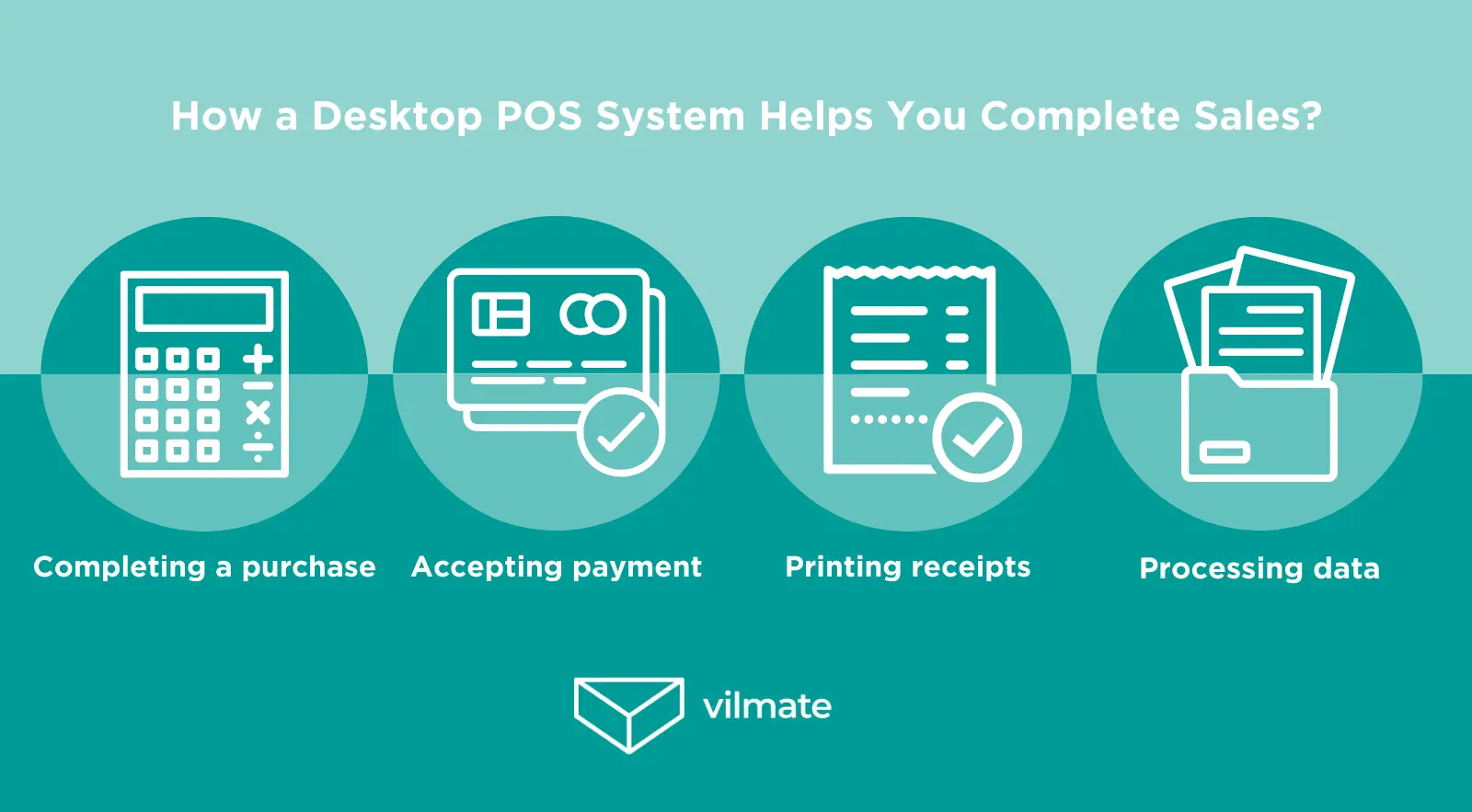
Advanced POS systems can also create reports, assist with logistics, and track store performance. A desktop POS system lets you complete sales by following these steps:
Completing a purchase: Scan product barcodes or press programmed keys on the terminal. The system calculates the total amount, adds tax, applies discounts, and allows customers to leave tips.
Accepting payment: Special equipment processes payments on-site. The POS system makes transactions fast and easy when customers pay by card.
Printing receipts: After payment is processed, the POS system prints a receipt or sends it to the customer via email. You can also add a loyalty program and include customers for personalized discounts.
Processing data: The POS software handles customer payments and generates reports on average purchase amounts, peak sales times, and other metrics.
If you’re unsure how a point-of-sale system differs from a cash register, we’ll explain this in more detail.
Cash Register vs. Point of Sale System
Experienced business owners know cash registers well, as they were once the only option for processing customer payments. However, more businesses are moving away from cash registers as they understand the importance of digitalization. POS systems are easier to use and offer many benefits for payment management. Online businesses also see them as the best choice.
In 2020, the market value of POS software was $9.3 billion and is expected to reach $18.1 billion by 2027.
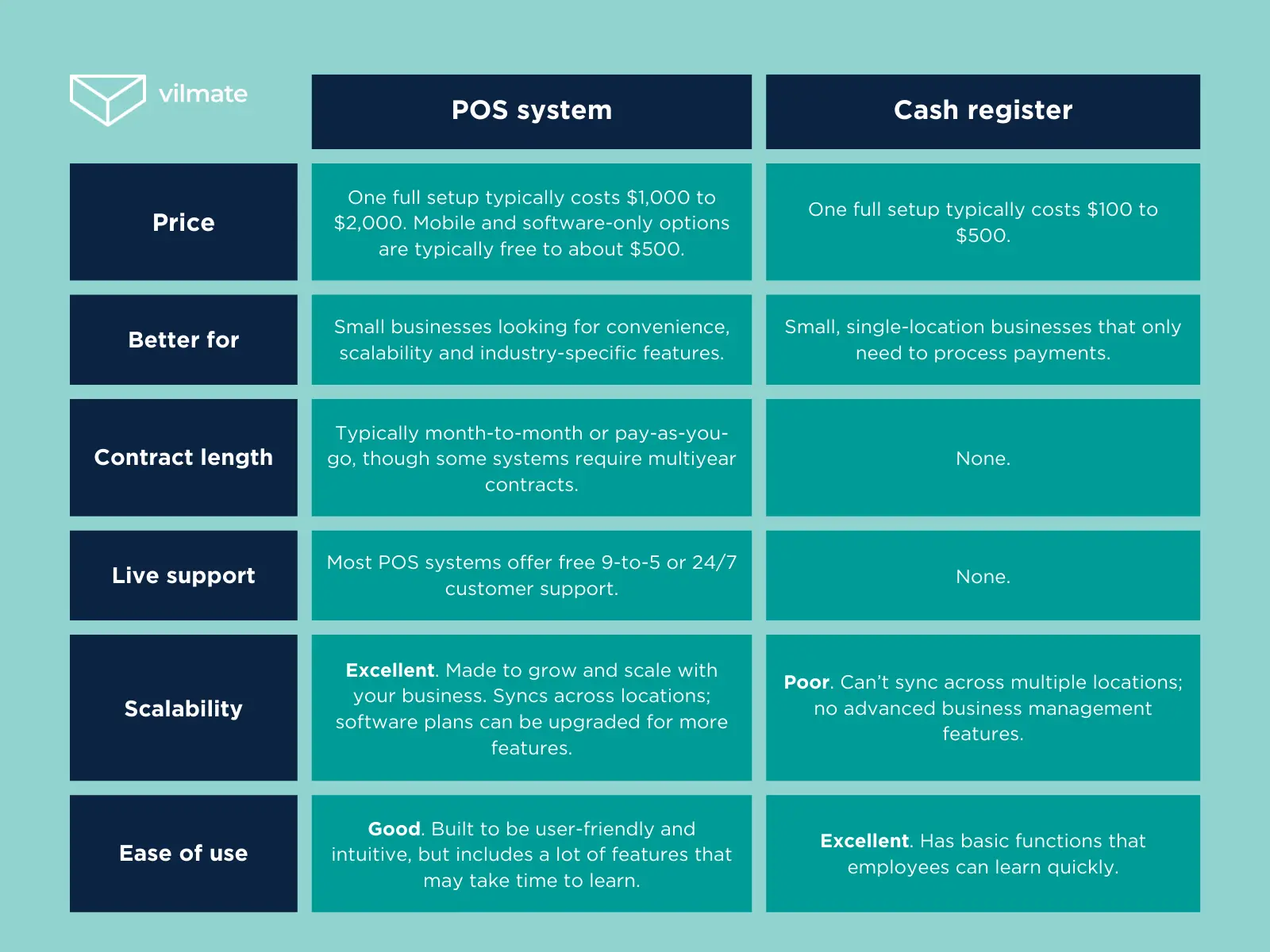
So, what is the difference between a point-of-sale system and a cash register? Both can accept cash and checks, but only a POS terminal has built-in credit card processing. Most cash registers also lack features such as tax and discount calculations, data analysis, or integration with external barcode scanners. POS systems provide all these functions, making the payment process more modern and efficient. Let’s look at a comparison table of these methods based on different criteria.
We can already make some conclusions from this information, but let’s explore the advantages of POS systems in more detail.
Key Benefits of a POS System
POS systems are replacing traditional cash registers because of their advanced capabilities beyond simple sales recording. Here are the main benefits:
Convenience and speed: POS systems make payments faster and more convenient, supporting various methods, including cash, card payments, digital wallets, and contactless transactions.
Integration with other tools: POS systems can connect to CRM systems, inventory management systems, analytics platforms, and other business applications. This integration helps automate tasks, reduce errors, and save time.
Advanced analytics: POS systems collect data on sales, customer behavior, and employee productivity. This data helps business owners make better decisions and create effective strategies.
Personalized service: POS systems store customer information, preferences, and purchase history, making it easier to offer personalized deals and loyalty programs.
Scalability and mobility: Modern point-of-sale systems can grow with your business. Mobile POS (mPOS) can be used at events or in small spaces like cafes.
Regulatory compliance: POS systems help automate tax calculations, issue fiscal receipts, and meet regulatory requirements, which is increasingly important in a stricter regulatory environment.
Another benefit of POS systems is their flexibility, which allows them to adapt to the needs of different industries. Let’s take a closer look at how this flexibility can benefit your business.
Personalizing POS Systems for Different Industries
POS systems are typically designed to meet the needs of various industries, making them versatile tools for businesses. Here are some examples:
1. Retail
In retail, a POS system simplifies inventory management. It updates stock levels after each sale, helping prevent out-of-stock situations. You can also use these systems to set up loyalty programs that retain regular customers and attract new ones with personalized offers.
For online store owners, POS systems integrate offline and online sales into a single system. This makes it easy to sync sales data, track returns, and analyze transactions in real time. It creates a better experience for both you and your customers.
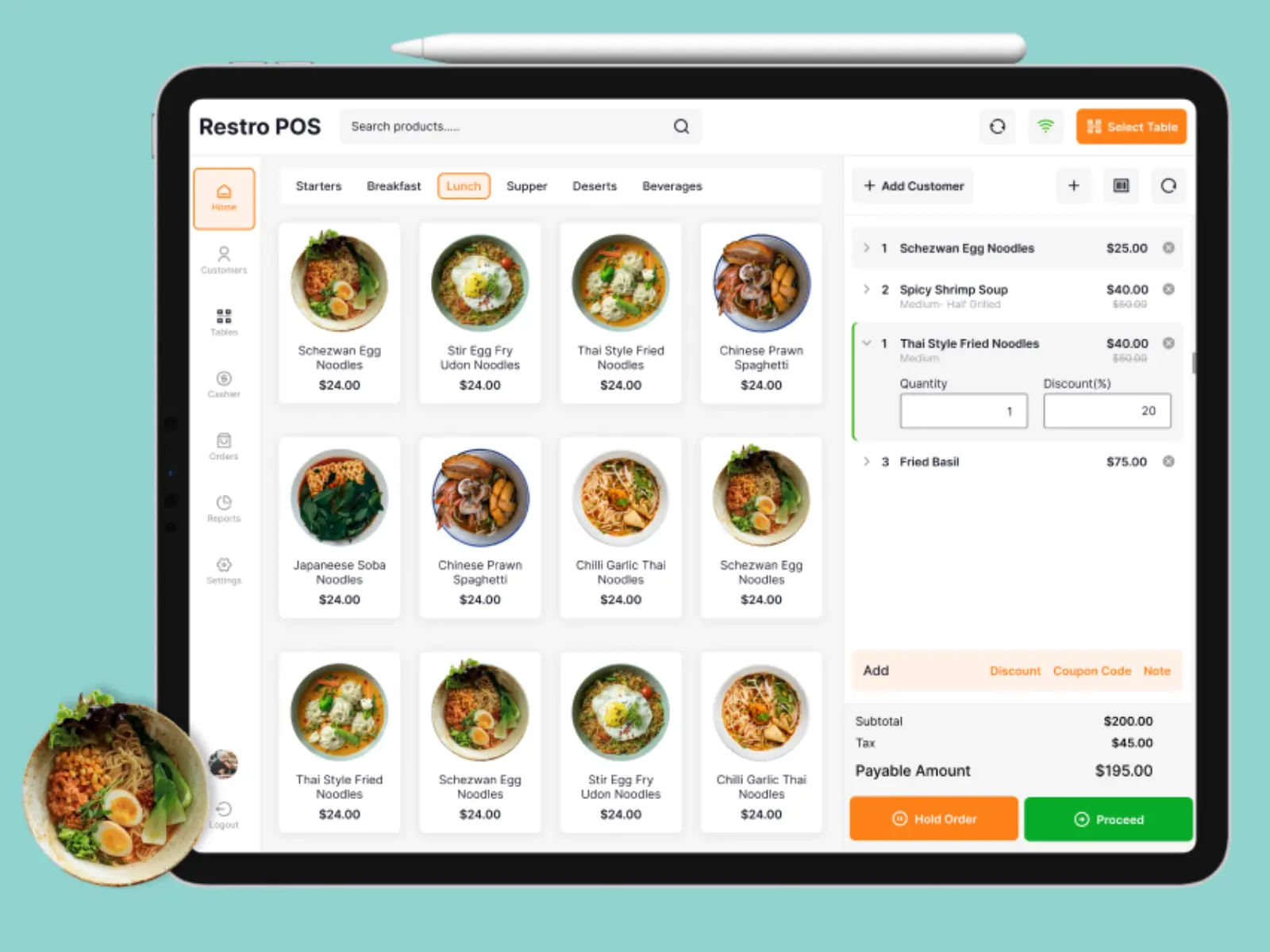
For restaurants and cafes, a POS system speeds up and streamlines service. You can take orders on tablets or terminals, send them directly to the kitchen, handle complex orders (such as splitting the bill), and manage tips. These features greatly improve your guests’ experience.
For service-based businesses, such as beauty salons or fitness centers, a POS system helps you process payments, manage client appointments, schedule staff, and track sales of products like cosmetics or sports supplements.
4. Hotels
For hotels, point-of-sale systems help automate payments for extra services, like dining, spa treatments, or equipment rentals. They also integrate with booking systems, making payments smoother and enhancing guest comfort.
To get the most out of your POS system, it’s important to understand its core components and functionalities. The following section will outline the essential features of a POS system.
Key Components of a POS System
What does a POS system include? It mainly has two parts: hardware and software.
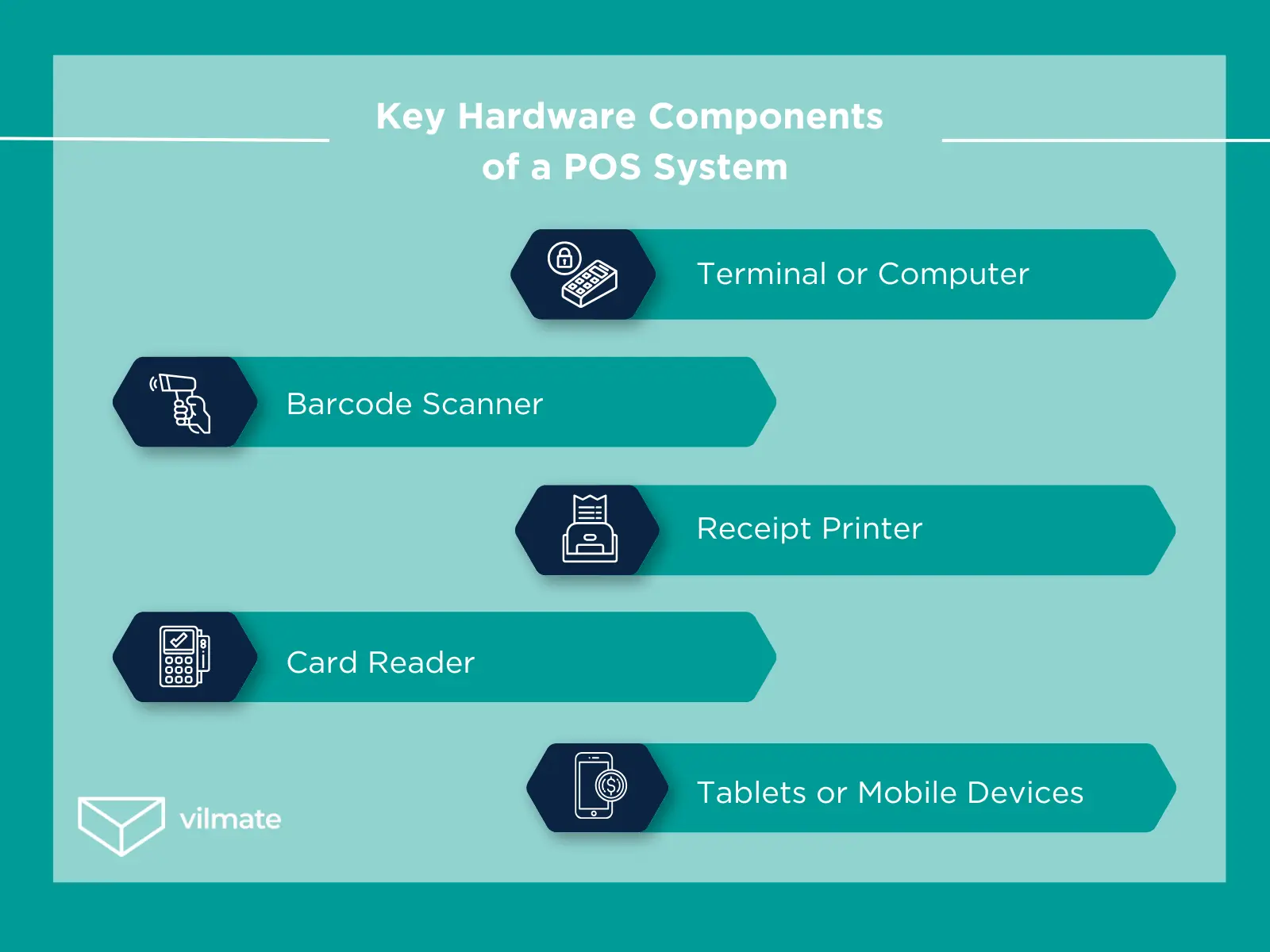
Hardware is essential for physical sales points and can include:
Terminal or Computer — the device used to manage sales and track inventory.
Barcode Scanner — quickly inputs product information into the system.
Receipt Printer — provides customers with payment confirmation.
Card Reader — processes payments from bank cards, including chip and contactless cards.
Tablets or Mobile Devices — used in mobile POS systems for on-the-go sales or smaller sales points.
POS Software can be local or cloud-based. These options differ in how they work, how they are installed, and their features:
Local software is installed directly on the devices used for sales management (e.g., terminals, computers, or servers). This type is considered outdated today, as it only works on the POS terminal on which it is installed.
Cloud-based software runs on servers that can be accessed online. Users manage the system through a web interface or mobile app. Popular providers include Clover, Square, Toast, and Shopify.
Integrating a POS system into your business may seem complex and detailed. It is true — integration should be done by experienced professionals in this work. If you want to implement a POS system that meets your business needs and supports data analysis and other processes, contact Vilmate. Our team has extensive experience in e-commerce solutions, including points of sale system integration.
At the start of this article, we discussed how POS systems connect with omnichannel support. Now, we will share important information on how POS systems expand their capabilities.
Why You Need an Omnichannel POS System
Omnichannel service is now a standard for successful e-commerce businesses. Customers can start interacting with a store through one channel and switch to another while keeping their conversations and actions in sync. This helps managers maintain context when meeting a returning customer for the first time or moving a new customer to a different channel, making it easier to provide personalized service.
In the U.S., 75% of customers expect an omnichannel service that lets them shop online and in-store. For example, customers want to be able to buy items in-store and return them online (or vice versa) without any problems. This is where an omnichannel POS system is essential.
An omnichannel POS system connects different sales channels — online and offline — into one platform. The system allows businesses to provide customers a more flexible and convenient shopping experience. You can sell through an online store, a physical location, or on marketplaces; all these channels will work together as one cohesive system. Let’s look at some examples of the benefits of an omnichannel approach and how they work in practice.
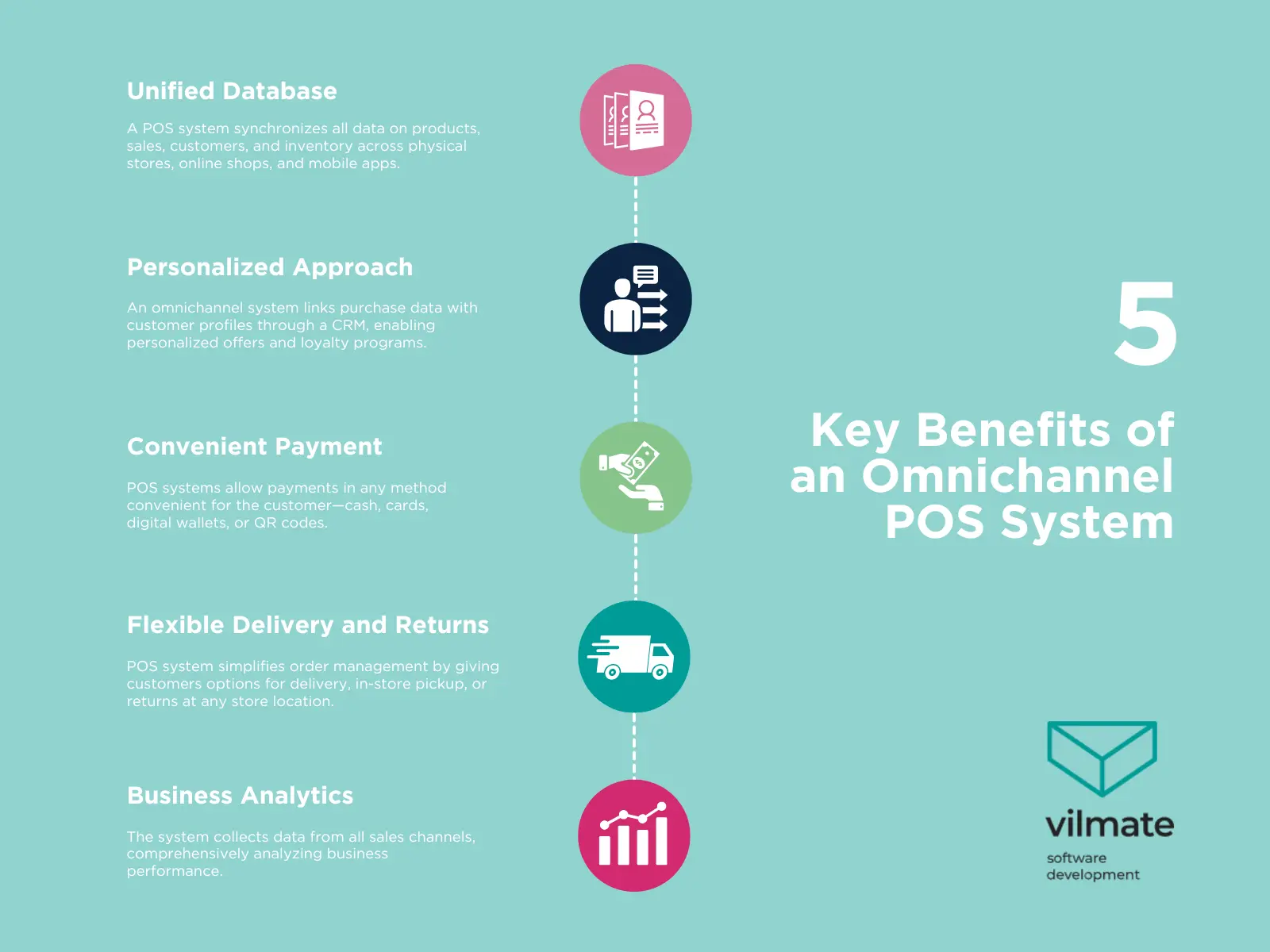
1. Unified Database
A POS system synchronizes all data on products, sales, customers, and inventory across physical stores, online shops, and mobile apps.
For example, imagine you own a clothing store. A customer visits your online shop, selects a T-shirt, and sees that it’s in stock at the store near their home. They order it online but pick it up in the store. The customer can do this because the system keeps all product data synchronized.
2. Personalized Approach
An omnichannel system links purchase data with customer profiles through a CRM, enabling personalized offers and loyalty programs.
For instance, a customer once bought a sports T-shirt from you. The system remembers this purchase and sends them a discount on sportswear. When the customer visits the store, the salesperson knows their interests, offers relevant options, and adds bonus points as a gift. This mechanism works thanks to integration with the customer database.
3. Convenient Payment
POS systems allow payments in any method convenient for the customer—cash, cards, digital wallets, or QR codes. An omnichannel POS system also supports mobile devices, allowing employees to take orders and payments on-site or at off-site events.
This variety makes shopping as convenient as possible for the customer. Imagine a shopper selects an item in the store but doesn’t want to stand in line. The salesperson brings over a mobile terminal (tablet or smartphone with mPOS), and the customer can pay immediately. This type of service is memorable and encourages the customer to return.
4. Flexible Delivery and Returns
An omnichannel POS system simplifies order management by giving customers options for delivery, in-store pickup, or returns at any store location.
For example, a customer bought a T-shirt at one store but wants to return it while in a different area. With an omnichannel POS, this is not a problem; returns can be processed at any store.
5. Business Analytics
The system collects data from all sales channels, comprehensively analyzing business performance. This approach allows for quick, informed decision-making.
For instance, you might notice that most customers buy shoes online but visit the physical store for accessories. This insight helps you better organize your product assortment and marketing strategies.
Overall, if you have multiple sales channels, an omnichannel point-of-sale system serves as a single control panel that simplifies everything—from inventory management to customer interactions.
Conclusion
If you think you provide a personalized user experience without an omnichannel POS system, you’re not alone—85% of companies believe the same. However, 60% of customers strongly disagree.
While other business owners may feel they don’t need to make improvements, you can take action now! We are confident that adopting an omnichannel POS system will give you a significant advantage over your competitors.
Implementing a POS system, especially with an omnichannel approach, is challenging. But with Vilmate, you can do it! Our team has extensive experience with e-commerce and can develop and integrate any modern solutions. Contact us to unlock new opportunities for your business and deliver an exceptional user experience for your customers!
AUTHOR BIO
Anastasiia Rezinkina
Copywriter / Content manager
Anastasiia is a content writer at Vilmate with a focus on e-commerce, AI, and emerging tech trends. She turns complex topics into clear, practical reads — whether it’s comparing CMS platforms or unpacking how AI is reshaping online retail.
CRM and order management systems are two different systems that exchange data. They address different questions: it’s “Who is our client, and why are they buying this?” for the CRM and “What exactly has been ordered, and where is it now?” for the OMS. These two systems are meant to complement each other, but in […]
Building or selecting an OMS without a clear list of requirements is like building a house without a blueprint. Companies often focus only on order intake and overlook critical backend fulfillment, inventory synchronization, and less common order scenarios. Avoiding these mistakes means distinguishing between business needs and the technical tools that fulfill them—which is why […]
Most online stores and wholesale businesses start with ready-made SaaS platforms. In the early stages, these off-the-shelf cloud solutions are often enough and cover essential business needs. This becomes a problem when your business grows, but the software doesn’t keep up. If you have to change some internal processes or manually fill in spreadsheets only […]
Cookies help us see what's working on this site and make it better. Your call on what we track.
Functional
Always active
The technical storage or access is strictly necessary for the legitimate purpose of enabling the use of a specific service explicitly requested by the subscriber or user, or for the sole purpose of carrying out the transmission of a communication over an electronic communications network.
Preferences
The technical storage or access is necessary for the legitimate purpose of storing preferences that are not requested by the subscriber or user.
Statistics
The technical storage or access that is used exclusively for statistical purposes.The technical storage or access that is used exclusively for anonymous statistical purposes. Without a subpoena, voluntary compliance on the part of your Internet Service Provider, or additional records from a third party, information stored or retrieved for this purpose alone cannot usually be used to identify you.
Marketing
The technical storage or access is required to create user profiles to send advertising, or to track the user on a website or across several websites for similar marketing purposes.