Navigating Software Development: Time and Material vs. Fixed Price Contracts
In this article
SHARE TO:
A high-quality website or application is essential for a successful business. Today, most companies aim to establish an online presence, and many startups focus on bringing new, valuable ideas to life. Software development is a complex process that requires professional expertise. You’ll find several cooperation models for this expertise, each with benefits.
The most common collaboration types with IT companies are Time and materials and Fixed price. In this article, we’ll explain when it’s best to choose a T&M contract and when a Fixed price approach might work better. We’ll also discuss hybrid models and share some insights from Vilmate.
What Is a Time and Material Contract?
Before discussing the pros and cons, it’s important to understand what time and materials mean. This model involves paying specialists hourly for the work they complete on your project. You pay as you receive results.
Predicting the final budget and timeline is challenging with T&M. Managers provide only rough estimates, which may change by the project’s end. This model is often chosen when the main priority is achieving the desired result, not strictly controlling costs.
Now, let’s look at all the aspects of a T&M contract.
Project Timelines: Time & Material does not set a strict deadline, unlike other collaboration models. The project is broken into shorter phases, usually lasting 2-4 weeks. These phases are easier to manage and allow for quick adjustments. Each phase targets a specific task or goal. After each completed task, you receive a detailed report to review the results and provide feedback.
Payment for Specialist Work: A Time and Material contract charges you based on specialists’ hours on your project. You agree with the company on an hourly rate, and the project manager estimates the time needed for each task. This approach directly links payment to the hours worked by the IT team. You can pay for each task individually or receive a combined invoice at the end of a set period. Detailed reports from the company offer clear visibility into your investment, ensuring transparency.
Flexibility and Change Management: T&M contracts allow changes without major restrictions, so you can test ideas and make improvements quickly. The client and the team can adjust priorities and strategies regularly, which is especially helpful for projects with high uncertainty or innovative goals.
Quality Control: The T&M model emphasizes quality at each stage, as there are no strict deadlines. The team can focus on refining and testing each feature thoroughly while the client can monitor quality throughout the process. Immediate feedback allows for predictable, reliable results.
A T&M contract is an excellent choice for projects requiring flexibility, quality control, and adapting to changes. Choosing Time & Material offers several key advantages:
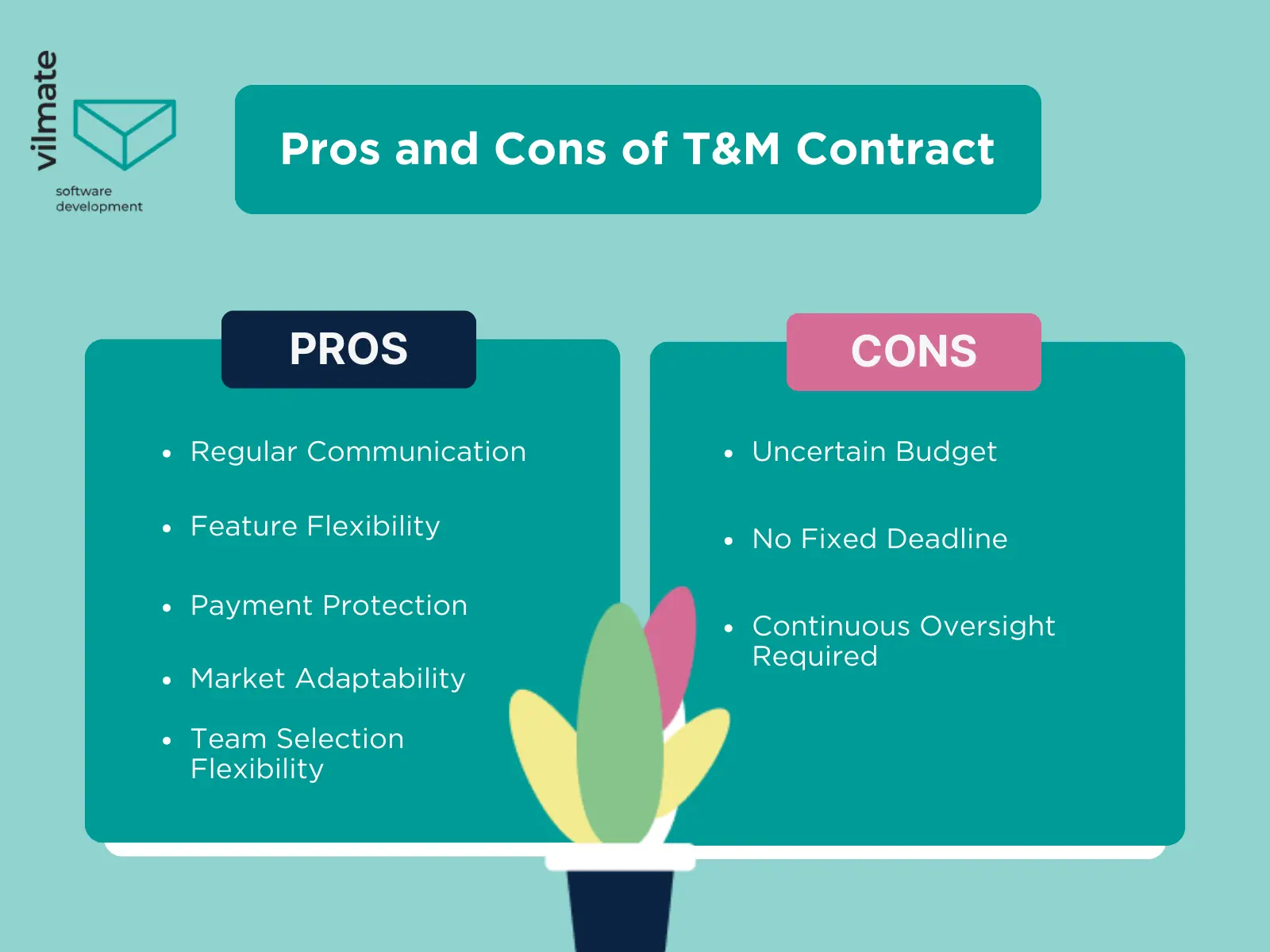
Regular communication with IT specialists for responsive project management.
The ability to add new features, adjust strategies, and find the best solutions for high-quality results.
Payment protection for both the client and provider.
Quick adaptation to market changes.
Flexibility in team selection, allowing you to approve the specialists working on your project.
The option to use Agile methods instead of the traditional waterfall approach.
However, if T&M were perfect for every project, there wouldn’t be any alternatives. Like any approach, it has certain downsides:
Uncertain Budget: Without a fixed price, the final cost may be higher than expected.
No Fixed Deadline: Projects can take longer if requirements frequently change.
Continuous Oversight Needed: While some consider this an advantage, others may find it a drawback. If you prefer to receive a ready-made result without constant involvement, T&M may not be the best fit.
Choosing the right IT company is crucial for a Time & Material contract. Some unreliable developers might inflate the hours required to increase billing. Vilmate is firmly against such practices. We guarantee transparency and accuracy in estimating work time and costs. Our team uses proven methodologies, provides regular progress updates, and adheres to high-quality standards, so you can trust the reliability and efficiency of our services. Contact us if you’re interested in a T&M contract and a high-quality digital product!
When we evaluate your project, we can recommend the best collaboration type for your needs. But if you’d like to decide independently, we’ll offer a few tips to help you make the right choice.
Which Projects Are Best Suited for a Time & Material Contract?
Let’s look at the projects where T&M is the ideal collaboration model.
1. Complex Software Solutions with Long Development Timelines
Large corporate platforms or unique systems can take months or even years to develop. This is because they require detailed analysis, iterative development, and regular updates. T&M allows flexible resource allocation, adapting to complex and frequently changing requirements.
2. Projects with Undefined Scope and Ongoing Development
T&M is perfect for products that begin with a general idea but need continuous development and feature expansion. As work progresses, new goals and tasks often arise, and a flexible T&M contract makes it easier to implement these changes.
3. Digital Products Requiring Quick Adaptation to Market Changes
For products influenced by market trends and changing customer needs, making adjustments and testing new features quickly is essential. T&M offers the flexibility to add features that enhance the product’s competitiveness. This is why many e-commerce platform owners prefer this model.
4. Existing Projects Requiring Regular IT Support
For projects already launched and need ongoing maintenance, enhancements, or bug fixes, T&M allows for flexible allocation of specialist hours. This approach is convenient for projects with variable support needs.
5. Projects Integrating Modern Solutions and Technologies
When implementing new technologies such as AI, machine learning, or cloud solutions, requirements can change significantly. T&M enables adjustments to the scope and focus as technology evolves, making it suitable for innovative projects.
If your project doesn’t fit any of these descriptions, consider an alternative collaboration model—the Fixed price contract, which we will discuss next.
What Is a Fixed Price Contract?
A Fixed price contract involves a clearly defined set of tasks for which the company provides a cost estimate upfront. This contract outlines the expected outcomes, project timelines, and project costs. The IT company commits to developing the software within a specified time frame and at a fixed price.
If changes to the project are needed, the cost estimate will be reviewed with the client. Each additional analysis will require specific time and resources. When signing a Fixed Price contract, you will go through several stages:
Briefing: In this phase, the team and the client discuss and define all project requirements. Describing each task and expectation in detail is crucial to avoid misunderstandings later.
Preparation of the Technical Specification: Based on the gathered requirements, IT specialists create a technical specification (TS) that documents all project details, including functionalities, timelines, and budget. The TS serves as the foundation for further work.
Budget Determination: A fixed project cost is established after agreeing on the TS. This price will not change during the project execution unless there are modifications to the project.
Project Execution: A team implements the project according to the TS. Both parties need to maintain regular communication to discuss the progress. However, in this collaboration model, the client’s involvement is much less than with the T&M method, limited to a few meetings.
Revising the Estimate for Changes: If new requirements or changes arise during the project, the team must discuss them with the client. Each additional analysis or adjustment will require time and resources, which may lead to a revision of the initial estimate.
Final Result: Once all work is completed and all contract conditions are met, the client accepts the project and makes the final payment.
Entering into a Fixed price contract offers several significant advantages:
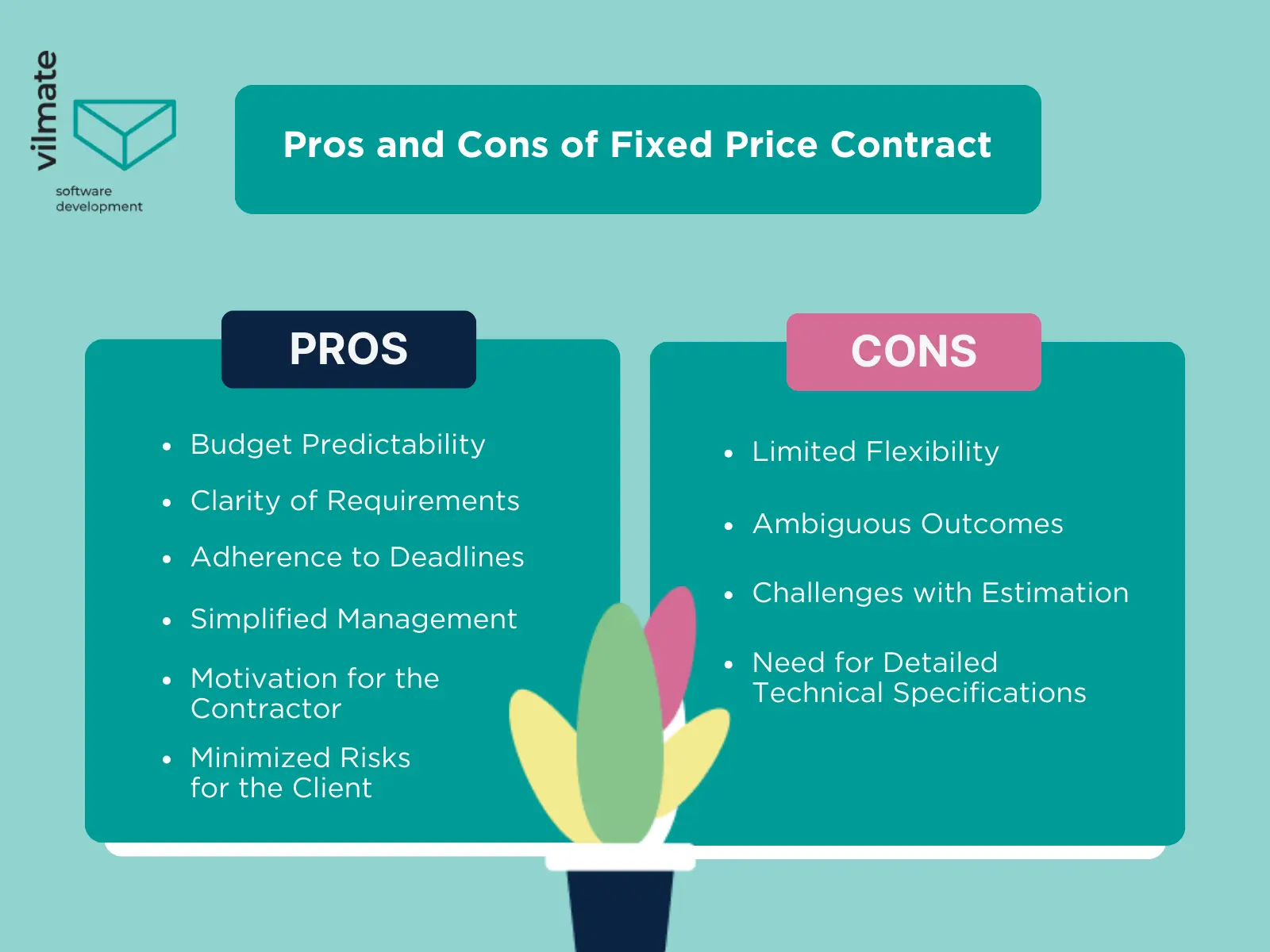
Budget Predictability: You know the project cost upfront, which helps you plan and manage your budget effectively.
Clarity of Requirements: All requirements must be defined initially, encouraging a detailed and thoughtful approach to project design and implementation.
Adherence to Deadlines: The contract includes fixed deadlines, which help the IT company organize its work and ensure timely project completion.
Simplified Management: You don’t need to worry about controlling costs, as the price is fixed, and any changes will be discussed separately.
Motivation for the Contractor: The service provider is incentivized to complete the work quickly and efficiently because their profit depends on the results, not the time spent.
Minimized Risks for the Client: If the IT company fails to meet deadlines or exceeds the budget, you bear no risks; the responsibility lies entirely with the developers.
However, the Fixed price collaboration model has its drawbacks, making the Time & material vs Fixed price differences quite pronounced:
Limited Flexibility: If new requirements or changes arise during the project, adjusting will be more challenging than in the T&M model.
Need for Detailed Technical Specifications: A well-prepared technical specification is essential for successful project completion. You must establish goals and choose the necessary software features from the start.
Challenges with Estimation: Without a clear understanding of the project scope, setting an appropriate Fixed price can be difficult. This may lead to underestimating or overestimating costs.
Ambiguous Outcomes: You receive the completed project after the work is done, which may result in discrepancies between your expectations and the actual outcome.
When signing a Fixed price contract, you should be as careful in selecting an IT company as you would be with a T&M model. Unscrupulous specialists may try to cut corners, leading to lower quality, especially if the requirements are unclear. That’s why we recommend reaching out to Vilmate! Our specialists can accurately assess the scope and budget of your project. We value our reputation and strive to deliver quality results at a reasonable cost.
Despite its drawbacks, the Fixed price contract has many advantages, making it especially appealing for certain projects, which we will explore next.
When to Choose the Fixed Price Model
It would be best if you considered the Fixed price model in the following situations:
1. Small to Medium Projects with a Limited Scope
A Fixed price allows for an accurate budget estimate if your project is simple and has clear tasks.
2. MVP (Minimum Viable Product)
For creating an MVP, where speed and clear requirements are crucial, a Fixed price helps you control costs and timelines.
If the project requirements are well established and unlikely to change, a Fixed price gives you confidence in timelines and costs.
4. Projects with a Limited Budget
When your budget cannot be exceeded, a Fixed price protects you from unexpected expenses and helps you stay within financial limits.
We do not recommend using the Fixed price model for long-term or very large projects, as you may not have enough control over the process. Fixed price contracts rely on predictability and accuracy, which are not always possible in software development. While this model offers a sense of security, it can also lead to challenges if unexpected issues arise.
Conclusion
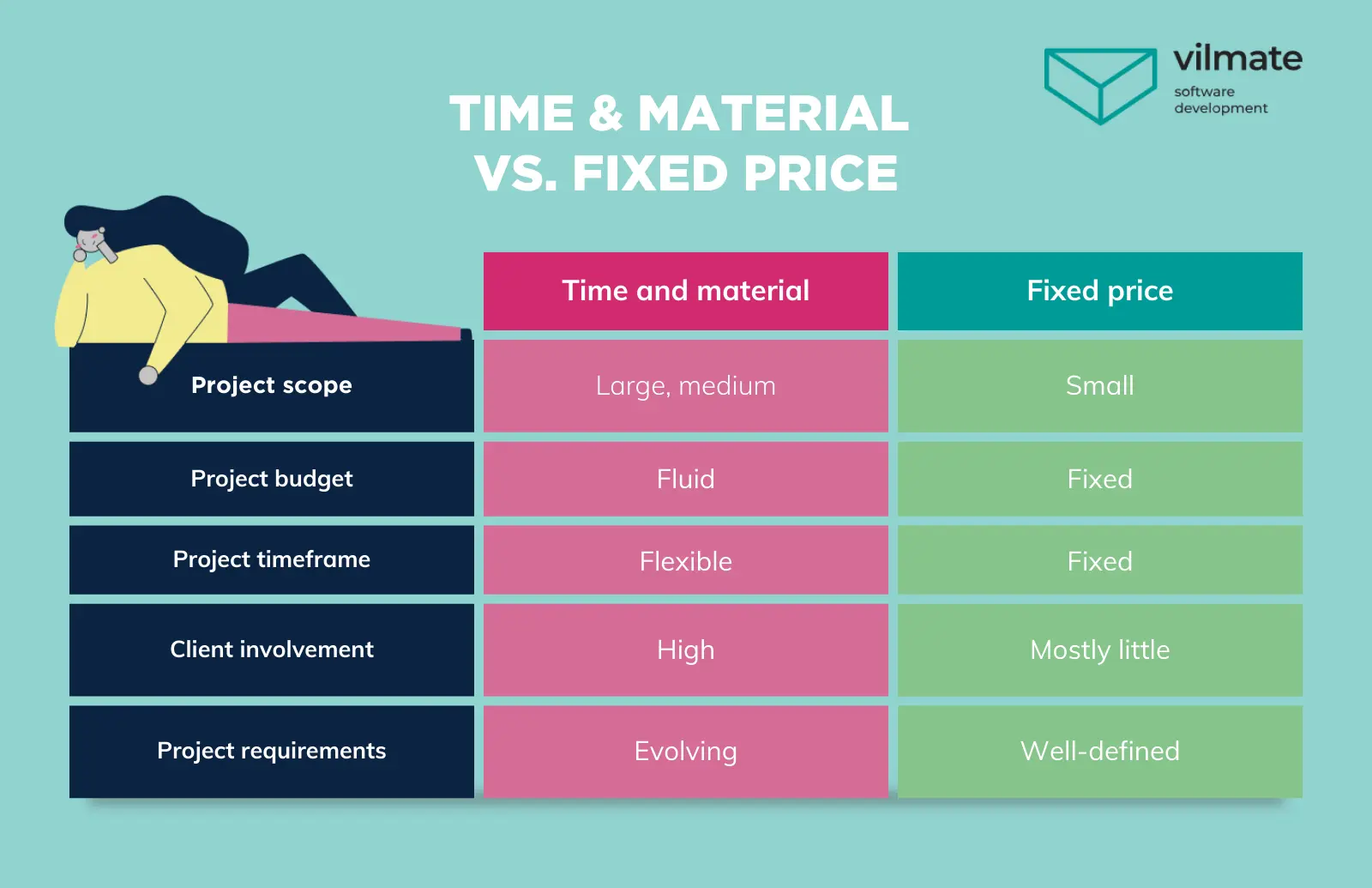
Now that you understand the pros and cons of Time and Materials vs. Fixed price, we will provide you with a guide table to help make your decision easier.
A hybrid approach might be effective in cases where neither model seems perfectly suited. This combines elements of Time and Materials for initial, flexible stages with Fixed price for later, more stable phases.
When choosing a model, assess the scope of your project, how much control you want, and your comfort level with budget changes. If you’re unsure which contract type is best for your project, the Vilmate team is here to help! Our professionals provide clear and detailed consultations, allowing you to select the most effective collaboration model for your needs.
Partnering with an experienced software development company like Vilmate ensures your project is managed with expertise and integrity. Contact us today to discuss your project requirements and find the ideal contract model for smooth and effective collaboration.
AUTHOR BIO
Anastasiia Rezinkina
Copywriter / Content manager
Anastasiia is a content writer at Vilmate with a focus on e-commerce, AI, and emerging tech trends. She turns complex topics into clear, practical reads — whether it’s comparing CMS platforms or unpacking how AI is reshaping online retail.
Imagine a software project where the budget is approved, the scope is clear, and the final invoice arrives without suspense music in the background. That is the appeal of a fixed-price contract: you know what you are building, how much it should cost, and when it is supposed to be delivered. For a business owner, […]
For some teams, fixed-price software development feels like the safest option—clear scope, a predictable budget, and no surprises halfway through. Others hear “fixed-price project” and think of limitations, change requests, and lengthy discussions about updates. Both reactions are valid. And both scenarios happen in real projects. Fixed-price software development sets clear rules. If your product […]
The world’s digital transformation continues, and remote communication has become a big part of our lives. We spend much time chatting online about various things, including work. Many teams of developers have switched to working entirely remotely, ditching offices and daily chats by the water cooler. The COVID-19 pandemic significantly influenced the digitalization of work. […]
Cookies help us see what's working on this site and make it better. Your call on what we track.
Functional
Always active
The technical storage or access is strictly necessary for the legitimate purpose of enabling the use of a specific service explicitly requested by the subscriber or user, or for the sole purpose of carrying out the transmission of a communication over an electronic communications network.
Preferences
The technical storage or access is necessary for the legitimate purpose of storing preferences that are not requested by the subscriber or user.
Statistics
The technical storage or access that is used exclusively for statistical purposes.The technical storage or access that is used exclusively for anonymous statistical purposes. Without a subpoena, voluntary compliance on the part of your Internet Service Provider, or additional records from a third party, information stored or retrieved for this purpose alone cannot usually be used to identify you.
Marketing
The technical storage or access is required to create user profiles to send advertising, or to track the user on a website or across several websites for similar marketing purposes.