Bringing Ethical AI into Your Product: What Businesses Need to Know
In this article
SHARE TO:
More and more companies today are exploring ways to integrate artificial intelligence into their products — and with good reason. AI offers powerful advantages, including personalization, automation, and increased efficiency, all of which can give businesses a significant competitive edge. But as the potential of AI grows, so does the responsibility that comes with it. If you’re planning to move in this direction, it’s essential to address ethical considerations from the very start.
In this article, we outline the key points to think through before development begins — how to minimize risks, why ethical AI is a strategic business decision, and which principles can help you build a solution that’s both technologically robust and socially responsible.
AI Risks: What Can Go Wrong If You Ignore Ethics
When adopting new technologies, it’s essential to consider not only the opportunities but also the limitations. Ethical AI is about recognizing potential risks from the start — and building safeguards against them. This is especially crucial when integrating AI into a product that interacts directly with users.
Here are some of the most common challenges companies face:
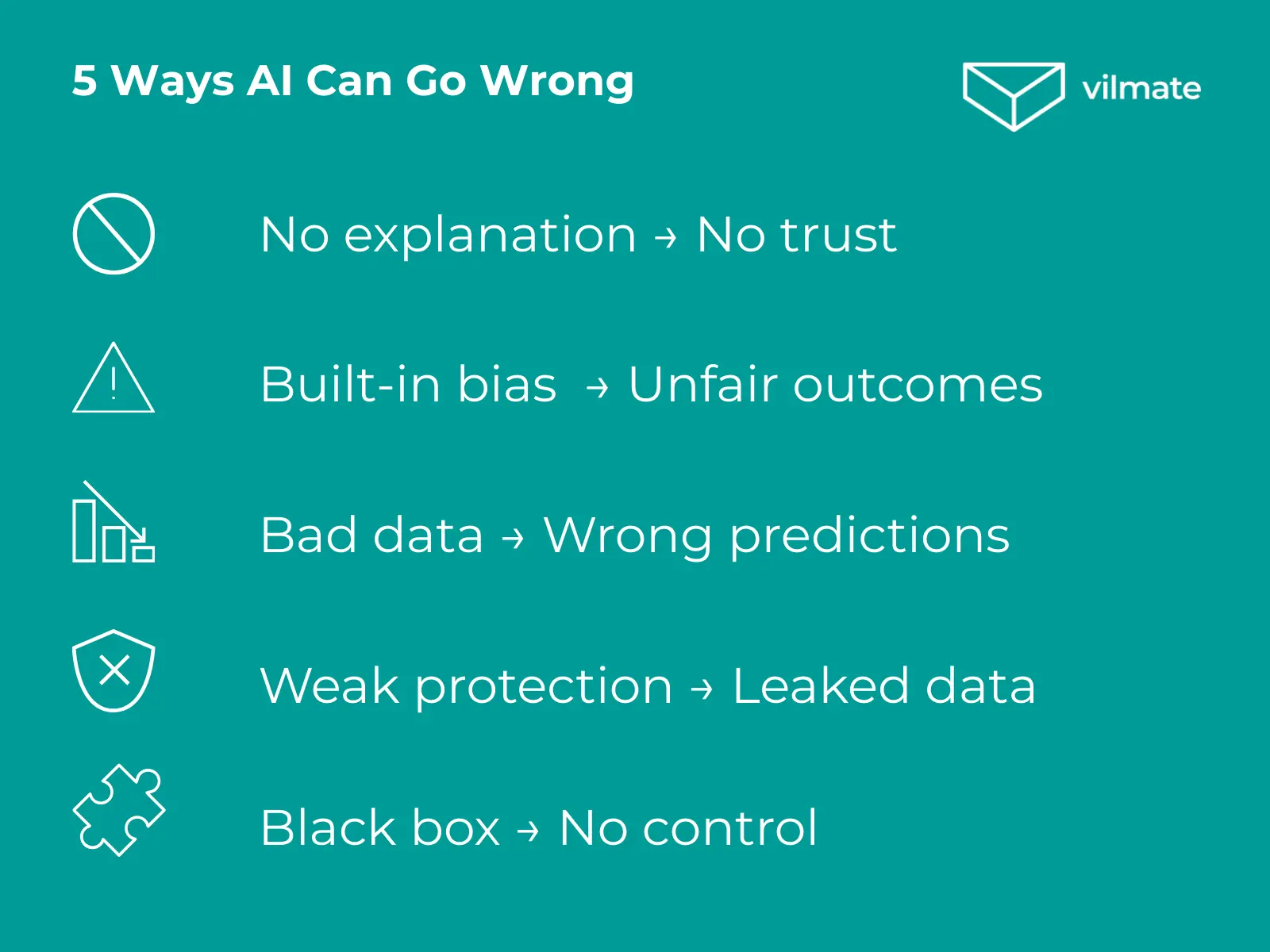
Opaque decision-making. Why did the algorithm approve one request and reject another? If the model doesn’t provide a clear rationale, it undermines trust. For example, a bank might deny a loan without explanation, leaving the customer with no way to appeal the decision.
Hidden bias. If the training data contains existing biases — based on gender, age, or geography — the AI will likely reproduce them. There have been cases where AI-powered resume screeners consistently rated female candidates lower for technical roles, simply because the model was trained on historical data dominated by male hires.
Data errors. Outdated or incomplete data can cause the system to behave unpredictably, resulting in poor predictions or irrelevant results. For instance, an e-commerce recommendation engine might become “stuck” on a user’s old preferences, hurting sales by displaying the wrong products.
Security vulnerabilities. The more advanced and intelligent a system is, the higher the stakes for data protection and processing. A single breach could compromise not only sensitive user data, but also your company’s reputation. There have been incidents where confidential customer queries were exposed through AI interfaces due to a lack of basic safeguards.
The “black box” problem. Without insight into how a model works, it’s challenging to manage outputs, tailor logic to business needs, or scale the solution. This is especially risky in B2B contexts, where clients may require complete transparency at every step of the system’s decision-making process.
Ethical AI helps establish clear boundaries, ensuring your system operates fairly, transparently, and securely. It’s not just about avoiding mistakes — it’s about building a resilient product that users can genuinely trust.
Many companies turn to AI to accelerate processes, conserve resources, or improve their products. But there’s a significant difference between AI that “works” and AI that’s ethical. The distinction lies less in the technology itself and more in the approach behind it.
Standard AI may be trained on historical data, make decisions automatically, and operate on a “set it and forget it” basis. It doesn’t always account for the consequences of its actions, fails to explain its reasoning, and can reproduce harmful patterns — from bias to hidden risks.
Ethical AI, by contrast, is guided by a responsible and forward-looking approach. It is:
Thoughtfully designed with a clear understanding of its impact on users and the business;
Trained on well-vetted, diverse, and secure datasets to avoid bias and distortion;
Equipped with tools for human oversight, transparency, and ongoing adjustments;
Regularly audited — both from a technical standpoint and with ethical considerations in mind.
As a result, ethical AI offers clear long-term benefits:
It operates fairly and transparently, not just efficiently;
Anticipates and reduces risks before they become real problems;
Earns greater trust from users, partners, and regulators alike;
Scales more easily and stays compliant as legal and social expectations evolve.
For businesses, it’s not about being faster or more cutting-edge — it’s about being sustainable. Ethical AI helps create products that can withstand not just technical demands, but also the scrutiny of the public, investors, and regulators.
Navigating Ethical AI Regulations
Ethical considerations in AI are no longer just a matter of internal policy — concrete laws and standards are emerging, and companies will need to comply.
AI Act (EU). The first comprehensive law on artificial intelligence. It classifies AI systems by risk level and introduces strict requirements for transparency, data quality, human oversight, and documentation. It will be implemented gradually starting in 2025.
GDPR. Already mandates algorithmic explainability and the protection of user rights in automated decision-making.
ISO/IEC 42001. An international standard for AI management, providing guidelines on safety, resilience, and ethical practices. It is increasingly adopted by companies operating in mature markets.
Even if you’re not operating in the EU, these frameworks are shaping the global direction of AI governance. Aligning with them means preparing your product for international markets and reducing regulatory and reputational risks from the outset.
How to Build Ethical AI
If you’re seriously considering integrating AI into your product, ethics shouldn’t be an afterthought — it should be a starting point. Ethical thinking doesn’t complicate the process; it makes your system more resilient from the ground up.
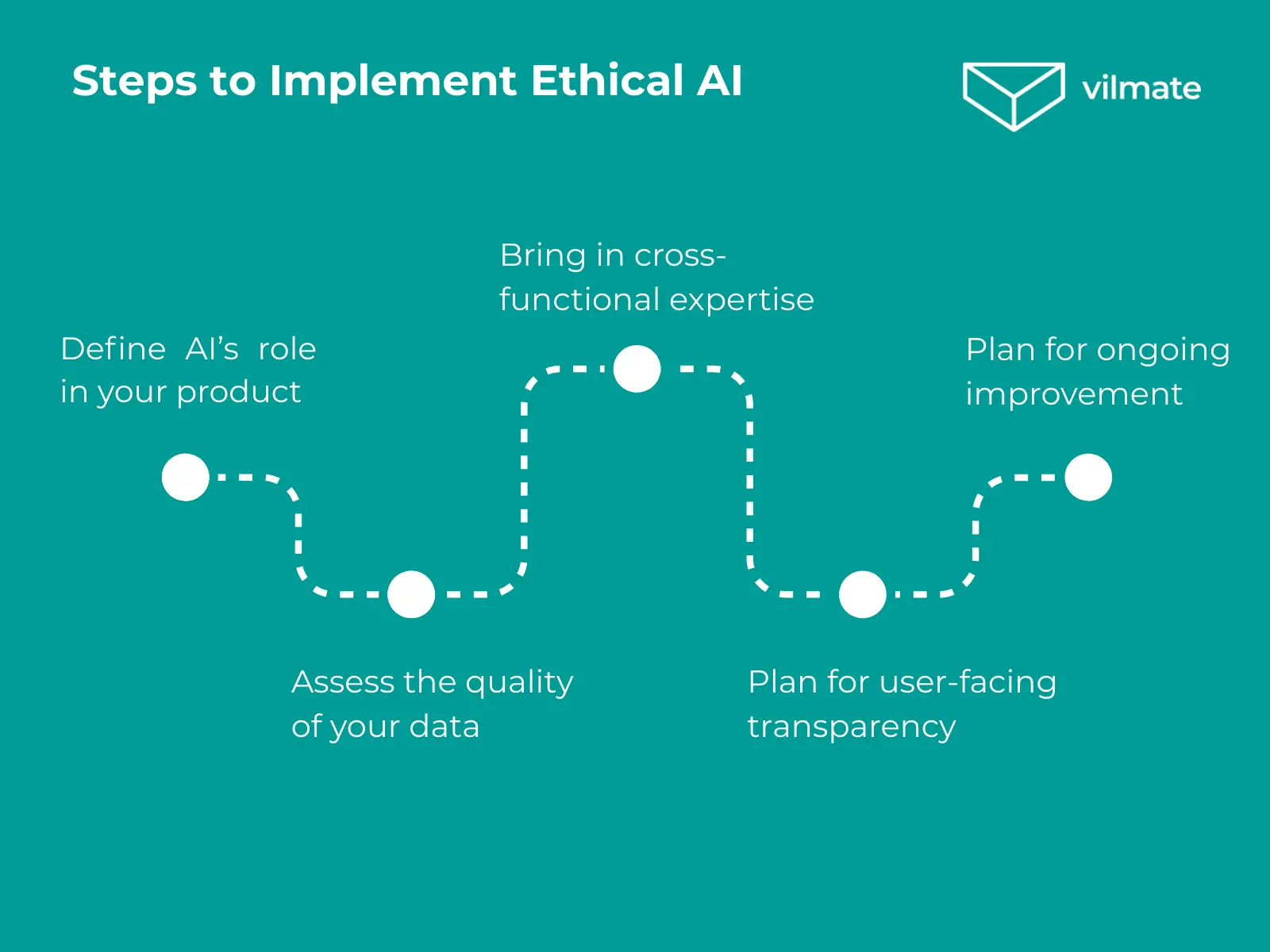
Where to begin with ethical AI implementation?
1. Define AI’s role in your product
Clearly outline what tasks the AI will handle, what data it will use, and where human oversight is necessary. This establishes transparent boundaries from the outset.
2. Assess the quality of your data
Data is the foundation of any model. Ensure it’s up-to-date, representative, and free from biases that could distort the outcomes.
3. Bring in cross-functional expertise
Involve specialists from development, UX, legal, and marketing. Each brings a unique perspective on potential risks, and collaboration early on helps identify vulnerabilities before launch.
4. Plan for user-facing transparency
Even if the model’s logic is complex, users should understand that AI is involved in decision-making — and know how they can interact with or challenge it.
5. Plan for ongoing improvement
AI is not a static system. Regular audits, testing, and user feedback help refine the model over time, ensuring it functions as intended.
An ethical approach not only helps avoid reputational risks — it also makes it easier to adapt to shifting market expectations and legal requirements. Ethical AI isn’t a roadblock — it’s a guarantee that your system will work in a way that serves both your business and your users.
Conclusion
Ethical AI isn’t just another item on a checklist. It’s a way to build a mature, reliable, and future-ready product.
If you’re planning to integrate AI and want to take a thoughtful approach, we’re here to help. At Vilmate, we combine technical expertise with a strong focus on business goals and responsibility.
Interested in an ethical AI journey? Let’s connect.
AUTHOR BIO
Anastasiia Rezinkina
Copywriter / Content manager
Anastasiia is a content writer at Vilmate with a focus on e-commerce, AI, and emerging tech trends. She turns complex topics into clear, practical reads — whether it’s comparing CMS platforms or unpacking how AI is reshaping online retail.
If AI has suddenly become one more thing your retail team is expected to figure out, we get it. There are vendor demos, competitor launches, internal questions, and probably a few very confident opinions about what you should be doing already. That can make AI in retail feel like a decision you’re late to. You’re […]
Somewhere between a board meeting and an e-commerce roadmap, “we need AI” becomes a non-negotiable business requirement. The pressure is real. In Dataiku’s 2026 survey of 900 enterprise CEOs, 80% said their role could be at risk if their company failed to show measurable AI gains by year-end. These circumstances can move an AI project […]
By now, the case for personalized search in e-commerce has been made loudly enough. Vendors praise it, reports measure it, case studies add conversion lifts, and we have already covered the theory in our guide to e-commerce personalized search and the scenarios in e-commerce personalized search examples. So yes, the point has landed. Personalized search […]
Cookies help us see what's working on this site and make it better. Your call on what we track.
Functional
Always active
The technical storage or access is strictly necessary for the legitimate purpose of enabling the use of a specific service explicitly requested by the subscriber or user, or for the sole purpose of carrying out the transmission of a communication over an electronic communications network.
Preferences
The technical storage or access is necessary for the legitimate purpose of storing preferences that are not requested by the subscriber or user.
Statistics
The technical storage or access that is used exclusively for statistical purposes.The technical storage or access that is used exclusively for anonymous statistical purposes. Without a subpoena, voluntary compliance on the part of your Internet Service Provider, or additional records from a third party, information stored or retrieved for this purpose alone cannot usually be used to identify you.
Marketing
The technical storage or access is required to create user profiles to send advertising, or to track the user on a website or across several websites for similar marketing purposes.