Managing Risks and Changes in IT Projects: Insights from Vilmate’s PM
In this article
SHARE TO:
The work of a project manager is always filled with interesting challenges. It’s no wonder, as this professional is responsible for the project’s success from beginning to end.
For a PM, it is crucial to keep everything under control. Effective managers must be steadfast and confident in themselves and their team. That’s why the two main challenges for a project manager are risks and changes.
A PM must always be ready for these challenges. But is it possible to anticipate all the unexpected events that may arise during development? We asked our talented project manager, Toma Svyatobatko. She helped us understand how to effectively manage risks and handle changes to ensure the successful completion of the project.
Effective Change Management: How to Adapt to New Requirements
First, we asked Toma how she handles sudden changes in a project.
Toma: Managing uncertainty is a regular part of a project manager’s role, especially when using the Agile approach. In Agile, even the client may not have a clear vision of the final product, requiring flexibility and adaptability. Therefore, you should always remain calm and prepare for changes. Urgent issues, such as critical production bugs, require immediate attention and swift resolution. For less urgent changes, effective prioritization and careful planning are essential to ensure their smooth implementation.
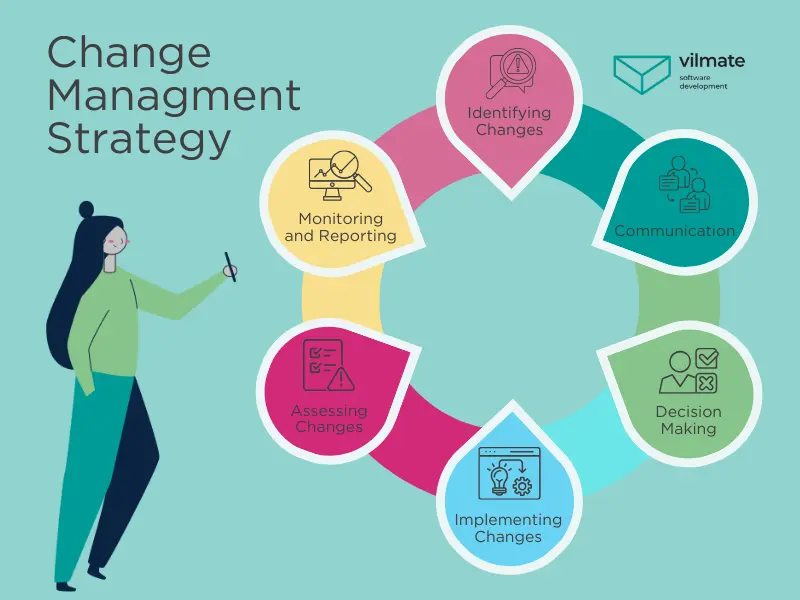
Overall, change control is a crucial part of any project manager’s job. In project management, change control involves handling new requests and smoothly integrating them into the project. Here’s a look at the change management strategy that helps professionals adapt effectively:
Identifying changes: New ideas can come from the client or the project team. For a project manager, it’s important to keep everyone informed, ensuring that all changes are agreed upon and feasible.
Assessing changes: The PM should evaluate how new tasks affect the project, including the budget, timeline, resources, and quality. The team should also evaluate the risks associated with the changes to avoid losing progress.
Decision making: The client usually makes the final decision on implementing changes. This decision should be based on a detailed assessment of the changes and their priorities.
Implementing changes: The PM must add the changes to the project plan, and the development team can start working on them.
Communication: This stage is crucial for the entire project. The communication process should be transparent, ensuring everyone understands the reasons for the changes and sees their benefits.
Monitoring and reporting: The project manager should constantly monitor the implementation of changes and report on their status. Analyzing the results will also be useful for future projects.
The project manager should lead and oversee all these stages. A good specialist must ensure transparency at every stage of the changes and avoid hasty decisions.
However, no matter how skilled the PM is, changes will always bring new risks. Therefore, it’s essential to use risk management skills to prevent potential problems.
Why Project Risk Management Is Important
What is risk management for a software project manager? The definition of risk management involves predicting, assessing, and controlling potential threats that could harm the project, systems, or infrastructure. A project manager must handle these risks effectively to minimize their impact and ensure smooth operations.
Toma: Risk management is critical in IT and a central responsibility for project managers, especially in an environment where uncertainty is the only constant. Experience plays a vital role in effectively managing risks; an experienced specialist can swiftly recognize patterns and either prevent issues or develop quick solutions when problems arise. Maintaining a risk register that details all identified risks, their descriptions, probability and potential impacts is essential. This register should be continually updated throughout the project’s lifecycle, beginning from the initiation phase.
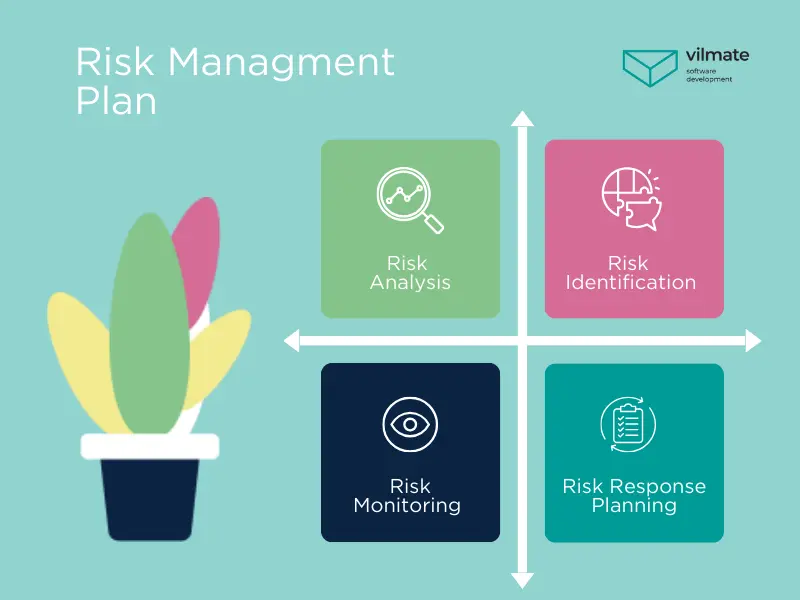
To make it convenient for you, we will create a risk management plan to help any project manager control the situation more effectively.
Risk identification: To identify possible risks, you must brainstorm with the entire team, analyze past projects, consult with experts, and create checklists.
Risk analysis: At this stage, the project manager assesses the likelihood of each risk and predicts its potential impact on the project. Risks that are more likely to occur are given high priority.
Risk response planning: Once potential risks are identified, a response strategy must be developed immediately. The team creates an action plan for each risk and assigns responsible employees.
Risk monitoring and control: The project manager must closely watch risks and take action quickly when necessary. They check the status of risks and their impact on the project regularly.
The main risks associated with a project that involves many changes are increased costs and extended timelines. Risk management should start early in the project, as dangers can arise without sudden changes in the roadmap. We asked our project manager to compile a list of the most common risks professionals face in her field.
Toma: I’d like to highlight three main risks that can occur in almost every project:
Lack of Clear Specifications: In Agile, it’s normal not to have a fully detailed specification. To start work successfully, you need to understand the main objectives and have a clear plan for a few sprints ahead. However, always be ready for changes and new tasks.
Insufficient Documentation: Often, when a project manager joins a project in its early stages, documentation is missing or outdated. Don’t hesitate to start from scratch. Gather all relevant links of documents, designs, meeting notes in one centralized location, such as a Wiki, Confluence, or Google document. If there is no business analyst, you can assign some documentation tasks to a QA engineer.
Irreplaceable Specialists: Finding the perfect developer is great, but it’s very risky if the entire project depends on them. If such a specialist leaves, it can be challenging to resume halted processes. Therefore, you should not neglect writing documentation, as it allows new team members to quickly integrate into the project. Involve other developers in code reviews to ensure you have potential replacements who are already familiar with the project, minimizing disruption if a replacement becomes necessary.
It is important to understand that risk management always requires additional resources. To be prepared for everything, you must spend more time, involve more people, and expand the budget. Therefore, the project manager’s goal is not to cover all possible risks. A good specialist uses common sense and knows how to prioritize.
At Vilmate, we have experienced and talented project managers who thoroughly understand their work. They manage changes and risks effectively and always ensure transparency. If your project needs a good leader, contact Vilmate, and don’t worry about things going wrong. In addition to a professional PM, we can provide an excellent team of specialists to work on your project. Let’s tackle risks together!
AUTHOR BIO
Anastasiia Rezinkina
Copywriter / Content manager
Anastasiia is a content writer at Vilmate with a focus on e-commerce, AI, and emerging tech trends. She turns complex topics into clear, practical reads — whether it’s comparing CMS platforms or unpacking how AI is reshaping online retail.
Building or selecting an OMS without a clear list of requirements is like building a house without a blueprint. Companies often focus only on order intake and overlook critical backend fulfillment, inventory synchronization, and less common order scenarios. Avoiding these mistakes means distinguishing between business needs and the technical tools that fulfill them—which is why […]
Most online stores and wholesale businesses start with ready-made SaaS platforms. In the early stages, these off-the-shelf cloud solutions are often enough and cover essential business needs. This becomes a problem when your business grows, but the software doesn’t keep up. If you have to change some internal processes or manually fill in spreadsheets only […]
For some teams, fixed-price software development feels like the safest option—clear scope, a predictable budget, and no surprises halfway through. Others hear “fixed-price project” and think of limitations, change requests, and lengthy discussions about updates. Both reactions are valid. And both scenarios happen in real projects. Fixed-price software development sets clear rules. If your product […]
Cookies help us see what's working on this site and make it better. Your call on what we track.
Functional
Always active
The technical storage or access is strictly necessary for the legitimate purpose of enabling the use of a specific service explicitly requested by the subscriber or user, or for the sole purpose of carrying out the transmission of a communication over an electronic communications network.
Preferences
The technical storage or access is necessary for the legitimate purpose of storing preferences that are not requested by the subscriber or user.
Statistics
The technical storage or access that is used exclusively for statistical purposes.The technical storage or access that is used exclusively for anonymous statistical purposes. Without a subpoena, voluntary compliance on the part of your Internet Service Provider, or additional records from a third party, information stored or retrieved for this purpose alone cannot usually be used to identify you.
Marketing
The technical storage or access is required to create user profiles to send advertising, or to track the user on a website or across several websites for similar marketing purposes.