Why Full-Cycle Development is a Game-Changer for Healthcare Startups
In this article
SHARE TO:
Starting a healthcare startup is exciting, but it can also be overwhelming. You’re dealing with patient privacy, strict rules like HIPAA and GDPR, and the challenge of integrating with hospital systems that often feel far from modern – all while investors push for quick results.
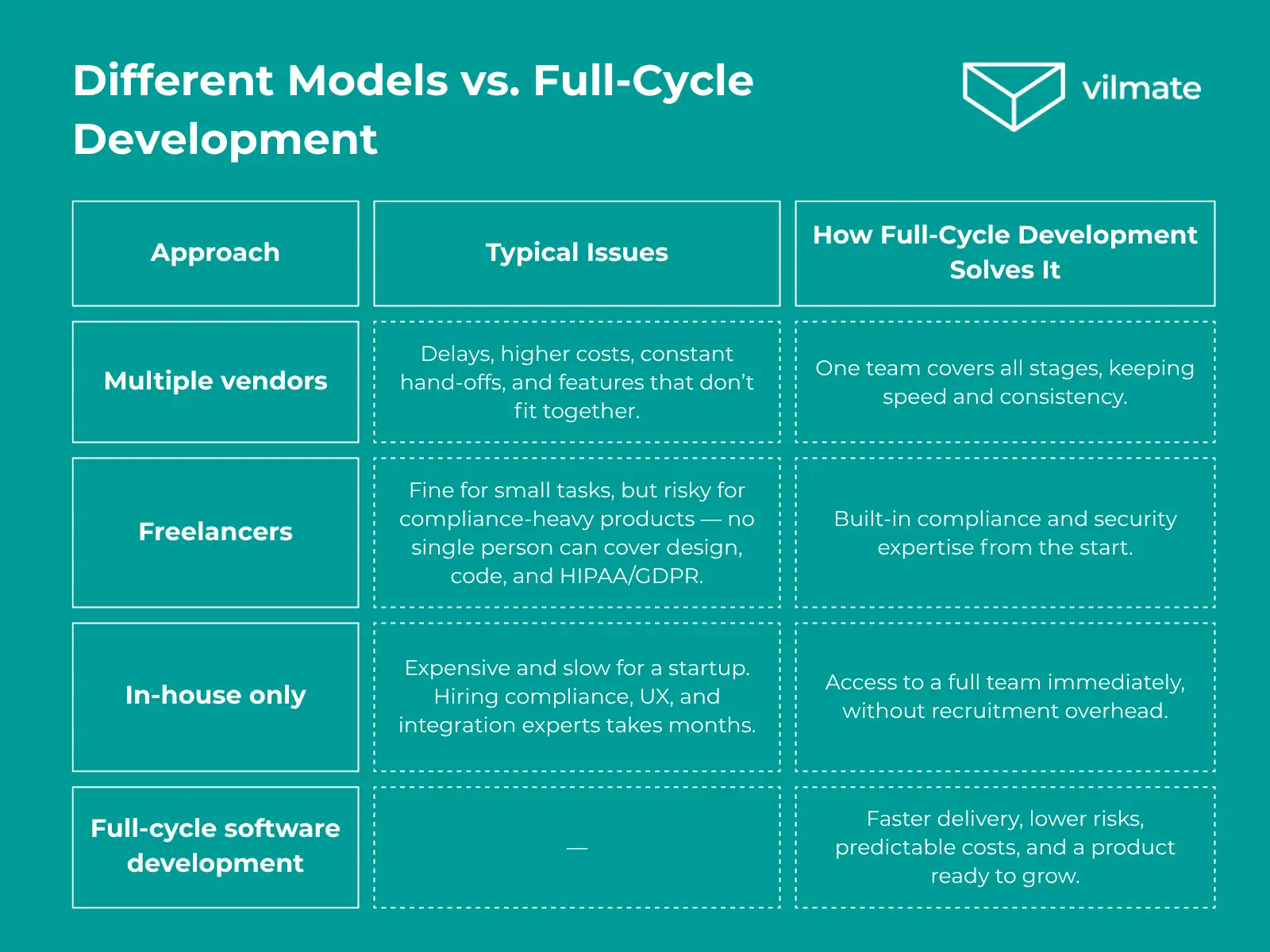
Many founders encounter the same problem: work is split between multiple vendors. One team designs, another codes, and compliance comes in last. Deadlines slip, costs climb, and the product still isn’t ready for real use.
Full-cycle development keeps everything under one roof, ensuring a seamless process. The same team handles discovery, design, coding, testing, and support. For healthcare software, this means projects move faster, risks are lower, and compliance is built in from day one.
At Vilmate, we’ve seen these challenges up close. We’ve guided both startups and established healthcare companies through this process, and this article brings together that experience to show why full-cycle development really matters.
What Is Full-Cycle Software Development?
Full-cycle software development is the whole journey of a product, from the very first sketch to the day it’s live and running in the real world. For a healthcare startup, it means every step is covered by a single team that understands the context and the goals.
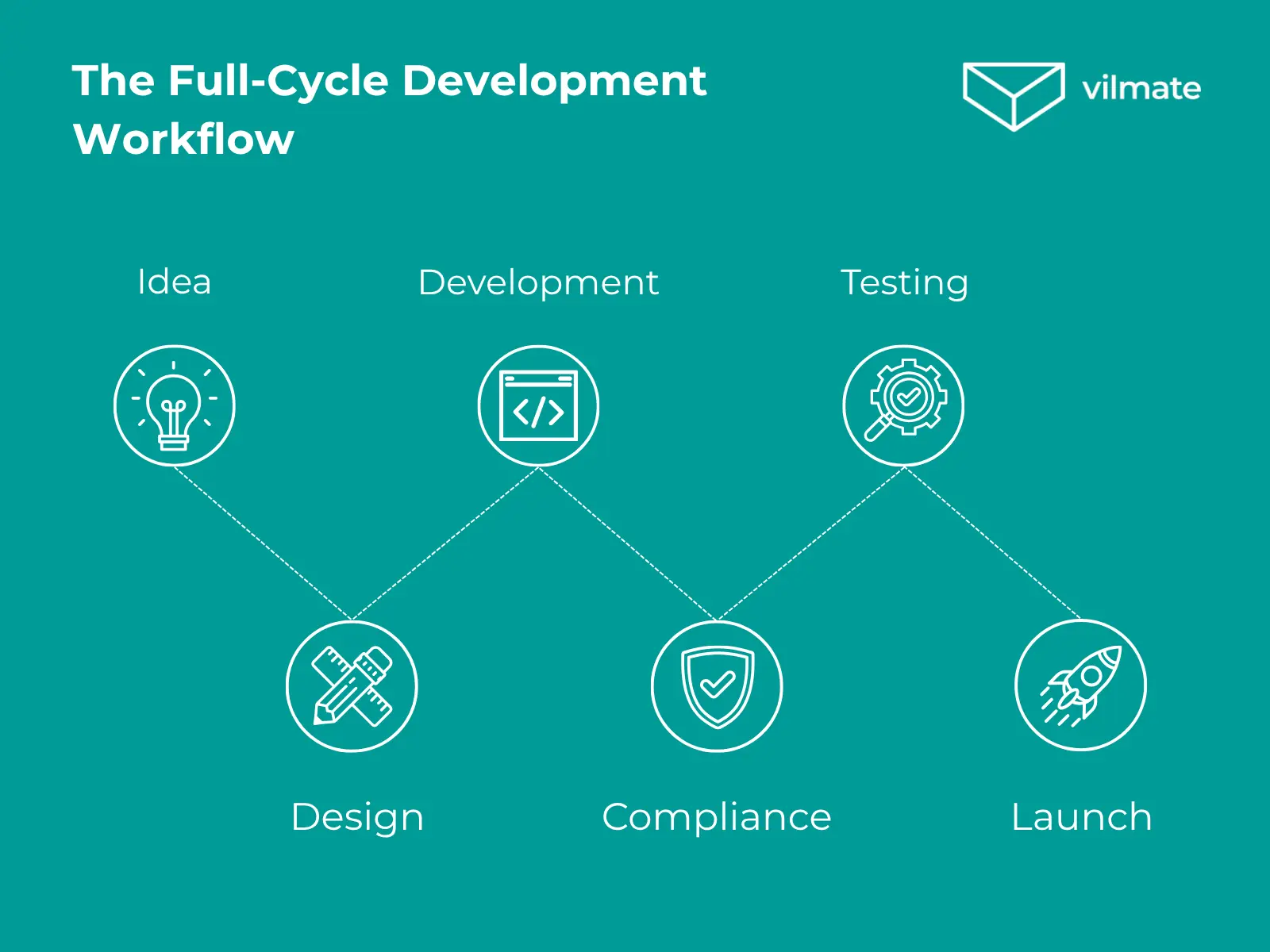
The stages usually look like this:
Discovery. This is where the idea takes shape. For example, a founder with a vision for a patient portal creates a clear roadmap that already accounts for HIPAA or GDPR.
Design. Interfaces are designed around real-life scenarios: a nurse updating records quickly, a patient booking an appointment with just two clicks.
Development. Code is written, features come to life, and integrations with hospital systems, such as EHRs, are added so the app works in practice, not just on paper.
Compliance. Security and privacy aren’t “bolted on.” They’re baked in from the start – encrypted data, safe logins, audit trails.
Testing. Every feature is checked to make sure it’s stable, safe, and user-friendly. In healthcare, even small glitches can be critical.
Launch & support. The product goes live, and the same team continues to keep it running, update it, and help it grow as the startup scales.
Each stage flows naturally into the next, and nothing is lost in hand-offs. That’s what makes full-cycle development so valuable: it delivers software that feels whole, consistent, and ready for the demands of healthcare.
Why Full-Cycle Development Matters for Healthcare Startups
For a healthcare startup, development is never just about writing code. The product must be secure, compliant, and reliable in real-world medical settings. Other models of collaboration often expose their weak points – fragmented work, lack of compliance, or high costs.
Full-cycle development changes the picture. One team guides the entire journey and takes full responsibility for the outcome. The main advantages are clear:
Speed. No wasted time on vendor hand-offs – the same team keeps things moving. In a market projected to hit USD 981 billion by 2032, moving fast is the only way to stay competitive.
Compliance by default. HIPAA, GDPR, and other rules are built into the process from day one. In 2023, the average cost of a healthcare data breach was $10.93 million – the highest across all industries. Skipping compliance isn’t an option.
Predictable costs. Working with one partner makes budgeting more straightforward and more transparent.
Consistency. Every stage naturally connects to the next, making the product feel stable and professional.
Room to scale. The same team that launches your MVP can grow and support it as the business expands.
For founders, this means fewer distractions and more focus on strategy. For patients and providers, it means software they can trust.
From Concept to Care: Full-Cycle Development Examples
Most healthcare startups begin with a simple idea: connecting patients with doctors online, providing people with easier access to their medical records, or making a device smarter with the right software. The real challenge begins later – when that idea must be transformed into something people can actually use.
This is where full-cycle development helps. One team stays with the product from day one, so the vision doesn’t get lost and every piece works together.
Telemedicine. A video call alone isn’t enough. Patients also need secure chat, prescriptions, and payment options. A full-cycle approach integrates all of that into one app.
Patient portals. Booking a visit, checking lab results, sending a message to a doctor – these things only feel useful when they’re connected.
Medical devices. Software for wearables or diagnostic tools has to be tested carefully. Full-cycle teams build safety into the product before it reaches patients.
Healthcare SaaS. Platforms for clinics – such as scheduling or billing – run more smoothly when design, compliance, and growth are managed in one place.
The big win is that ideas don’t just stay on paper. Full-cycle development helps them grow into products that doctors and patients can actually trust.
Building a product in healthcare is tough. Compliance, security, and old hospital systems – all of it slows down founders who just want to bring their idea to life. Splitting the work across vendors usually makes it worse.
Full-cycle development offers a more streamlined approach. One team stays with you from the first sketches to launch and support, so nothing gets lost on the way. For a healthcare startup, that means faster results, fewer risks, and software people can actually trust.
At Vilmate, we’ve been down this road with other startups. We know the traps, we know the rules, and we know how to get from concept to care without wasting months.
If you’re thinking about your own healthcare product, let’s have a conversation. No sales pitch – just a chance to see if full-cycle development could make your life easier.
AUTHOR BIO
Anastasiia Rezinkina
Copywriter / Content manager
Anastasiia is a content writer at Vilmate with a focus on e-commerce, AI, and emerging tech trends. She turns complex topics into clear, practical reads — whether it’s comparing CMS platforms or unpacking how AI is reshaping online retail.
For most private clinics, digital transformation in healthcare has quietly turned from a nice idea into a survival question. It’s not about following trends – it’s about keeping patients, doctors, and processes in sync. Patients now expect the same simplicity they get from any other service: book an appointment online, get test results without calling […]
Technology is quietly changing the way healthcare works. What once took endless paperwork and phone calls now happens inside healthcare software – from patient scheduling and billing to secure data management and modern telehealth software solutions. These digital tools have made medicine faster, more organized, and in many ways, more accessible. Still, if you ask […]
Good interface design isn’t just about convenience – it’s one of the things that makes an online product competitive. In healthcare, though, the stakes are much higher: medical UX design can affect not only how easy a product is to use but also the health – and sometimes even the lives – of patients. Nevertheless, […]
Cookies help us see what's working on this site and make it better. Your call on what we track.
Functional
Always active
The technical storage or access is strictly necessary for the legitimate purpose of enabling the use of a specific service explicitly requested by the subscriber or user, or for the sole purpose of carrying out the transmission of a communication over an electronic communications network.
Preferences
The technical storage or access is necessary for the legitimate purpose of storing preferences that are not requested by the subscriber or user.
Statistics
The technical storage or access that is used exclusively for statistical purposes.The technical storage or access that is used exclusively for anonymous statistical purposes. Without a subpoena, voluntary compliance on the part of your Internet Service Provider, or additional records from a third party, information stored or retrieved for this purpose alone cannot usually be used to identify you.
Marketing
The technical storage or access is required to create user profiles to send advertising, or to track the user on a website or across several websites for similar marketing purposes.