Digital Transformation in Healthcare: Why Private Clinics Can’t Wait Anymore
In this article
SHARE TO:
For most private clinics, digital transformation in healthcare has quietly turned from a nice idea into a survival question. It’s not about following trends – it’s about keeping patients, doctors, and processes in sync.
Patients now expect the same simplicity they get from any other service: book an appointment online, get test results without calling three times, pay digitally, and move on.Doctors, on the other hand, need systems that help them treat people – not fight paperwork.
So the real point of going digital isn’t innovation for its own sake. It’s about making the clinic run more smoothly, saving time, and giving everyone – from reception to the examination room – a bit more space to breathe.
In this article, we’ll look at why private clinics should invest in digital tools, what both patients and doctors expect from them, and how to get started without unnecessary stress or disruption.
Why private clinics should invest in digital transformation
Digital transformation in healthcare isn’t just a buzzword anymore. For private clinics, it’s becoming a practical necessity. Unlike public institutions that always have patients coming in, private practices rely on reputation, convenience, and how easy it is for someone to become – and stay – a patient.
And today, the first impression happens online long before anyone walks through the door. According to MD Connect, 83% of patients visit a clinic’s website before booking, and 61% compare at least two providers. If the site is confusing, outdated, or burdensome to use, people leave. They expect a healthcare experience that feels as simple as booking a flight or ordering groceries – not because healthcare is the same, but because digital habits already formed elsewhere carry over.
But it’s not only about getting noticed online. Digital tools shape how a clinic works inside, too. When clinics invest in digital systems, they usually see:
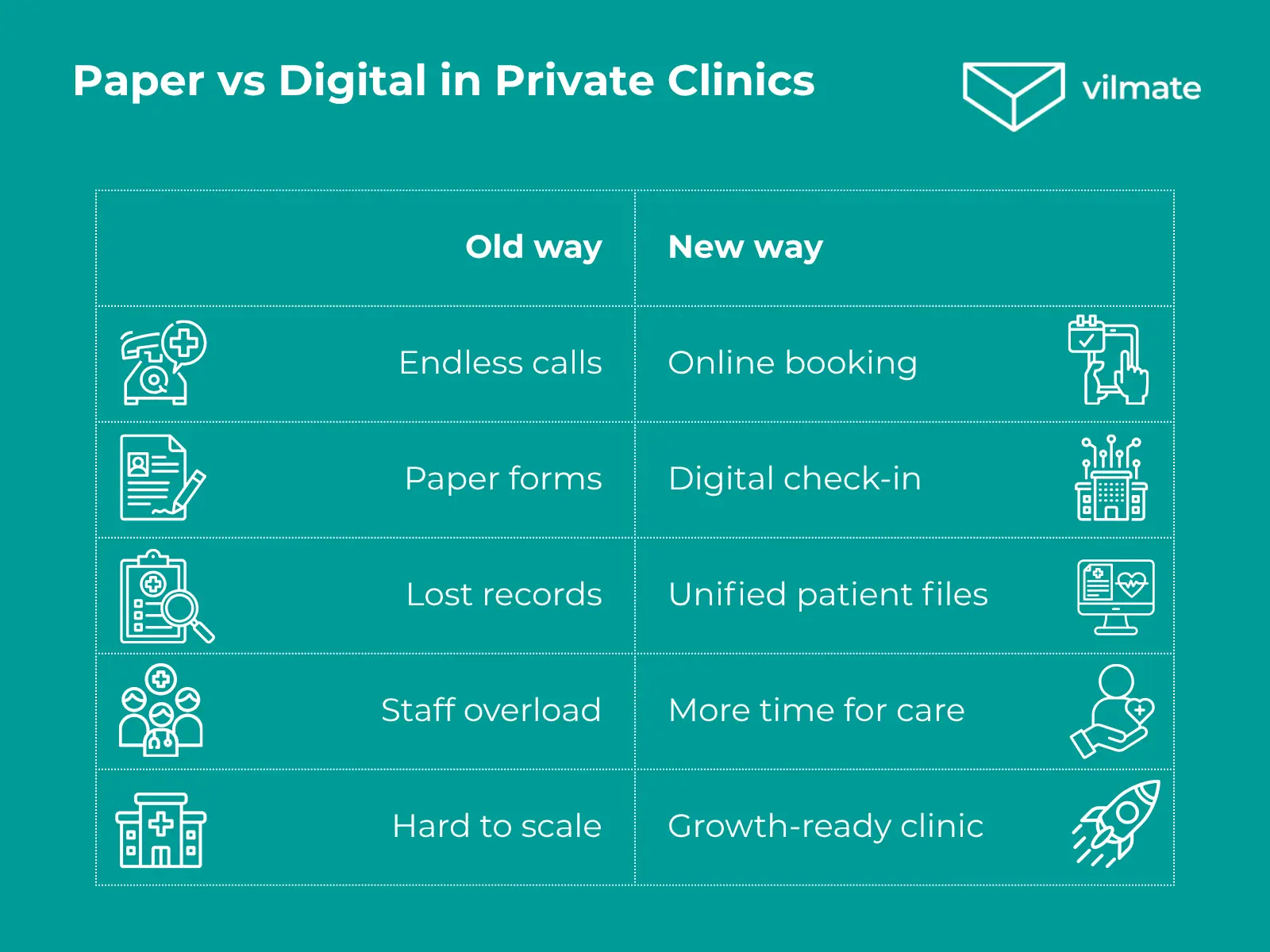
Smoother scheduling and patient flow People want to book appointments online, fill in forms without paper, and get reminders automatically. Every phone call and printed form is extra friction – and over time, that adds up.
Less admin stress Digital workflows reduce repetitive tasks. In healthcare, saving time means more space for real patient care and fewer tired staff at the end of the day.
Clearer information and fewer mistakes Keeping records, lab results, and notes in one system reduces errors – no handwritten notes to decipher, no missing files, no duplicated work. It’s a cleaner, safer way to operate.
Stronger patient loyalty When booking, communication, follow-ups, and payments run smoothly, people feel it. Patients notice when a clinic respects their time and removes hassle – and that’s often what keeps them coming back.
A competitive edge Private healthcare is getting crowded. Clinics that modernize early build trust faster and scale with fewer growing pains than those relying on paper and manual coordination.
Digital tools don’t solve everything on their own. They simply create a foundation that allows the clinic to run smoothly and consistently, benefiting everyone involved.
Before we talk about technology, it makes sense to look at the people using it. Let’s start with patients and what they now expect from a clinic’s digital experience.
What patients expect from a clinic’s digital experience
For most patients, the experience starts long before they step inside the clinic. They look online, compare a few options, and decide who feels more reliable. The first impression is digital.
People don’t think about “systems” or “platforms.” They just want things to work:
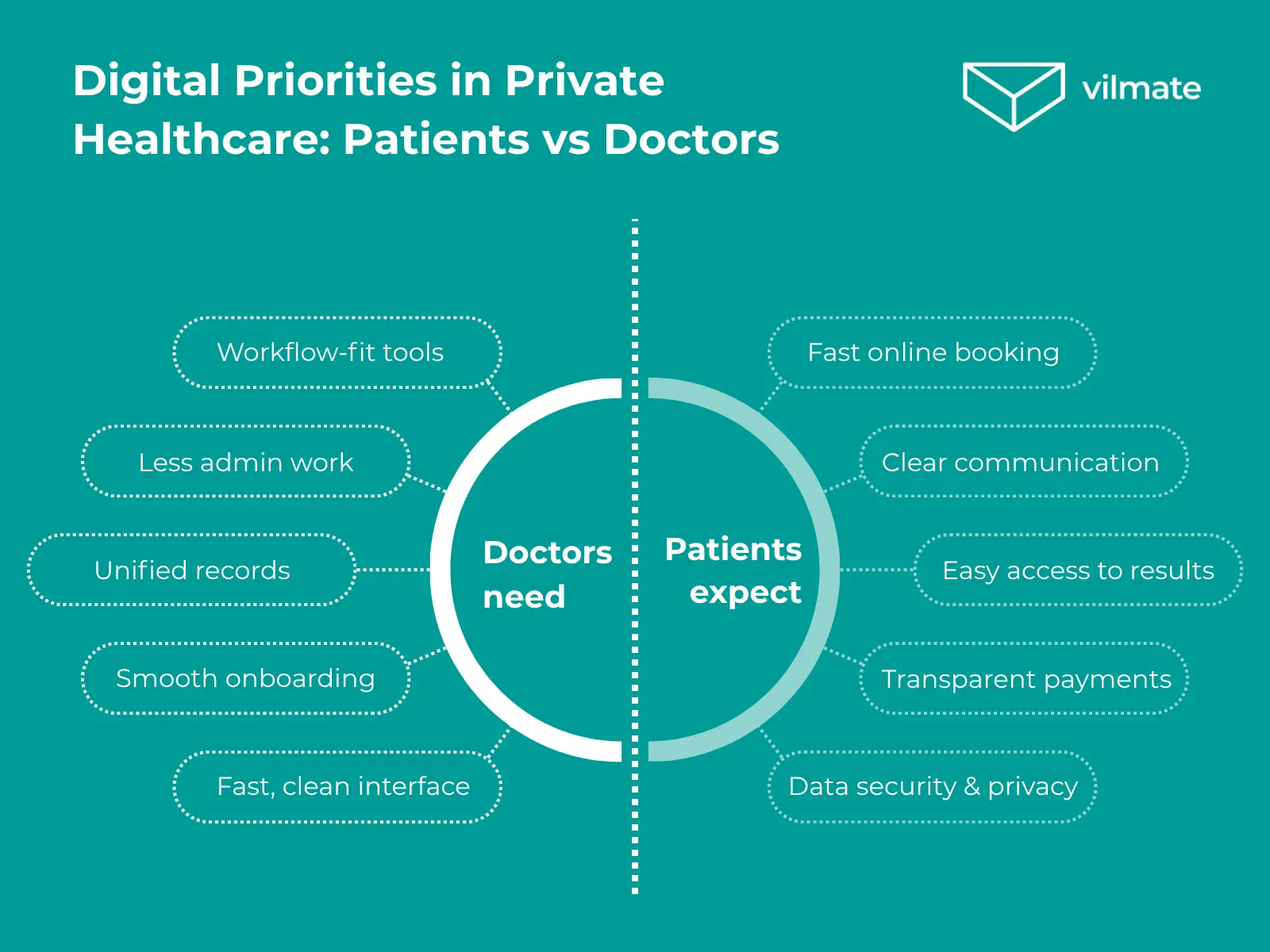
Easy booking Booking an appointment should take seconds — not calls and waiting. Choose a time, confirm, done. That’s what patients expect because the rest of their life works the same way.
Clear communication A short reminder, a quick update, a message when results are ready — small things that make a big difference. Patients appreciate when the clinic stays in touch, and they don’t have to chase information.
Access to results Nobody wants to return just to pick up papers. Checking test results or prescriptions online feels simple and respectful of their time.
Honest billing Money is already a sensitive topic in healthcare. Transparent pricing and online payments help patients feel safe and informed.
Trust in data safety People rarely ask about data protection, but they care. They assume their information is secure — and when the clinic takes privacy seriously, it builds confidence.
When everything works smoothly, patients notice. It doesn’t make medical care better by itself, but it makes it easier to trust the people who provide it.
And while patients value convenience and calm, doctors view digital tools from a different angle — how they help them do their job.
What doctors expect from a clinic’s digital system
Patients feel the impact of digital tools from the outside. Doctors feel it every minute inside the clinic. And when systems don’t work well, the pressure adds up fast.
According to Stanford Medicine research, 71% of primary care physicians say digital systems contribute to burnout. Not because technology is bad — but because poorly designed tools slow them down instead of helping.
So, what do doctors actually want?
Less admin, more patient time Technology should reduce screens, clicks, and forms — not multiply them. Saving even a few minutes per visit gives that time back to care, not paperwork.
Information in one place Doctors don’t want to chase lab results, histories, and notes across multiple systems. They need a single, clear view to support decisions and keep treatment moving.
Systems that follow real workflows Every clinic works differently. Digital tools should adapt to how doctors work — not force inefficient processes.
Speed and simplicity No one cares how “feature-rich” a platform is if it’s slow or confusing. Performance, intuitive design, and minimal clicks matter more than long menu lists.
Support during adoption Even the right system needs time to settle in. Training, onboarding, and iterative improvements make change smoother and less stressful.
When technology respects time and workflow, doctors feel it immediately — less friction, fewer screens, more focus on patients. That’s when digital tools stop being just software and become a natural part of responsible care.
Where private clinics should start with digital transformation
Digital transformation in a private clinic doesn’t start with software – it begins with understanding what slows your clinic down and where small digital changes can make a daily difference.
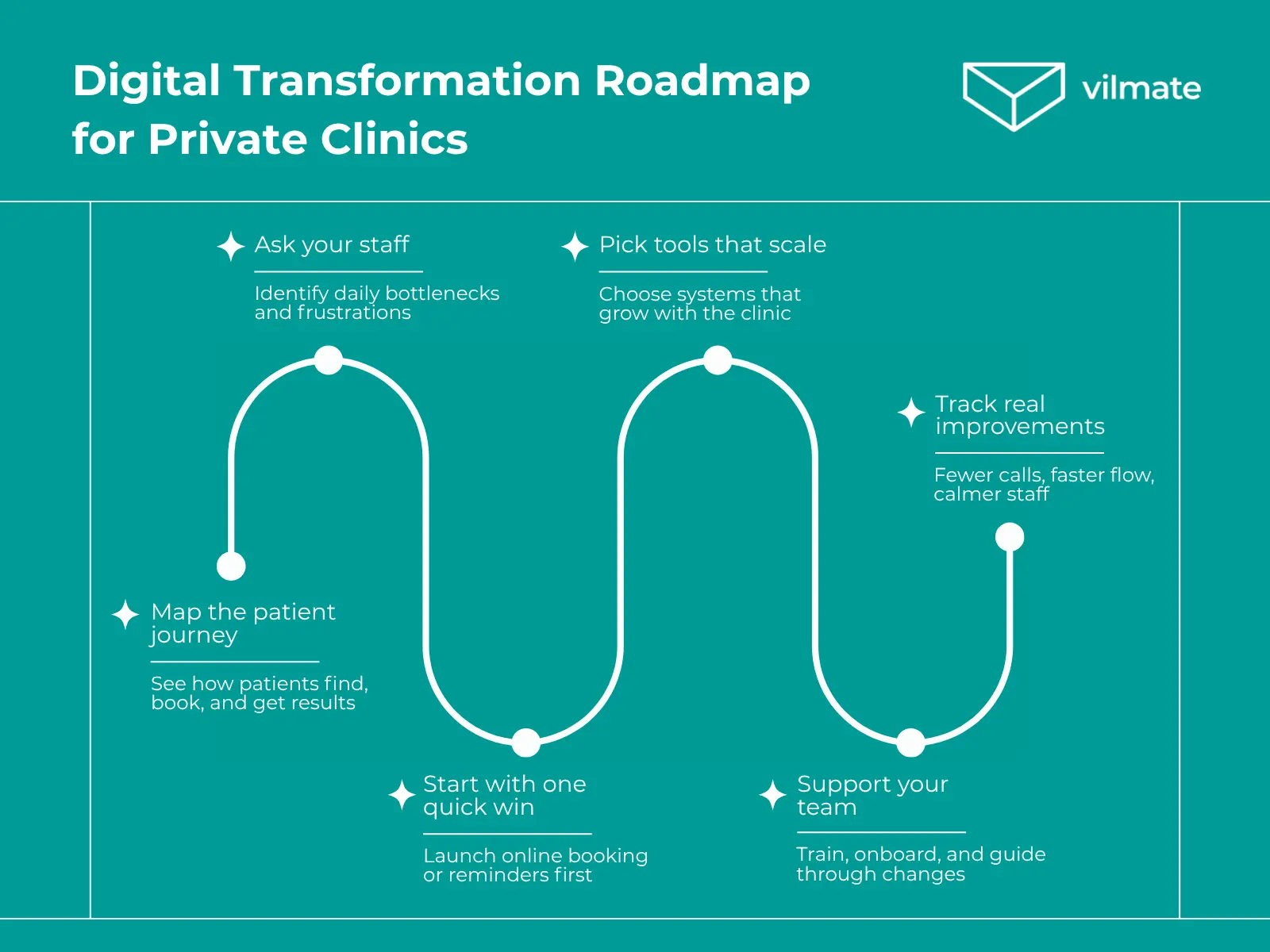
Here’s a practical roadmap:
1. Walk through the patient journey
Look at every step from the patient’s side:
how they find your clinic
how they book and confirm
how they receive updates
how they get results and follow-ups
These are usually the areas where digital tools bring the quickest wins – booking, communication, and transparency.
2. Listen to your team
Doctors, nurses, and front-desk staff often know exactly what’s broken. Ask where time is lost: too many calls, repeated forms, or missing information. Honest feedback will point to what needs attention first.
3. Start small but visible
Don’t aim to change everything at once. Start with something everyone will notice – online scheduling, automated reminders, or digital forms. One improvement that works well is to build trust and make the next step easier.
4. Choose scalable tools
Pick technology that fits your current size and can grow with you. Avoid complex systems built for hospitals – flexibility and gradual growth matter more than features.
5. Support your team
Technology only works when people use it confidently. Plan for a short onboarding period, clear instructions, and a few weeks to adapt. Smooth adoption is more important than a fast rollout.
6. Track what improves
Measure success by what changes in daily work:
fewer calls and paper forms
faster processing
fewer repeated questions
happier staff and calmer patients
If the day feels smoother, you’re moving in the right direction.
Conclusion
Digital transformation isn’t about trends or big budgets. It’s about making your clinic more predictable, connected, and patient-friendly – step by step.
And when you’re ready to go further, working with a technology partner experienced in healthcare makes everything simpler.
At Vilmate, we’ve helped clinics modernize operations and patient experiences gradually – designing custom solutions that fit their rhythm, not the other way around.
Because the right digital tools aren’t built for clinics – they’re built with them.
AUTHOR BIO
Anastasiia Rezinkina
Copywriter / Content manager
Anastasiia is a content writer at Vilmate with a focus on e-commerce, AI, and emerging tech trends. She turns complex topics into clear, practical reads — whether it’s comparing CMS platforms or unpacking how AI is reshaping online retail.
Technology is quietly changing the way healthcare works. What once took endless paperwork and phone calls now happens inside healthcare software – from patient scheduling and billing to secure data management and modern telehealth software solutions. These digital tools have made medicine faster, more organized, and in many ways, more accessible. Still, if you ask […]
Starting a healthcare startup is exciting, but it can also be overwhelming. You’re dealing with patient privacy, strict rules like HIPAA and GDPR, and the challenge of integrating with hospital systems that often feel far from modern – all while investors push for quick results. Many founders encounter the same problem: work is split between […]
Good interface design isn’t just about convenience – it’s one of the things that makes an online product competitive. In healthcare, though, the stakes are much higher: medical UX design can affect not only how easy a product is to use but also the health – and sometimes even the lives – of patients. Nevertheless, […]
Cookies help us see what's working on this site and make it better. Your call on what we track.
Functional
Always active
The technical storage or access is strictly necessary for the legitimate purpose of enabling the use of a specific service explicitly requested by the subscriber or user, or for the sole purpose of carrying out the transmission of a communication over an electronic communications network.
Preferences
The technical storage or access is necessary for the legitimate purpose of storing preferences that are not requested by the subscriber or user.
Statistics
The technical storage or access that is used exclusively for statistical purposes.The technical storage or access that is used exclusively for anonymous statistical purposes. Without a subpoena, voluntary compliance on the part of your Internet Service Provider, or additional records from a third party, information stored or retrieved for this purpose alone cannot usually be used to identify you.
Marketing
The technical storage or access is required to create user profiles to send advertising, or to track the user on a website or across several websites for similar marketing purposes.